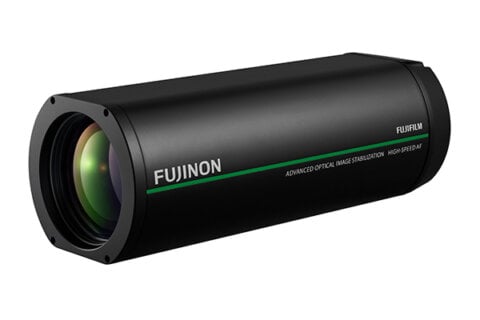
Fujinon SX800 Very Long Range Multi-Purpose Camera
- Technology
- Visible camera modules
- Partner
- Fujifilm
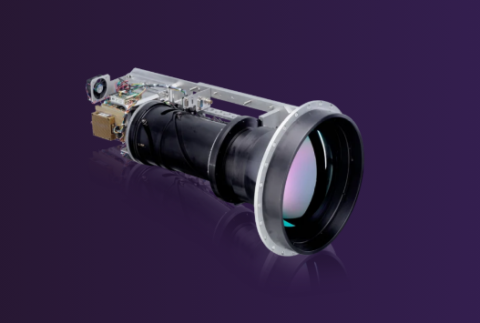
The SX800 40× optical zoom camera is designed for observing distant subjects in security, infrastructure, industrial and environmental applications. Its 20–800 mm optical range supports both wider scene assessment and close framing of remote targets, with digital zoom providing nominal framing up to 1600 mm. Typical uses include airport, border, port and construction-site surveillance, as well as monitoring forests, flood areas, volcanic activity and other locations that may be difficult or unsafe to approach. The camera can also support remote inspection of wind turbines, transmission lines and elevated structures.
Optical and electronic stabilisation options help manage vibration, while selectable heat-haze and fog reduction can support visibility across long atmospheric paths. IP streaming, baseband video outputs and RS-485 control allow the unit to be incorporated into networked or stand-alone systems. Outdoor installations require an appropriate protective housing, a base-down mounting arrangement and a structure designed for the camera’s 6.4 kg weight.

Range features
A high level overview of what this range offers
- 20–800 mm focal range with 40× optical zoom – Covers overview monitoring and detailed observation of distant targets.
- Digital zoom up to 2× – Provides nominal framing equivalent to a reach of up to 1600 mm.
- Approximately 0.1-second minimum autofocus time – Supports acquisition of moving or changing subjects.
- Continuous AF, quick AF and manual focus – Allows the focus method to be matched to dynamic or fixed scenes.
- AUTO, OIS and EIS stabilisation modes – Help reduce image movement caused by wind, vibration or mounting conditions.
- Three-level heat-haze and fog reduction – Supports image assessment when atmospheric conditions reduce visibility.
- Visible-light and 808, 850, 940 and 950 nm settings – Allow operation with several infrared illumination wavelengths.
- H.264 and MJPEG encoding with CBR or VBR – Enables image quality, frame rate and bandwidth to be configured for the network.
- HDMI, HD-SDI, composite and 100BASE-T connectivity – Supports digital, analogue and IP-based video architectures.
- ONVIF, HTTP, RTSP and Pelco control – Provides options for VMS, streaming and RS-485 integration.
- Selectable image controls and correction functions – Support adjustment for contrast, backlighting, noise, colour and scene conditions.
- 12 V DC input with 9.5 W consumption – Provides defined requirements for power-supply and enclosure design.
Downloads
for Fujinon SX800 Very Long Range Multi-Purpose Camera
What’s in this range?
All the variants in the range and a comparison of what they offer
Specifications
| Specification | Value |
|---|---|
Model | SX800 |
Product type | Very long-range multi-purpose camera |
Focal length | 20–800 mm |
Optical zoom | 40× |
Digital zoom | 1.25×, 1.5×, 1.75× or 2× |
Maximum nominal reach with digital zoom | 1600 mm at 2× digital zoom |
Maximum aperture | f/4–f/7.4 |
Minimum object distance | 10 m at focal lengths from 20–400 mm; 20 m at focal lengths from 401–800 mm, measured from the foremost part of the forward lens |
Image sensor | CMOS sensor |
Recording file format | MOV |
Video compression | H.264 compliant |
Frame sizes | 1920 × 1080, 1280 × 720, 640 × 480 for NTSC, 768 × 576 for PAL |
Metering | Average |
Focus modes | Continuous AF, quick AF and manual focus |
Focus area | Centre or selectable area within a 3 × 3 grid |
Minimum autofocus time | Approximately 0.1 seconds |
Aperture selection | Auto or manual from f/4 to f/16 |
Shutter speed | Auto with selectable minimum speed from 1/8 to 1/125 s; manual from 1 to 1/32,000 s |
Gain adjustment | Manual ISO 400–819200, AGC or Hyper AGC |
Day/night selection | Auto, scheduled, auto and scheduled, day or night |
Supported wavelengths | Visible light, 808 nm, 850 nm, 940 nm and 950 nm |
Day optical filters | IRC or visible-light cut |
Night optical filters | Clear or visible-light cut |
Image stabilisation | AUTO, optical image stabilisation, electronic image stabilisation or off |
Wide dynamic range | Selectable, 2 levels |
Backlight compensation | Selectable, 2 levels |
Heat-haze reduction | Selectable, 3 levels |
Fog reduction | Selectable, 3 levels |
Noise reduction | Selectable, 3 levels |
Shooting presets | Surveillance and Movie Production |
Brightness adjustment | 100 levels |
Contrast adjustment | 100 levels |
Saturation adjustment | 100 levels |
Sharpness adjustment | 100 levels |
White balance | Auto, Auto White Priority, Custom 1, Custom 2, Fine, Shade or colour temperature |
Selectable colour temperatures | 3000 K, 5000 K and 9000 K |
Image output connectors | HDMI, HD-SDI and composite BNC |
Audio input impedance | 40 kΩ |
Audio output impedance | 200 Ω |
NTSC video output | 1080p, 720p or 480p |
PAL video output | 1080p, 720p or 576p |
IP encoding | H.264 or MJPEG |
Bit-rate mode | CBR or VBR |
H.264 frame rate | 1–30 fps for NTSC; 1–25 fps for PAL |
MJPEG frame rate | 1–15 fps for NTSC; 1–13 fps for PAL |
Bit rate | 1–18 Mbps |
I-frame interval | 0.5 or 1 second |
External interfaces | 100BASE-T, RS-485 and external day/night trigger |
RS-485 baud rates | 2400, 4800, 9600, 19200, 38400 or 115200 bps |
RS-485 device ID | 1–31; default 7 |
RS-485 protocols | Pelco-D and Pelco-P, including product-specific commands |
Pelco command interval | 10–300 ms |
Network protocols | ONVIF, HTTP and RTSP |
Default network ports | HTTP 80, RTSP 554 and ONVIF 8080 |
Local recording | SD card recording in stand-alone mode |
Power source | 12 V DC |
Power consumption | 9.5 W |
Dimensions | 156 × 139 × 410 mm, W × H × D |
Weight | Approximately 6.4 kg |
Operating temperature | −10 to +50 °C; operation below freezing requires uninterrupted power |
Operating humidity | 10–80%, without condensation |
Installation orientation | Base down |
Tilt limit | ±45° from level |
LAN cable requirement | Category 5 or higher shielded twisted-pair cable |
Regulatory statements | FCC Part 15 Class A; CAN ICES-3(A)/NMB-3(A); CISPR 32 Class A; EU RoHS Directive 2011/65/EU; EU EMC Directive 2014/30/EU |
The following reference values apply to housing designs based on a 1/1.8-inch, 16:9 image format. The optical opening should remain outside the boundary lines, and the completed housing should be verified through practical image testing.
Optical boundary design data
| Image direction | Line 1 height | Line 1 angle | Line 2 height | Line 2 angle |
|---|---|---|---|---|
Vertical | ±20.08 mm | ±7.0° | ±57.89 mm | ±1.2° |
Horizontal | ±31.77 mm | ±11.7° | ±58.05 mm | ±1.8° |
Diagonal | ±35.65 mm | ±13.3° | ±58.09 mm | ±1.8° |
FAQs
for Fujinon SX800 Very Long Range Multi-Purpose Camera
The SX800 provides a 20–800 mm focal range with 40× optical zoom, while selectable digital zoom ratios up to 2× provide nominal framing equivalent to 1600 mm. The optical range should be the primary selection factor because digital zoom enlarges the captured image rather than adding optical detail. Minimum object distance is 10 m from 20–400 mm and 20 m from 401–800 mm, so the camera is intended for distant observation rather than close-range inspection. This range suits perimeter, transport, infrastructure and remote inspection applications. During system design, calculate the required target size within the 1920 × 1080 frame using the optical focal length first, then treat digital zoom as a secondary viewing aid.
Continuous AF is the appropriate starting point for subjects whose distance changes, while quick AF or manual focus can be used for fixed observation points. The camera provides continuous AF, one-shot quick AF after zoom adjustment and fully manual focusing. Its rear-focus system has a stated minimum autofocus time of approximately 0.1 seconds, which can support the acquisition of moving subjects. At the 800 mm telephoto position, minor focus errors become more visible and a stable mounting arrangement remains important. For unattended surveillance, test continuous AF against the expected target speed and background; for fixed infrastructure monitoring, quick AF or manual focus can reduce unnecessary refocusing.
AUTO stabilisation is suitable as an initial setting, with separate optical, electronic and off modes available for installation-specific adjustment. Optical image stabilisation addresses physical camera movement, while electronic stabilisation applies image-based correction. At long focal lengths, small movements in the mount can produce large changes in framing, so stabilisation should be combined with a suitably rigid support. Heat-haze and fog reduction each provide three selectable levels for atmospheric conditions that reduce subject visibility. For towers, vehicles, coastal sites or long paths over warm surfaces, evaluate the correction levels at the actual observation distance because excessive processing may alter fine image detail.
Yes, the camera supports visible-light operation and selectable infrared wavelengths of 808, 850, 940 and 950 nm. Day/night operation can be automatic, scheduled, combined automatic and scheduled, or manually fixed to day or night. Manual gain from ISO 400 to ISO 819200, AGC and Hyper AGC provide options for low-light scenes, although higher gain settings can introduce more image noise. The clear night filter allows visible and infrared light to reach the sensor, while the visible-light-cut option is intended for infrared-only imaging. Select the camera wavelength to match the illuminator and verify the required range on site, as usable distance will also depend on illuminator power, beam angle, atmospheric conditions and target reflectivity.
Yes, the SX800 supports IP networking alongside HDMI, HD-SDI and composite BNC video outputs. The network interface is 100BASE-T and supports ONVIF on port 8080, HTTP and RTSP, with H.264 and MJPEG encoding options. The baseband outputs allow direct connection to compatible monitors, recorders or video-routing equipment without relying on an IP stream. RS-485 control is available through Pelco-D and Pelco-P, including product-specific commands for camera and lens functions. Because the network settings include Basic and MD5-based authentication options, the camera should be installed on a controlled network and validated against the site’s access-control and cyber-security requirements.
The camera can output or stream 1920 × 1080 and 1280 × 720 video, with additional standard-definition formats for NTSC and PAL systems. H.264 supports 1–30 fps in NTSC or 1–25 fps in PAL, while MJPEG supports up to 15 fps in NTSC and 13 fps in PAL. The configurable bit-rate range is 1–18 Mbps, with constant and variable bit-rate modes available for H.264. Constant bit rate simplifies network and storage planning, while variable bit rate can allocate more data to complex scenes but may produce changing bandwidth demand; I-frame intervals of 0.5 or 1 second are available. Recorder capacity and network headroom should therefore be calculated using the selected resolution, frame rate, encoding mode and worst-case bit rate rather than default settings alone.
The installation must support a camera measuring 156 × 139 × 410 mm and weighing approximately 6.4 kg. It requires a regulated 12 V DC supply and consumes 9.5 W before allowing for enclosure heaters, illuminators, pan-and-tilt equipment or other accessories. The operating range is −10 to +50 °C at 10–80% relative humidity without condensation, and power must remain uninterrupted when operating below freezing. The camera must be mounted base down, with a permitted tilt of ±45° from level, and placed in a suitable housing where rain, wind, dust or direct sunlight could reach it. Mounting structures should account for static weight, wind loading and vibration, while IP connections should use Category 5 or better shielded twisted-pair cable.