Alvium UV camera modules
- Technology
- UV camera modules
- Partner
- Allied Vision
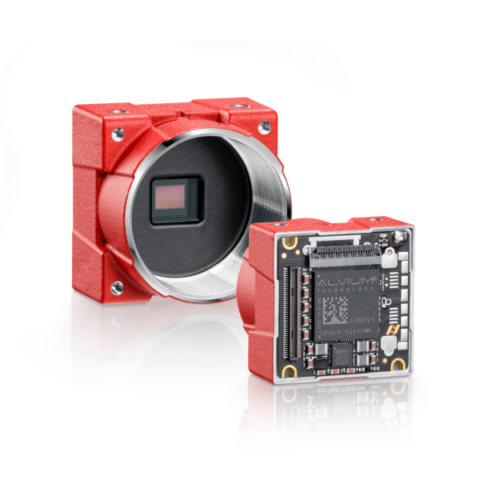
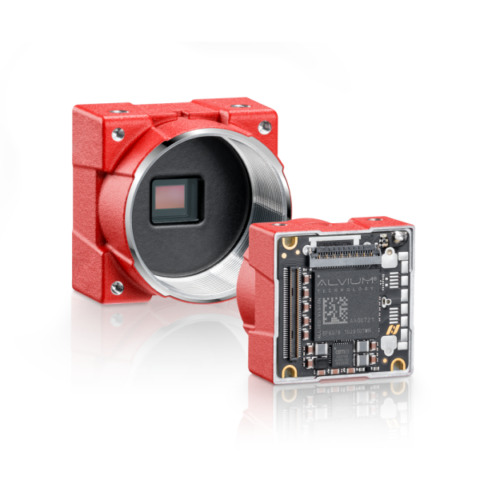
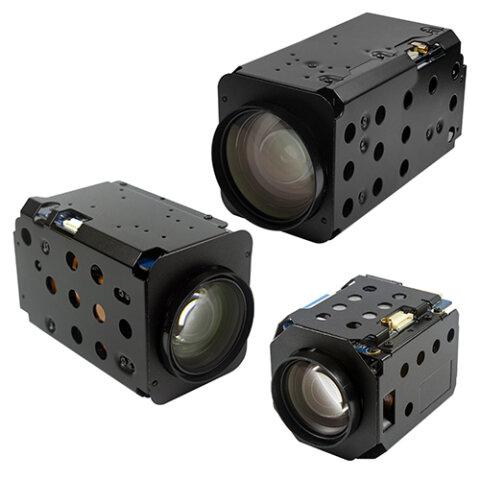
The Allied Vision Alvium UV camera modules combine Sony’s high-performance IMX487 CMOS global-shutter sensor with Allied Vision’s compact Alvium camera platforms. Designed for ultraviolet and extended-spectrum imaging, the cameras deliver 8.1 MP resolution at 2,848 × 2,848 pixels, with a spectral response extending from approximately 200 nm into the visible and near-infrared range, depending on the model.
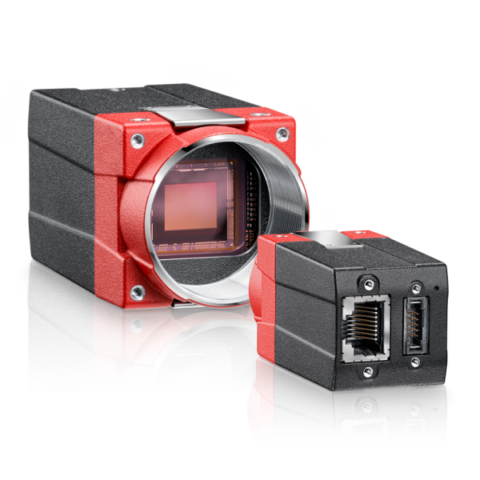
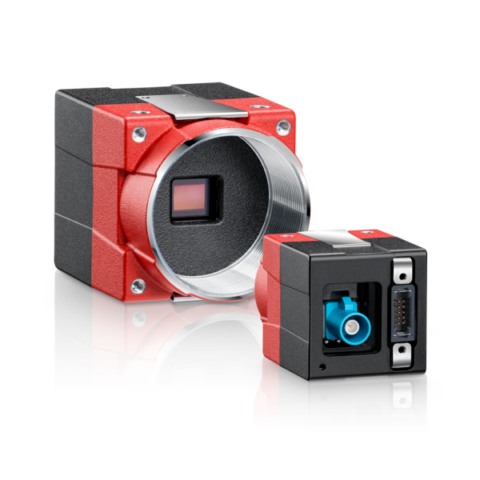
With six interface options — GMSL2, FPD-Link III, GigE, USB 3.0, MIPI CSI-2 and 5GigE — the Alvium UV family gives system designers flexibility to select the connectivity, processing architecture and camera form factor that best fits their application.
The range is suited to machine vision and embedded imaging applications where UV sensitivity, high spatial resolution and precise motion capture are important, including semiconductor and electronics inspection, solar-cell inspection, fluorescence imaging, scientific imaging, surface inspection, UV-based measurement and industrial quality control.
All six models use the same 8.1 MP Sony IMX487 sensor and 2.74 µm pixels, making it easier to maintain a consistent optical and imaging architecture while changing the camera interface to suit the system.
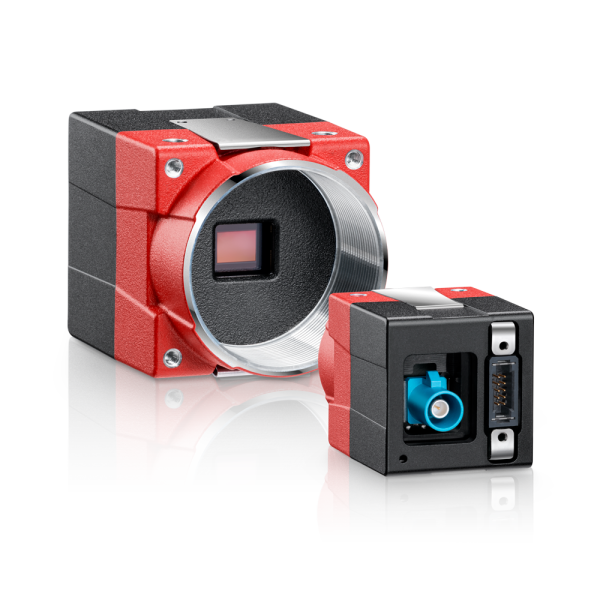
Range features
A high level overview of what this range offers
-
High-sensitivity UV imaging from 200 nm The Alvium UV cameras are built around the Sony IMX487 UV-capable sensor, providing sensitivity from 200 nm through the visible spectrum and, depending on model, further into the near infrared. This enables imaging of features that conventional visible-spectrum cameras can miss. The 1800 U-812 UV extends to 1100 nm, while the other listed models specify a range to 1000 nm.
-
8.1 MP resolution for detailed inspection Every camera in the range uses the 2,848 × 2,848-pixel Sony IMX487, providing 8.1 megapixels in a square image format. The 2.74 µm pixel size provides a useful balance between resolution and sensitivity for demanding inspection tasks.
-
Global shutter for accurate motion capture The IMX487 uses a global shutter, exposing the entire image simultaneously rather than line-by-line. Minimise motion distortion when inspecting moving components, conveyor-borne products or rapidly changing processes.
-
Six interface platforms for system flexibility The Alvium UV range is available across a broad selection of interfaces:
-
Alvium GM2-812 UV: GMSL2, based on MIPI CSI-2
-
Alvium FP3-812 UV: FPD-Link III, based on MIPI CSI-2
-
Alvium G1-812 UV: GigE / GigE Vision
-
Alvium 1800 U-812 UV: USB 3.0 / USB3 Vision
-
Alvium 1800 C-812 UV: MIPI CSI-2
-
Alvium G5-812 UV: 5GigE
-
Compact industrial form factors The cameras are designed for integration into space-constrained industrial and embedded systems. Depending on the platform, body dimensions range from approximately 26 × 29 × 29 mm for the Alvium 1800 C to 60 × 29 × 29 mm for the Alvium G5. Integrate UV imaging into compact inspection equipment, robotic systems, OEM machines and embedded vision platforms.
-
High-speed acquisition Frame rates vary by interface, with the range reaching 58 fps at full 8.1 MP resolution on the Alvium G5-812 UV and Alvium 1800 C-812 UV. The 1800 U-812 UV reaches 51 fps, while the G1-812 UV delivers 14 fps. The embedded GM2 and FP3 variants are dependent on the host hardware and register configuration. Acquire detailed UV images quickly enough for automated inspection and high-throughput processes.
-
Industrial control and integration features Depending on the model, Alvium UV cameras provide programmable GPIOs, opto-isolated I/O, triggering, exposure control, gain control, ROI functionality and other camera-control features. The G1 and G5 models, for example, provide opto-isolated input/output alongside GPIOs, while the 1800 U provides four programmable GPIOs. Synchronise image acquisition with lighting, sensors, motion controllers and other machine-vision hardware.
-
One sensor architecture across multiple camera platforms All six requested models use the Sony IMX487, 8.1 MP, 2.74 µm global-shutter CMOS sensor. Simplify optical development and system scaling. Once the imaging performance has been established, different interface versions can be selected for new installations without changing the fundamental sensor architecture.
What’s in this range?
All the variants in the range and a comparison of what they offer
| Specification | GM2-812 UV | FP3-812 UV | G1-812 UV | 1800 U-812 UV | 1800 C-812 UV | G5-812 UV |
|---|---|---|---|---|---|---|
Interface | GMSL2, MIPI CSI-2 | FPD-Link III, MIPI CSI-2 | GigE / GigE Vision | USB 3.0 / USB3 Vision | MIPI CSI-2 | 5GigE / 2.5GigE / GigE |
Resolution | 2,848 × 2,848 | 2,848 × 2,848 | 2,848 × 2,848 | 2,848 × 2,848 | 2,848 × 2,848 | 2,848 × 2,848 |
Resolution | 8.10 MP | 8.10 MP | 8.10 MP | 8.10 MP | 8.10 MP | 8.10 MP |
Sensor | Sony IMX487 | Sony IMX487 | Sony IMX487 | Sony IMX487 | Sony IMX487 | Sony IMX487 |
Sensor type | CMOS | CMOS | CMOS | CMOS | CMOS | CMOS |
Shutter | Global shutter | Global shutter | Global shutter | Global shutter | Global shutter | Global shutter |
Pixel size | 2.74 µm | 2.74 µm | 2.74 µm | 2.74 µm | 2.74 µm | 2.74 µm |
Sensor format | Type 2/3 | Type 2/3 | Type 2/3 | Type 2/3 | Type 2/3 | Type 2/3 |
Spectral range | 200–1000 nm | 200–1000 nm | 200–1000 nm | 200–1100 nm | 200–1000 nm | 200–1000 nm |
Max. frame rate | Dependent on hardware/register settings | Dependent on hardware/register settings | 14 fps | 51 fps | 58 fps | 58 fps |
ADC | 12-bit | 12-bit | 12-bit | 12-bit | 12-bit | 12-bit |
Lens mount | C-Mount, CS-Mount | C-Mount, CS-Mount | C-Mount, CS-Mount | C-Mount, CS-Mount | C-Mount, CS-Mount | C-Mount, CS-Mount |
Exposure time | 8 µs–10 s | — | 26 µs–10 s | — | 8 µs–10 s | 8 µs–10 s |
Gain | 0–48 dB | — | 0–48 dB | — | 0–48 dB | 0–48 dB |
GPIO / I/O | 2 programmable GPIOs | 2 programmable GPIOs | 2 GPIOs + 1 opto-isolated input/output | 4 programmable GPIOs | 2 programmable GPIOs | 2 GPIOs + 1 opto-isolated input/output |
Typical power | 5 VDC via MIPI CSI-2* | 5 VDC via MIPI CSI-2* | 4.0 W external / 4.6 W PoE | 3.9 W USB / 4.1 W external | 3.7 W | 7.2 W external / 7.6 W PoE |
Operating temperature | -20 to +65 °C housing | -20 to +65 °C housing | -20 to +65 °C housing | -20 to +65 °C housing | -20 to +65 °C housing | -20 to +60 °C housing |
FAQs
for Alvium UV camera modules
The Alvium UV series uses the Sony IMX487 UV-capable global-shutter CMOS sensor, providing sensitivity from approximately 200 nm into the visible spectrum and beyond, depending on the model. This enables engineers to capture UV-specific information such as fluorescence, surface defects, coatings and material characteristics that may not be visible with conventional cameras.
The choice depends primarily on your interface and bandwidth requirements. The GM2-812 UV and FP3-812 UV are designed for GMSL2 and FPD-Link III embedded architectures, while the 1800 C-812 UV provides direct MIPI CSI-2 connectivity in an especially compact form factor. For PC-based systems, the 1800 U-812 UV offers USB3 Vision, while the G1-812 UV provides GigE Vision. For higher-bandwidth Ethernet applications, the G5-812 UV supports 5GigE, 2.5GigE and GigE.
Yes. The Sony IMX487 sensor uses a global shutter, exposing the pixels simultaneously rather than progressively. This makes the cameras suitable for inspecting moving components, conveyor-based production lines and other applications where rolling-shutter distortion could compromise measurement or defect detection.
All six models provide 8.1 MP resolution at 2,848 × 2,848 pixels, with 2.74 µm pixels and 12-bit ADC. Maximum frame rate depends on the camera interface: the 1800 C-812 UV and G5-812 UV reach up to 58 fps at full resolution, while the 1800 U-812 UV reaches 51 fps and the G1-812 UV reaches 14 fps. Embedded models such as the GM2-812 UV and FP3-812 UV depend on the host system and interface configuration.
UV imaging requires more than simply selecting a UV-sensitive sensor. Engineers should verify that the lens, filters, windows and other optical components transmit at the required wavelength; many conventional optical components have poor transmission in the UV. The UV illumination source should also be selected around the wavelength and exposure requirements of the application. The Alvium UV cameras provide the sensor sensitivity needed for UV imaging, but the complete optical path must be designed to preserve that sensitivity.