FUJINON SX1600 Ultra Long Range Multi-Purpose Camera
- Technology
- Visible and UV camera modules (OEM)
- Partner
- Fujifilm
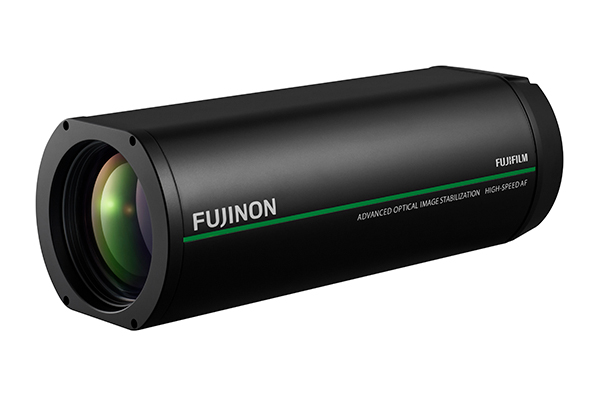
The SX1600 ultra-long-range camera is an integrated optical and imaging system with a 40–1600 mm focal range and 40× optical zoom. It is designed for engineers and system integrators developing long-distance observation, security, emergency-monitoring and remote-inspection systems. Applications include border, port, maritime, airport and infrastructure surveillance, along with forest-fire, flood and volcanic-activity monitoring. Its optical reach can also support stand-off inspection of wind turbines and transmission lines.
Coordinated optical and electronic image stabilisation helps manage vibration, while selectable heat-haze and fog reduction addresses atmospheric interference. Continuous AF, Quick AF and manual focus modes are available, with a minimum autofocus time of approximately 0.1 seconds under suitable conditions. IP, RS485 and stand-alone video connections allow the camera to be incorporated into new installations and selected legacy control architectures.
Range features
A high level overview of what this range offers
- 40–1600 mm focal range with 40× optical zoom – Covers wide framing through super-telephoto observation without changing optics.
- Digital zoom from 1.25× to 2× – Extends the displayed reach to a 3200 mm equivalent range when additional enlargement is acceptable.
- Approximately 0.1-second minimum autofocus time – Supports rapid focus acquisition for moving or intermittent targets under suitable conditions.
- Continuous AF, Quick AF and manual focus – Allows focusing behaviour to be matched to target movement, contrast and scene conditions.
- Coordinated OIS and EIS – Helps compensate for vibration across a wider frequency range at long focal lengths.
- Three-level heat-haze and fog reduction – Provides adjustable processing for atmospheric interference during long-distance observation.
- Visible-light and 808, 850, 940 and 950 nm settings – Supports day/night operation with compatible infrared illumination.
- H.264 and MJPEG encoding up to 1080p – Provides options for network bandwidth, recording and monitoring compatibility.
- ONVIF, HTTP, RTSP and RS485 Pelco-D/P integration – Supports networked and serial control architectures.
- HDMI, HD-SDI and composite outputs – Enables local monitoring and stand-alone video configurations.
- 12 V DC, 15 W operation – Provides defined power requirements for system design.
- Surveillance and Movie Production presets – Offers either enhanced outline visibility or more accurate colour reproduction.
Downloads
for FUJINON SX1600 Ultra Long Range Multi-Purpose Camera
What’s in this range?
All the variants in the range and a comparison of what they offer
Specifications
| Specification | Value |
|---|---|
Model | SX1600 |
Focal length | 40–1600 mm for 1/1.8-inch equivalent; 20–800 mm for 1.1-inch equivalent |
Optical zoom | 40× |
Digital zoom | 1.25×, 1.5×, 1.75×, 2× |
Maximum aperture | f/8–f/14.8 |
Minimum object distance | 10 m at focal lengths of 40–800 mm; 20 m at focal lengths of 801–1600 mm |
Image sensor | CMOS sensor |
Video file and compression | MOV; H.264 compliant |
Frame sizes | 1920 × 1080; 1280 × 720; 640 × 480 NTSC; 768 × 576 PAL |
Metering | Average |
Focus modes | Continuous AF, Quick AF, MF |
Aperture selection | Auto; manual from f/8 to f/32 |
Shutter speed | Auto with minimum-speed selection from 1/8 to 1/125 s; manual from 1 to 1/32000 s |
Gain adjustment | Manual ISO 400–819200; AGC; Hyper AGC |
Day/night selection | Auto, Scheduled, Auto and Scheduled, Day, Night |
Illumination wavelength settings | Visible light, 950 nm, 940 nm, 850 nm, 808 nm |
Image stabilisation | Auto OIS+EIS, OIS, EIS, Off |
Wide dynamic range | Selectable, 2 levels |
Backlight compensation | Selectable, 2 levels |
Heat-haze reduction | Selectable, 3 levels |
Fog reduction | Selectable, 3 levels |
Noise reduction | Selectable, 3 levels |
Shooting presets | Surveillance, Movie Production |
Brightness | Selectable, 100 levels |
Contrast | Selectable, 100 levels |
Saturation | Selectable, 100 levels |
Sharpening | Selectable, 100 levels |
White balance | Auto, Auto White Priority, Custom 1, Custom 2, Fine, Shade, Colour Temperature at 3000 K, 5000 K or 9000 K |
Image output connectors | HDMI, HD-SDI, composite BNC |
Audio input/output | 40 kΩ input impedance; 200 Ω output impedance |
Video output | NTSC: 1080p, 720p, 480p; PAL: 1080p, 720p, 576p |
Encoding types | H.264, MJPEG |
Bit-rate types | CBR, VBR |
Frame rate | 1–30 fps H.264/NTSC; 1–25 fps H.264/PAL; 1–15 fps MJPEG/NTSC; 1–13 fps MJPEG/PAL |
Bit rate | 1–18 Mbps |
I-frame interval | 0.5 s, 1 s |
External interfaces | 100BASE-T, RS485, external day/night trigger |
RS485 baud rates | 115200, 38400, 19200, 9600, 4800 and 2400 bps |
Internet protocols | ONVIF on port 8080, HTTP, RTSP |
RS485 protocols | Pelco-D, Pelco-P, including custom commands |
RS485 communication | Full-duplex, half-duplex |
RS485 device ID | 1–31 |
Power source | 12 V DC |
Power consumption | 15 W |
Dimensions, W × H × D | 156 × 139 × 450 mm; 6.14 × 5.47 × 17.72 in |
Weight | Approximately 7.4 kg; 16.31 lb |
Operating temperature | −10 to +50 °C |
Operating humidity | 10–80% RH, non-condensing |
Tilt limit | ±45° from level, base down |
Installation orientation | Base down |
Base mounting | Fifteen ¼-inch UNC 20 threaded holes; 10 mm depth; 6.5–10 mm thread engagement; 240–300 N·cm tightening torque |
Handle mounting | Two M4 holes; pass-through with 4 mm threaded depth; 80–100 N·cm tightening torque; maximum 6 mm protrusion |
LAN cable requirement | Category 5 or better shielded twisted-pair cable |
Regulatory statements | FCC Part 15 Class A; CAN ICES-003(A)/NMB-003(A); CISPR 32 Class A; RoHS Directive 2011/65/EU; EMC Directive 2014/30/EU |
Optical boundary-line design values
| Direction | Line 1/1′ height | Line 1/1′ angle | Line 2/2′ height | Line 2/2′ angle |
|---|---|---|---|---|
Vertical | ±22.96 mm | ±8.2° | ±57.73 mm | ±1.0° |
Horizontal | ±35.45 mm | ±12.7° | ±57.91 mm | ±1.2° |
Diagonal | ±37.29 mm | ±14.3° | ±58.06 mm | ±1.9° |
The minimum object distance is measured from the foremost part of the forward lens. At 720p or standard-definition output, 30 fps NTSC or 25 fps PAL footage may be repeated to provide 60 fps or 50 fps monitor output respectively.
The optical boundary-line values define the 16:9 optical effective area ahead of the lens for enclosure integration. Components should remain outside these boundaries, and final optical performance should be validated using actual images. No ingress-protection rating is specified, so the camera requires a housing or protected installation that shields it from rain, wind, dust and direct sunlight.
FAQs
for FUJINON SX1600 Ultra Long Range Multi-Purpose Camera
The 40–1600 mm focal range provides 40× optical zoom, with 1.25×, 1.5×, 1.75× and 2× digital settings available when additional enlargement is required. Minimum object distance is 10 m across the 40–800 mm range and 20 m from 801–1600 mm, measured from the front of the lens. This means the camera is intended for stand-off observation rather than close inspection, so blind zones and the nearest required target distance must be checked during layout. Digital zoom should be treated as image enlargement rather than additional optical detail, and site trials are advisable at the longest working distances.
The camera can be integrated through 100BASE-T networking with ONVIF on port 8080, HTTP and RTSP, or through RS485 in full- or half-duplex mode. Pelco-D and Pelco-P are available for control, while HDMI, HD-SDI and composite BNC outputs support local or stand-alone video paths. RS485 supports 2400, 4800, 9600, 19200, 38400 and 115200 bps, with device IDs from 1 to 31. Engineers should match protocol, duplex mode, termination, device address and baud rate across the camera and pan-and-tilt system before commissioning, particularly when retaining existing serial infrastructure.
The camera can run OIS and EIS together in Auto mode, or use either stabilisation method independently. This is relevant where long focal lengths amplify vibration from towers, vehicles, platforms or wind-loaded structures. Heat-haze, fog and noise-reduction functions each provide three selectable levels, allowing image processing to be adjusted to observed conditions rather than applied as a fixed correction. These functions can improve subject visibility, but they do not remove the need for a rigid mount, suitable enclosure and correct line of sight. Commissioning should therefore include tests at representative zoom positions, vibration levels and atmospheric conditions.
Low-light operation combines a CMOS sensor, manual gain from ISO 400 to ISO 819200, AGC and Hyper AGC with selectable day/night behaviour. Day and night modes can be automatic, scheduled, combined automatic and scheduled, fixed, or driven through an external trigger. Illumination settings cover visible light plus 808, 850, 940 and 950 nm wavelengths, enabling coordination with suitable near-infrared illuminators and optical filters. Higher gain can expose more detail but may increase noise, so the three-level noise-reduction control should be tuned against motion detail and latency requirements. Illumination wavelength, filter state and switching thresholds should be validated as a complete optical system.
The camera provides 1920 × 1080, 1280 × 720 and standard-definition frame sizes, with H.264 and MJPEG encoding. H.264 runs from 1–30 fps for NTSC or 1–25 fps for PAL, while MJPEG is limited to 15 fps for NTSC and 13 fps for PAL. Bit rate is adjustable from 1–18 Mbps using CBR or VBR, with I-frame intervals of 0.5 or 1 second. Recorder throughput, switch capacity and storage retention should be calculated from the selected format, frame rate and bit rate rather than from resolution alone. Where multiple cameras share a link, allow headroom for control traffic and scene-driven VBR peaks.
The camera measures 156 × 139 × 450 mm, weighs approximately 7.4 kg and must be installed base down. The base provides fifteen ¼-inch UNC 20 threaded mounting points, with 6.5–10 mm thread engagement and a stated tightening torque of 240–300 N·cm; the supporting structure must carry the combined camera, housing and mount load. Operation is specified from −10 to +50 °C at 10–80% relative humidity without condensation, and below-freezing operation requires uninterrupted power. No ingress-protection rating is stated, and the installation instructions require protection from rain, wind, dust and direct sunlight. Enclosure size, front optical clearance, cooling, condensation control and cable strain relief should therefore be designed as part of the installation.
The camera offers Continuous AF, Quick AF and manual focus, with a stated minimum autofocus time of approximately 0.1 seconds under suitable conditions. Its rear-focus arrangement combines image-plane phase-detection and contrast AF, switching between methods as required. Continuous AF is suited to moving subjects that remain in view, while Quick AF can limit unnecessary focus activity on more static scenes; manual focus is useful where foreground objects or atmospheric shimmer could mislead autofocus. The final choice should be tested at the intended focal length, target speed and contrast, because long-range focus behaviour depends heavily on scene conditions.