Fastcam Nova series high-speed cameras
- Technology
- High-speed cameras
- Partner
- Photron
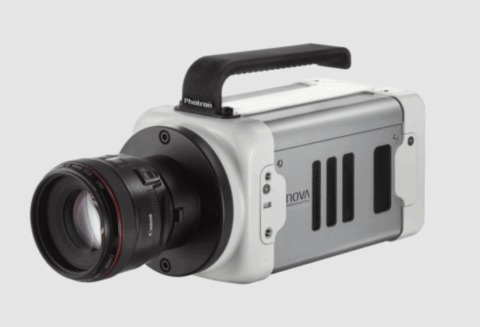
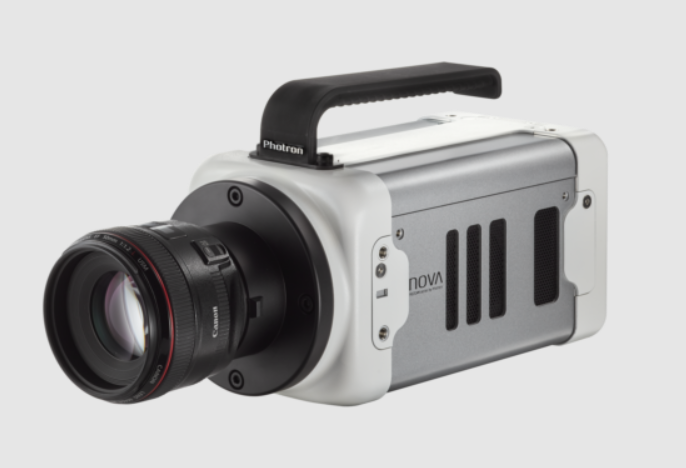
The FASTCAM NOVA high-speed camera series is a configurable range for engineers who need to record short-duration events with controlled exposure, synchronisation and onboard data storage. The 1-megapixel S family includes the S6, S9, S12, S16 and S20, covering full-frame recording rates from 6,400 to 18,750 fps at 1024 × 1024 pixels. The S20 can also record 1024 × 992 images at 20,000 fps in 10-bit mode or operate at full resolution and 16,500 fps in 12-bit mode. For applications requiring greater spatial detail, the R3-4K and R5-4K provide 4096 × 2304 resolution at 750 and 1,250 fps respectively.
Monochrome and colour configurations are available, with multiple lens-mount, memory and reduced-resolution frame-rate options. Typical applications include combustion analysis, fluid dynamics, materials testing, automotive development, aerospace testing, biomechanics and scientific research. Programmable I/O, IRIG-B timing, memory segmentation and software-development tools allow the cameras to be integrated into multi-camera and data-acquisition systems.
Range features
A high level overview of what this range offers
- Seven current performance models – Match the resolution and frame rate to the event being studied.
- Global electronic shutter – Control motion blur with exposure durations down to 0.2 µs on S models and 2 µs on R3-4K and R5-4K models.
- 1-megapixel S-series sensor – Combine 1024 × 1024 resolution with full-frame rates from 6,400 to 18,750 fps.
- 9.4-megapixel R-series sensor – Capture 4096 × 2304 images when fine spatial detail or a wide field of view is required.
- Selectable 10-bit or 12-bit S20 operation – Choose between higher recording speed and greater tonal depth.
- Configurable region of interest – Increase frame rate and reduce data volume by limiting readout to the active sensor area around the event.
- Up to 128 GB internal memory – Store transient events onboard without relying on continuous host-computer streaming.
- Up to 128 memory partitions – Support repeated tests and download from one partition while another is used for recording.
- Optional removable SSD storage – Offload recorded data to a 1 TB or 4 TB drive, depending on the camera family and configuration.
- 1/10-Gigabit Ethernet interface – Control the camera and transfer images through a standard computer network connection.
- IRIG-B and programmable trigger I/O – Align recordings with other cameras, sensors and data-acquisition equipment.
- Interchangeable lens mounts – Use F/G-type, C-mount, EF, RF or M42 optics according to the selected model.
- Mechanical calibration shutter – Perform remote sensor black-balance calibration without manually covering the lens.
- Sealed body and fan-stop control – Limit contamination of internal electronics and reduce vibration during sensitive recordings.
- Viewer software and control libraries – Support camera operation, image replay, calibration and integration with custom software, MATLAB or LabVIEW.
What’s in this range?
All the variants in the range and a comparison of what they offer
Specifications
| Specification | NOVA S6 / S9 / S12 / S16 | NOVA S20 | NOVA R3-4K / R5-4K |
|---|---|---|---|
Camera technology | CMOS global-shutter high-speed camera | CMOS global-shutter high-speed camera | CMOS global-shutter 4K high-speed camera |
Maximum resolution | 1024 × 1024 pixels | 1024 × 1024 pixels | 4096 × 2304 pixels |
Sensor size | 20.48 × 20.48 mm; 28.96 mm diagonal | 20.48 × 20.48 mm; 28.96 mm diagonal | 26.62 × 14.98 mm; 30.55 mm diagonal |
Pixel size | 20 × 20 µm | 20 × 20 µm | 6.5 × 6.5 µm |
Light sensitivity | ISO 64,000 monochrome; ISO 16,000 colour; equivalent monochrome ISO 160,000 including near-infrared response | ISO 64,000 monochrome; ISO 16,000 colour; equivalent monochrome ISO 160,000 including near-infrared response | ISO 3,200 monochrome; ISO 640 colour |
Image depth | 12-bit monochrome; 36-bit colour | Selectable 10-bit or 12-bit monochrome; 30-bit or 36-bit colour | 12-bit monochrome; 36-bit colour |
Electronic shutter | 1 ms to 0.2 µs, independent of frame rate | 1 ms to 0.2 µs, independent of frame rate | Minimum exposure of 2 µs, independent of frame rate |
Export-control note | Frame rates above 225,000 fps and exposure below 1 µs may be controlled in some regions | Frame rates above 225,000 fps and exposure below 1 µs may be controlled in some regions | No equivalent sub-microsecond restriction stated |
Region-of-interest increments | 128 pixels horizontally × 16 pixels vertically | 128 pixels horizontally × 16 pixels vertically | 128 pixels horizontally × 8 pixels vertically |
Internal recording memory | S6/S9: 16, 32, 64 or 128 GB; S12/S16: 32, 64 or 128 GB | 32, 64 or 128 GB | 32, 64 or 128 GB |
Memory partitions | Up to 128 | Up to 128 | Up to 128 |
Optional removable storage | 1 TB or 4 TB FASTDrive SSD | 4 TB FASTDrive SSD | 4 TB FASTDrive SSD |
SSD transfer rate | Up to 1 GB/s | Up to 1 GB/s | Up to 1 GB/s |
Camera-control interface | RJ45, 1000BASE-T / 10GBASE-T | RJ45, 1000BASE-T / 10GBASE-T | RJ45, 1000BASE-T / 10GBASE-T |
Trigger input | Selectable TTL or contact input with programmable I/O | Selectable TTL or contact input with programmable I/O | Selectable TTL or contact input with programmable I/O |
Trigger modes | Start, centre, end, manual, random, random reset and record on command | Start, centre, end, manual, random, random reset and record on command | Start, centre, end, manual, random, random centre, random manual and record on command |
Programmable trigger delay | 100 ns resolution | 100 ns resolution | 100 ns resolution |
Time-code input | IRIG-B | IRIG-B | IRIG-B |
External synchronisation | Variable-frequency synchronisation; ±TTL 5 Vp-p | Variable-frequency synchronisation; ±TTL 5 Vp-p | Variable-frequency synchronisation; ±TTL 5 Vp-p |
Standard lens mount | F/G-type mount | F/G-type mount | F/G-type mount |
Optional lens mounts | C-mount, EF, RF and M42 | C-mount, EF, RF and M42 | C-mount, EF and M42 |
Optional live video | 1080p HD-SDI at 30 or 25 Hz; unavailable on NV configurations | 1080p HD-SDI at 30 or 25 Hz; unavailable on NV configurations | 1080p HD-SDI at 30 or 25 Hz; unavailable on NV configurations |
Camera dimensions | 120 × 120 × 217.2 mm, excluding protrusions | 120 × 120 × 217.2 mm, excluding protrusions | 120 × 120 × 223.2 mm, excluding protrusions |
Camera weight | 3.3 kg | 3.5 kg | 3.5 kg |
Camera-only operating temperature | Documentation differs between 0 to 45°C and −10 to 45°C; accessory-dependent limits apply | −10 to 40°C; accessory-dependent limits apply | −10 to 45°C; accessory-dependent limits apply |
Storage temperature | −20 to 60°C | −20 to 60°C | −20 to 60°C |
Humidity | Up to 80% RH operating and 85% RH storage, non-condensing | Up to 80% RH operating and 85% RH storage, non-condensing | Up to 80% RH operating and 85% RH storage, non-condensing |
Operational shock | 30 G, 11 ms, six axes | 30 G, 11 ms, six axes | 30 G, 11 ms, six axes |
Cooling | Internal fan cooling with remote fan-stop function | Internal fan cooling with remote fan-stop function | Internal fan cooling with remote fan-stop function |
AC power | 100–240 VAC, 50–60 Hz through supplied adaptor | 100–240 VAC, 50–60 Hz through supplied adaptor | 100–240 VAC, 50–60 Hz through supplied adaptor |
DC power | 22–32 VDC, 150 VA | 22–32 VDC, 150 VA | 22–32 VDC, 120 VA |
Software and integration | FASTCAM Viewer, device-control SDK, MATLAB libraries and LabVIEW libraries | FASTCAM Viewer, device-control SDK, MATLAB libraries and LabVIEW libraries | FASTCAM Viewer, device-control SDK, MATLAB libraries and LabVIEW libraries |
Compliance information | FCC Part 15 Class A; CE and EU EMC Directive 2014/30/EU Class A; WEEE disposal marking | FCC Part 15 Class A; CE and EU EMC Directive 2014/30/EU Class A; WEEE disposal marking | FCC Part 15 Class A; CE and EU EMC Directive 2014/30/EU Class A; WEEE disposal marking |
NOVA S Model Comparison
| Specification | NOVA S6 | NOVA S9 | NOVA S12 | NOVA S16 | NOVA S20 |
|---|---|---|---|---|---|
Maximum resolution | 1024 × 1024 | 1024 × 1024 | 1024 × 1024 | 1024 × 1024 | 1024 × 1024 |
Full-frame rate at 1024 × 1024 | 6,400 fps | 9,000 fps | 12,800 fps | 16,000 fps | 18,750 fps at 10-bit; 16,500 fps at 12-bit |
Additional 10-bit mode | — | — | — | — | 20,000 fps at 1024 × 992 |
Maximum reduced-resolution rate | 800,000 fps | 900,000 fps | 1,000,000 fps | 1,100,000 fps | 1,100,000 fps |
Maximum-rate type options | 800K, 500K, 200KS | 900K, 500K, 200KS | 1000K, 500K, 200KS | 1100K, 500K, 200KS | 1100K, 550K, 220K |
Minimum exposure | 0.2 µs | 0.2 µs | 0.2 µs | 0.2 µs | 0.2 µs |
Monochrome image depth | 12-bit | 12-bit | 12-bit | 12-bit | Selectable 10-bit or 12-bit |
Internal memory options | 16, 32, 64 or 128 GB | 16, 32, 64 or 128 GB | 32, 64 or 128 GB | 32, 64 or 128 GB | 32, 64 or 128 GB |
Weight | 3.3 kg | 3.3 kg | 3.3 kg | 3.3 kg | 3.5 kg |
NOVA R Model Comparison
| Specification | NOVA R3-4K | NOVA R5-4K |
|---|---|---|
Maximum resolution | 4096 × 2304 | 4096 × 2304 |
Full 4K frame rate | 750 fps | 1,250 fps |
UHD frame rate at 3840 × 2160 | 800 fps | 1,440 fps |
Maximum reduced-resolution rate | 150,000 fps at 2048 × 8 | 200,000 fps at 2048 × 8 |
Minimum exposure | 2 µs | 2 µs |
Monochrome image depth | 12-bit | 12-bit |
Internal memory options | 32, 64 or 128 GB | 32, 64 or 128 GB |
Dimensions | 120 × 120 × 223.2 mm | 120 × 120 × 223.2 mm |
Weight | 3.5 kg | 3.5 kg |
Installation note: Confirm the required lower ambient-temperature limit before specifying an S6, S9, S12 or S16 installation. The available documentation gives different minimum operating values of 0°C and −10°C, and installed accessories may impose additional limits.
FAQs
for Fastcam Nova series high-speed cameras
Choose a NOVA S model when temporal resolution, light sensitivity and very short exposure are the main priorities, and choose a NOVA R model when spatial detail across a larger image area matters more. The S6 to S20 cameras record 1024 × 1024 images at between 6,400 and 18,750 fps, while the S20 also reaches 20,000 fps at 1024 × 992. The R3-4K and R5-4K record 4096 × 2304 images at 750 and 1,250 fps respectively. Their maximum reduced-resolution rates are 150,000 or 200,000 fps, compared with up to 1,100,000 fps for the S family. Selection should therefore begin with the smallest feature that must remain visible and the time interval that must be resolved.
The S models provide a minimum exposure of 0.2 µs, while the R3-4K and R5-4K provide a minimum of 2 µs. Motion blur at the object plane is approximately object speed multiplied by exposure duration, so an object moving at 100 m/s travels about 20 µm during 0.2 µs and 200 µm during 2 µs. This travel distance should be compared with the calibrated object-plane distance represented by one pixel. The S family also offers ISO 64,000 monochrome sensitivity, whereas the R family is rated at ISO 3,200 monochrome, so the 4K models normally require more illumination for short exposures. S-series exposures below 1 µs may also be subject to export controls in some regions.
Reducing the region of interest limits sensor readout to the part of the image containing the event, which increases the available frame rate and reduces data volume. The S cameras configure the region in increments of 128 horizontal pixels and 16 vertical pixels, reaching between 800,000 and 1,100,000 fps at 128 × 16 on the highest-rate model configurations. The R3-4K and R5-4K use increments of 128 horizontal pixels and 8 vertical pixels, reaching 150,000 and 200,000 fps at 2048 × 8. Cropping does not alter pixel pitch, but it reduces the captured field of view. The event position, expected movement and trigger uncertainty must therefore be considered before defining a narrow readout area.
Memory capacity should be selected from the required resolution, bit depth, frame rate, event duration and uncertainty in trigger timing. S-family configurations provide up to 128 GB, while the R3-4K and R5-4K configurations provide 32, 64 or 128 GB. As an example, a 128 GB S20 configuration stores approximately 87,357 frames at 1024 × 1024 in 12-bit mode, corresponding to roughly 5.3 seconds at 16,500 fps. Up to 128 memory partitions can divide the available capacity between repeated events and support recording in one partition while another is downloaded. A removable SSD with up to 4 TB capacity and transfer rates up to 1 GB/s can shorten the offload stage between tests.
Yes, the range provides trigger inputs, programmable inputs and outputs, IRIG-B time code and variable-frequency external synchronisation. Programmable trigger delays have 100 ns resolution, allowing timing offsets to be applied to selected input and output signals. Available recording modes include start, centre, end, manual, random and record-on-command arrangements, with additional random modes on the R family. Frame-rate accuracy is specified at ±50 ppm, while IRIG-B timing can be referenced to the beginning or end of frame exposure. In a multi-instrument test, the trigger polarity, signal voltage, cable delay and selected exposure-time reference should all be documented before acquisition begins.
The sensor dimensions differ considerably between the S and R families, so field of view and image-circle coverage must be calculated for the chosen model. S cameras use a 20.48 × 20.48 mm square sensor with 20 µm pixels and a 28.96 mm diagonal, while the R3-4K and R5-4K use a 26.62 × 14.98 mm sensor with 6.5 µm pixels and a 30.55 mm diagonal. An F/G-type mount is standard, with C-mount, EF and M42 options; selected S configurations also support RF mounts. The square S sensor can be useful where vertical and horizontal coverage are equally important, whereas the R sensor provides a wider 4K format. Lens image circle, working distance, aperture, magnification and remote-control requirements should be checked together rather than selecting by focal length alone.
The S6 to S20 bodies measure 120 × 120 × 217.2 mm, while the R3-4K and R5-4K are 223.2 mm deep; camera weights range from 3.3 to 3.5 kg. Camera-only limits are −10 to 40°C for the S20 and −10 to 45°C for the R3-4K and R5-4K, while the stated lower limit for S6 to S16 differs between 0°C and −10°C in the available documentation. Installing a FASTDrive can reduce the permitted maximum temperature; for example, the S20 is limited to 25°C with the drive mounted on the side or 32°C with it on top. The S cameras require a 22–32 VDC, 150 VA supply, while the R3-4K and R5-4K require 120 VA. Fan-stop operation should be limited to recording periods that require reduced vibration because normal thermal management depends on internal fan cooling.