Alvium VSWIR series
- Technology
- SWIR cameras
- Partner
- Allied Vision
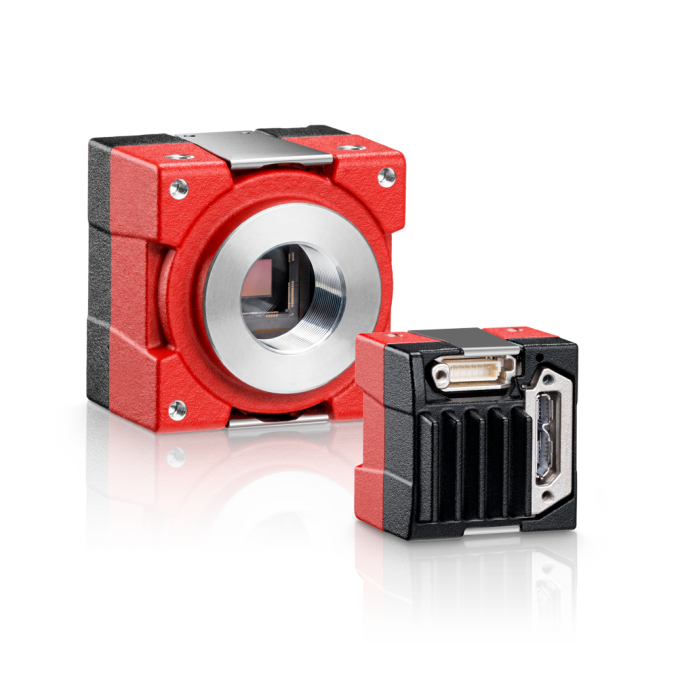
The Alvium VSWIR camera series is a multi-interface range for industrial imaging across the visible and short-wave infrared spectrum. The range contains 21 model variants built around four uncooled SenSWIR InGaAs sensors. Resolution options extend from 656 × 520 to 2,592 × 2,056 pixels, with either 5 µm or 3.45 µm pixels. Interface choices include MIPI CSI-2, USB3 Vision, GigE Vision, 5GigE Vision, GMSL2 and FPD-Link III. Housed versions use a 29 mm × 29 mm frontal footprint, while selected embedded configurations are available as bare-board or open-housing cameras.
Applications include semiconductor analysis, material sorting, hyperspectral imaging, food and packaging inspection, hot-glass inspection and counterfeit detection. Image correction, triggering, GPIO control and configurable regions of interest support integration into automated inspection and embedded vision systems. Common sensor and processing technology across the interfaces can simplify migration between prototype, embedded and networked camera architectures.
Range features
A high level overview of what this range offers
- 400 to 1,700 nm spectral range: Captures visible and SWIR information with one monochrome camera.
- Four SenSWIR InGaAs sensor options: Supports resolution requirements from 0.3 to 5.3 MP.
- Global shutter architecture: Reduces geometric distortion when imaging moving objects.
- Six interface families: Enables integration with PCs, embedded processors, Ethernet networks and long-cable serializers.
- Up to 249 fps at full resolution: Supports time-sensitive inspection with selected models.
- 3.45 µm and 5 µm pixel options: Allows designers to balance spatial sampling, sensor size and data volume.
- TEC-less sensor design: Avoids internal thermoelectric cooling hardware in compact installations.
- 29 mm × 29 mm housed footprint: Supports installation where the available camera cross-section is restricted.
- Bare-board and open-housing options: Provide mechanical flexibility for embedded and OEM assemblies.
- C-Mount, CS-Mount and selected S-Mount options: Accommodate different optical formats and installation depths.
- On-camera image processing: Includes defect-pixel correction, contrast, gamma, convolution, lens-shading correction and multiple regions of interest, depending on interface and firmware.
- Trigger, GPIO and sequencer functions: Support synchronized acquisition and coordinated machine control.
- GenICam-compatible control paths: Provide consistent feature access across network, USB and supported CSI-2 implementations.
Downloads
for Alvium VSWIR series
What’s in this range?
All the variants in the range and a comparison of what they offer
Specifications
| Specification | Range data |
|---|---|
Product type | Monochrome visible-to-SWIR industrial area-scan camera series |
Spectral range | 400 to 1,700 nm |
Sensor technology | SenSWIR InGaAs area-scan sensors |
Sensor models | IMX991, IMX990, IMX993 and IMX992 |
Shutter | Global shutter |
Resolution range | 656 × 520 to 2,592 × 2,056 pixels |
Megapixel range | 0.30 to 5.30 MP |
Sensor formats | Type 1/4, Type 1/2, Type 1/1.8 and Type 1/1.4 |
Pixel sizes | 5 µm × 5 µm or 3.45 µm × 3.45 µm |
Fixed-interface frame-rate range | 77 to 249 fps at full resolution; FP3 and GM2 rates depend on host hardware and register settings |
Interfaces | MIPI CSI-2 up to 4 lanes, USB3 Vision, GigE Vision, 5GigE Vision, GMSL2 based on MIPI CSI-2, or FPD-Link III based on MIPI CSI-2 |
ADC | 12-bit |
Output formats | Interface-dependent 8-bit, 10-bit and 12-bit monochrome or raw formats; adaptive 10-bit and 12-bit modes on supported models |
Lens mounts | C-Mount and CS-Mount; S-Mount on selected models and configurations |
Housing options | Bare board, open housing or closed housing, depending on interface family |
Frontal footprint | 29 mm × 29 mm for housed versions; 26 mm × 26 mm for applicable bare-board versions |
Camera weight | Configuration-dependent; up to approximately 15 g bare board, 50 g open housing and 100 g closed housing |
Operating temperature | Model-dependent; lower limit typically −20 °C, with upper housing-temperature limits of +55 °C, +60 °C or +65 °C |
Sensor cooling | No thermoelectric sensor cooling |
Power | Interface-dependent power through USB, PoE, MIPI CSI-2 or external DC input |
I/O | Two or four programmable GPIOs depending on interface; Ethernet models also provide an opto-isolated input and output |
Image functions | Auto exposure, auto gain, noise correction, defect-pixel correction, black level, contrast, gamma, LUT, convolution, lens-shading correction, ROI and multiple ROI, depending on model |
Camera control | Acquisition-rate control, triggering, counters, timers, sequencer, user sets, temperature monitoring and field firmware update, depending on interface |
CSI-based access modes | GenICam for CSI-2, direct register access and Video4Linux2 support on compatible platforms |
Variant Comparison
| Model | Interface | Sensor | Resolution | Pixel size | Maximum listed frame rate |
|---|---|---|---|---|---|
Alvium 1800 C-030 VSWIR | MIPI CSI-2 | IMX991 | 656 × 520, 0.30 MP | 5.00 µm | 249 fps |
Alvium 1800 C-130 VSWIR | MIPI CSI-2 | IMX990 | 1,296 × 1,032, 1.30 MP | 5.00 µm | 130 fps |
Alvium 1800 C-320 VSWIR | MIPI CSI-2 | IMX993 | 2,080 × 1,544, 3.20 MP | 3.45 µm | 131 fps |
Alvium 1800 C-530 VSWIR | MIPI CSI-2 | IMX992 | 2,592 × 2,056, 5.30 MP | 3.45 µm | 84 fps |
Alvium 1800 U-030 VSWIR | USB3 Vision | IMX991 | 656 × 520, 0.30 MP | 5.00 µm | 249 fps |
Alvium 1800 U-130 VSWIR | USB3 Vision | IMX990 | 1,296 × 1,032, 1.30 MP | 5.00 µm | 130 fps |
Alvium 1800 U-320 VSWIR | USB3 Vision | IMX993 | 2,080 × 1,544, 3.20 MP | 3.45 µm | 123 fps |
Alvium 1800 U-530 VSWIR | USB3 Vision | IMX992 | 2,592 × 2,056, 5.30 MP | 3.45 µm | 77 fps |
Alvium FP3-030 VSWIR | FPD-Link III | IMX991 | 656 × 520, 0.30 MP | 5.00 µm | Host and register dependent |
Alvium FP3-130 VSWIR | FPD-Link III | IMX990 | 1,296 × 1,032, 1.30 MP | 5.00 µm | Host and register dependent |
Alvium FP3-320 VSWIR | FPD-Link III | IMX993 | 2,080 × 1,544, 3.20 MP | 3.45 µm | Host and register dependent |
Alvium FP3-530 VSWIR | FPD-Link III | IMX992 | 2,592 × 2,056, 5.30 MP | 3.45 µm | Host and register dependent |
Alvium G1-030 VSWIR | GigE Vision | IMX991 | 656 × 520, 0.30 MP | 5.00 µm | 249 fps |
Alvium G1-130 VSWIR | GigE Vision | IMX990 | 1,296 × 1,032, 1.30 MP | 5.00 µm | 88 fps |
Alvium G5-130 VSWIR | 5GigE Vision | IMX990 | 1,296 × 1,032, 1.30 MP | 5.00 µm | 130 fps |
Alvium G5-320 VSWIR | 5GigE Vision | IMX993 | 2,080 × 1,544, 3.20 MP | 3.45 µm | 131 fps |
Alvium G5-530 VSWIR | 5GigE Vision | IMX992 | 2,592 × 2,056, 5.30 MP | 3.45 µm | 84 fps |
Alvium GM2-030 VSWIR | GMSL2 | IMX991 | 656 × 520, 0.30 MP | 5.00 µm | Host and register dependent |
Alvium GM2-130 VSWIR | GMSL2 | IMX990 | 1,296 × 1,032, 1.30 MP | 5.00 µm | Host and register dependent |
Alvium GM2-320 VSWIR | GMSL2 | IMX993 | 2,080 × 1,544, 3.20 MP | 3.45 µm | Host and register dependent |
Alvium GM2-530 VSWIR | GMSL2 | IMX992 | 2,592 × 2,056, 5.30 MP | 3.45 µm | Host and register dependent |
FAQs
for Alvium VSWIR series
Select the sensor by balancing object-space resolution, field of view, pixel size and permitted data rate. The IMX991 and IMX990 use 5 µm pixels and provide 0.30 MP and 1.30 MP respectively, while the IMX993 and IMX992 use 3.45 µm pixels and provide 3.20 MP and 5.30 MP. The smaller pixels support finer spatial sampling when the lens and working distance can resolve the additional detail. The larger pixels reduce the number of pixels required for a given sensor area, which can simplify data handling, although practical sensitivity still depends on illumination, exposure and optics. Engineers should calculate the required object-space micrometres per pixel before choosing the camera model.
USB3 Vision suits short, direct connections to a PC or embedded host, while GigE Vision and 5GigE Vision provide Ethernet-based networking and PoE options. MIPI CSI-2 is intended for close integration with compatible embedded processors and carrier boards, where the host design controls the data path. GMSL2 and FPD-Link III extend CSI-2-based cameras over rugged coaxial or shielded twisted-pair connections through a serializer and deserializer. Coaxial versions support cable runs up to 15 m, while documented STP limits are up to 8 m for GM2 and 10 m for FP3. The final choice should account for bandwidth, cable movement, connector type, power delivery and host-driver availability.
Yes, the sensors cover a specified spectral range from 400 to 1,700 nm, encompassing visible wavelengths and the SWIR band. This enables a single monochrome camera to observe features that may respond differently under visible, near-infrared and SWIR illumination. The camera does not create color-separated spectral channels by itself, so wavelength discrimination requires controlled illumination, filters or a hyperspectral optical arrangement. Lenses, windows and protective materials must also transmit the wavelengths used by the application. In practice, the optical stack and lighting design are as important as the camera when combining visible and SWIR measurements.
Throughput depends on resolution, frame rate and selected pixel format. At Mono8, the 3.20 MP G5 model is specified at 131 fps and approximately 525 MByte/s, while the 5.30 MP G5 model reaches 84 fps at the same stated transport rate. The USB models provide 123 fps at 3.20 MP and 77 fps at 5.30 MP, reflecting the available USB transport bandwidth. Higher bit depths increase the data volume, so 10-bit or 12-bit acquisition may reduce the achievable frame rate or require packed formats. Regions of interest can reduce transmitted pixels and may permit higher acquisition rates when only part of the scene is required.
The lens must cover both the sensor format and the wavelength range used by the inspection. Sensor formats extend from Type 1/4 to Type 1/1.4, so the required image circle grows with the selected resolution and sensor model. C-Mount and CS-Mount options are available across the range, with S-Mount offered on selected models and configurations. A lens designed only for visible imaging may lose transmission, focus consistency or contrast in the SWIR band. Engineers should therefore verify spectral transmission, chromatic focus shift, working distance, aperture and image-circle coverage before finalizing the optical design.
These cameras do not use thermoelectric sensor cooling, so heat transfer into the surrounding mechanical structure needs to be considered during installation. Published operating limits refer to housing temperature and should not be treated automatically as unrestricted ambient-temperature limits. Depending on model and interface, the upper housing-temperature limit is +55 °C, +60 °C or +65 °C, with a typical lower limit of −20 °C. Board-level and open-housing installations also require the system designer to provide a suitable thermal path and EMC treatment. Temperature monitoring can be used during prototype testing to confirm that the intended enclosure, mounting plate and airflow keep the camera within its permitted range.
Available functions include defect-pixel correction, adaptive noise correction, black-level adjustment, contrast, gamma, lookup tables, convolution, lens-shading correction and configurable regions of interest. These operations can prepare or reduce image data before it reaches the host, although exact availability depends on the interface, model and firmware. Multiple ROI and binning can be useful when only defined inspection zones or reduced spatial data are required. Sequencers, counters and timers allow acquisition settings to change in a controlled series without continuous host intervention. The feature set should be checked against the intended software access method, particularly when moving between Ethernet, USB and CSI-2 implementations.
The series provides hardware triggering and programmable GPIOs, with the exact line arrangement determined by the interface family. GigE and 5GigE versions also support Ethernet-oriented functions such as Action Commands and Precision Time Protocol on applicable models. CSI-2, GMSL2 and FPD-Link III variants provide trigger and peripheral control through their camera I/O arrangements and compatible host hardware. Sequencers, counters and timers can coordinate exposure settings with repetitive machine cycles. During system design, trigger latency, cable propagation, host buffering and illumination timing should be validated together rather than assessed as independent components.