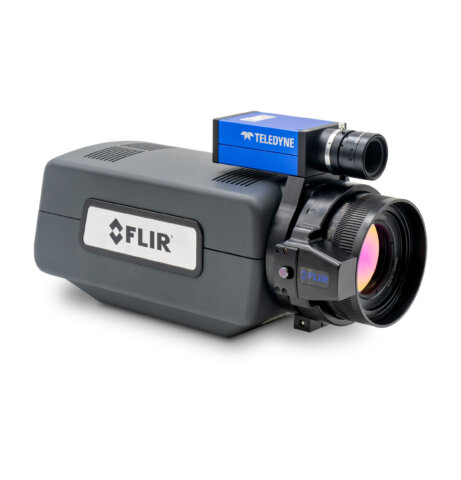
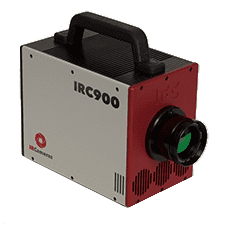
IRC 900 series SWIR cameras
- Technology
- SWIR cameras
- Partner
- IR Cameras
The IRC 900 series comprises two closed-cycle cooled InSb cameras for scientific, industrial and field-based SWIR imaging. The IRC906-SWIR uses a 640 × 512 array with a standard 20 µm pixel pitch, while the IRC912-SWIR provides 1280 × 1024 resolution with 12 µm pixels. Their configurable SWIR filtering extends operation to 2600 nm, with custom filter configurations available for application-specific wavelength selection. Both models operate at approximately 120 Hz across the full image and support user-defined windowing for higher-speed acquisition from a smaller region of interest.
Typical applications include spectroscopy, infrared search and track, target signature measurement, astronomy, laser detection and laser characterisation. Simultaneous Camera Link, Gigabit Ethernet and HDMI interfaces provide flexible options for image acquisition, system control and local monitoring. Optional IRIG-B, GPS data stamping and a four-position warm filter wheel support synchronised measurements and multispectral test arrangements.
Range features
A high level overview of what this range offers
- Closed-cycle cooled InSb focal plane: Supports low-noise SWIR imaging over a configurable spectral band.
- Two array formats: Select between 640 × 512 and 1280 × 1024 resolution to suit spatial sampling requirements.
- 119–120 Hz full-window acquisition: Supports imaging of dynamic scenes without reducing the active image area.
- Reduced-window operation: Enables higher frame rates for measurements focused on a smaller region of interest.
- Integration times below 150 ns: Supports measurements of brief events or high-flux scenes.
- 14-bit imaging with a 13-bit option: Allows bit depth to be balanced against increased small-window frame rates.
- No pixel crosstalk or blooming: Helps maintain separation between bright areas and adjacent image regions.
- Simultaneous Camera Link, GigE and HDMI outputs: Provides flexible connections for acquisition, control and local monitoring.
- Cross-platform GenICam control: Supports integration into compatible software and automated measurement systems.
- Motorised four-position warm filter wheel option: Enables automated switching between selected spectral filters.
- Sync I/O and integration output: Supports timing coordination with external test and measurement equipment.
- Optional IRIG-B and GPS data stamping: Supports time-referenced image capture and event correlation.
- IP-51 environmental rating: Supports operation in suitable laboratory and controlled field installations.
What’s in this range?
All the variants in the range and a comparison of what they offer
Shared series specifications
| Parameter | Series specification |
|---|---|
Detector technology | Indium antimonide (InSb) focal-plane array |
Cooling | Closed-cycle Stirling cooling |
Standard FPA spectral response | Below 900 nm to above 5000 nm |
SWIR operating band | Model and cold-filter dependent; extends to 2600 nm |
Integration time | Below 150 ns to full-frame time |
Dynamic range | 14-bit; 13-bit option for increased frame rates at small window sizes |
Windowing increments | User-defined in 4 × 1 pixel increments |
Integration modes | Snapshot; automatic selection of integrate-while-read or integrate-then-read |
Synchronisation | Sync I/O and integration output |
Image outputs | Simultaneous Camera Link, GigE and HDMI |
Communications | Serial over Camera Link and GigE |
Software control | Cross-platform, GenICam compliant |
Lens mounts | Bayonet, M42 or C-mount |
Optional filter wheel | Motorised four-position warm filter wheel for 25.4 mm diameter × 1.0 mm thick filters; unavailable with C-mount configurations |
Timing options | IRIG-B and GPS data stamping |
Power | 35 W at 24 VDC |
System weight | Below 13 lb |
Dimensions | 8.96″ × 5.13″ × 6.70″, L × W × H |
Operating temperature | −40°C to +55°C |
Storage temperature | −55°C to +80°C |
Environmental rating | IP-51 |
Mounting holes | 2 × 1/4-20 and 4 × #10-24 |
Variant comparison
| Specification | IRC906-SWIR | IRC912-SWIR |
|---|---|---|
Product or variant | IRC906-SWIR | IRC912-SWIR |
Resolution | 640 × 512 pixels | 1280 × 1024 pixels |
Pixel pitch | 20 µm standard; 12 µm option | 12 µm |
Standard SWIR cold filter | 900–2600 nm | 960–2600 nm |
Standard system SWIR response | 900–2600 nm | Below 900–2600 nm |
Frame rate at maximum window | 119–120 Hz | 119 Hz |
High-speed operation | 475 Hz with the 12 µm pixel option | Above 6800 Hz with a reduced window |
Minimum window | 320 pixels wide × 32 pixels high | 320 pixels wide × 8 pixels high |
Well capacity | 7 million electrons; 2 million with the 12 µm option | 2 million electrons |
Operability | 99.8% | 99.6% |
Standard camera f-number | f/2.3 and f/4.0 | f/2.0, f/2.3 and f/4.0 |
Custom optical configuration | Custom cold shields available | Custom cold shields available |
FAQs
for IRC 900 series SWIR cameras
Choose the IRC906-SWIR when 640 × 512 resolution, a standard 20 µm pixel pitch and a 7 million-electron well capacity match the measurement requirement. Its detailed configuration also permits a 12 µm option, which changes the well capacity to 2 million electrons and raises the full-window rate to 475 Hz. The IRC912-SWIR is more appropriate when the design requires 1280 × 1024 resolution, 12 µm pixels or reduced-window rates above 6800 Hz. Both models operate at approximately 120 Hz across their standard full image. The final choice should account for spatial resolution, optical field of view, signal level, frame rate and available acquisition bandwidth.
Both cameras use an InSb focal-plane array with a standard detector response extending from below 900 nm to above 5000 nm, but cold filtering defines the practical SWIR operating band. The IRC906-SWIR has a standard 900–2600 nm cold-filter option, while the IRC912-SWIR uses a 960–2600 nm filter and has a standard system response extending from below 900 nm to 2600 nm. Custom filters can be specified when a narrower or differently positioned band is required. A motorised four-position warm filter wheel can hold 25.4 mm diameter, 1.0 mm thick filters. Engineers should select the spectral configuration alongside the lens mount because the filter wheel is unavailable with C-mount versions.
Yes, both models combine approximately 120 Hz full-frame imaging with integration times below 150 ns and user-defined windowing. The IRC906-SWIR can operate at 475 Hz when configured with the optional 12 µm pixel array, while the IRC912-SWIR can exceed 6800 Hz when its active window is reduced. Window dimensions are adjusted in 4 × 1 pixel increments, with minimum heights of 32 pixels for the IRC906-SWIR and 8 pixels for the IRC912-SWIR. A 13-bit mode is available when increased small-window frame rate is prioritised over the standard 14-bit depth. The acquisition system must be sized for the selected resolution, bit depth, interface and sustained frame rate.
Image data can be delivered simultaneously through Camera Link, Gigabit Ethernet and HDMI, giving system designers several integration paths. Serial communication is available over Camera Link and GigE, while cross-platform GenICam compliance supports compatible control and acquisition software. Camera Link can be assigned to high-rate image capture, with GigE and HDMI available for network integration or monitoring as the system architecture requires. Sync I/O and an integration output allow image acquisition to be coordinated with external equipment. Optional IRIG-B and GPS data stamping can add a timing reference when frames must be correlated with test events, position data or other instruments.
The IRC906-SWIR supports standard f/2.3 and f/4.0 configurations, while the IRC912-SWIR also offers f/2.0. Bayonet, M42 and C-mount interfaces are available, and custom cold shields can be specified to match particular optical arrangements. The optional four-position warm filter wheel accepts 25.4 mm diameter, 1.0 mm thick filters but cannot be used with a C-mount configuration. Both camera bodies measure 8.96″ × 5.13″ × 6.70″ and weigh less than 13 lb. Mechanical designs should provide suitable support for that mass, access to the selected lens mount and clearance for the filter wheel, connectors and cooling system.
Each camera requires a 24 VDC supply and has a stated power consumption of 35 W. The closed-cycle Stirling cooling system should be considered when planning supply capacity, thermal management, vibration control and installation space. Operation is specified from −40°C to +55°C, with storage permitted from −55°C to +80°C. The enclosure carries an IP-51 environmental rating and provides 2 × 1/4-20 plus 4 × #10-24 mounting holes. For field installation, engineers should verify that the application enclosure, power conditioning, mounting structure and environmental protection meet the conditions expected at the deployment site.