IRC900 Series MWIR cameras
- Technology
- MWIR cameras for R&D
- Partner
- IR Cameras
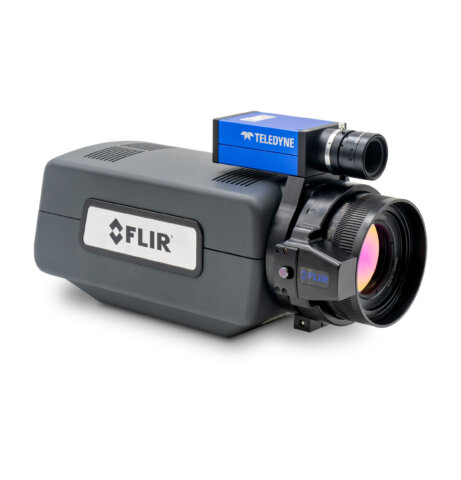
The IRC900 Series includes the IRC906, IRC906HS, IRC910 and IRC912 cooled MWIR cameras. Each model uses an indium antimonide focal plane array with a spectral response extending from below 1.0 µm to 5.3 µm. The available formats address different priorities, including high-speed capture, increased pixel count, square-array imaging and thermal sensitivity down to 18 mK NEdT. Applications include spectroscopy, materials evaluation, quality assurance, process analysis, range phenomenology, long-range surveillance and scientific imaging.
Full-frame rates range from 76 Hz for the 1024 × 1024 IRC910 to 475 Hz for the 640 × 512 IRC906HS, with user-defined windowing for reduced-area acquisition. Optical configurations can be adapted through selectable f-numbers, cold filters, lens mounts and an optional four-position filter wheel. Simultaneous Camera Link and GigE image outputs, serial communications and GenICam-compatible control support integration with laboratory equipment and installed imaging systems.

Range features
A high level overview of what this range offers
- Closed-cycle cooled InSb detector: Supports MWIR measurement without an external cooling supply.
- Four array and speed configurations: Allows selection based on spatial resolution, pixel pitch and capture rate.
- Full-frame rates from 76 to 475 Hz: Accommodates steady-state measurements and faster events.
- Integration times below 150 ns: Supports short-exposure capture when sufficient scene signal is available.
- User-defined windowing: Reduces the active readout area for application-specific acquisition.
- 14-bit dynamic range with a 13-bit option: Balances image depth against higher reduced-window frame rates.
- Snapshot integration: Captures the focal plane at a common point in time for moving-scene analysis.
- Sync I/O and integration output: Supports timing coordination with external test and measurement equipment.
- Simultaneous Camera Link and GigE data: Provides alternative paths for image acquisition and system integration.
- GenICam-compatible control: Simplifies connection to cross-platform imaging software.
- Configurable cold filtering and f-number: Adapts the optical path to different spectral and radiometric requirements.
- IP51 environmental rating: Provides a defined ingress rating for enclosure and installation planning.
What’s in this range?
All the variants in the range and a comparison of what they offer
Series-wide specifications
| Specification | Value |
|---|---|
Detector technology | Indium antimonide focal plane array |
Spectral response | Below 1.0 µm to 5.3 µm |
Integration time | Below 150 ns to full frame |
Dynamic range | 14-bit; 13-bit option for increased frame rate at small window sizes |
Windowing | User-defined in 4 × 1 increments; minimum width 320 pixels and minimum height 32 pixels |
Integration mode | Snapshot; automatic selection of integrate-while-read or integrate-then-read |
Synchronisation | Sync I/O and integration output |
Image data | Simultaneous Camera Link and GigE |
Communications | Serial over Camera Link and GigE |
Software control | Cross-platform GenICam compatible |
Standard camera f-numbers | f/2.3, f/3.0 and f/4.0; custom cold shields available on request |
Standard cold-filter options | 3.0 to 5.0 µm or no cold filter |
Additional filter options | CO₂, SWIR or custom filters |
Optional filter wheel | Motorised four-position warm filter wheel for 25.4 mm diameter × 1.0 mm filters |
Input power | 24 V DC |
Operating temperature | -40 to +55 °C (-40 to +131 °F) |
Storage temperature | -55 to +80 °C (-67 to +176 °F) |
Environmental rating | IP51 |
Mounting holes | 2 × 1/4-20 and 4 × #10-24 |
Model comparison
| Specification | IRC906 | IRC906HS | IRC910 | IRC912 |
|---|---|---|---|---|
Resolution | 640 × 512 pixels | 640 × 512 pixels | 1024 × 1024 pixels | 1280 × 1024 pixels |
Pixel pitch | 20 µm | 12 µm | 25 µm | 12 µm |
Maximum full-frame rate | 119 Hz | 475 Hz | 76 Hz | 119 Hz |
NEdT | 18 mK | Below 30 mK | 18 mK | Below 30 mK |
Well capacity | 7 million electrons | 2 million electrons | 10 million electrons | 2 million electrons |
Operability | 99.8% | 99.6% | 99.6% | 99.6% |
Lens mount | Bayonet | Bayonet | Bolt-hole pattern | Bayonet |
Power at 24 V DC | 20 W | 25 W | 35 W | 28 W |
System weight | Under 7 lb | Under 7 lb | Under 10 lb | Under 7 lb |
Closed-cycle cooler | Rotary | Rotary | Linear | Rotary |
Dimensions | 5.1 × 5.8 × 8 in | 5.1 × 5.8 × 8 in | 6 × 6 × 9 in | 5.1 × 5.8 × 8 in |
FAQs
for IRC900 Series MWIR cameras
The choice depends mainly on whether frame rate, array size, pixel pitch or thermal sensitivity has priority. The IRC906 combines 640 × 512 resolution, 20 µm pixels, 119 Hz full-frame operation and 18 mK NEdT, while the IRC906HS retains 640 × 512 resolution but moves to 12 µm pixels and 475 Hz. The IRC910 offers a square 1024 × 1024 array, 25 µm pixels, 76 Hz operation and a 10 million-electron well capacity. The IRC912 provides the largest array at 1280 × 1024, with 12 µm pixels and 119 Hz. In practice, select the IRC906HS for event speed, the IRC912 for pixel count, the IRC910 for square-format scientific imaging or the IRC906 for 18 mK sensitivity in a smaller array.
NEdT indicates the camera’s ability to distinguish small apparent temperature differences under defined measurement conditions. The IRC906 and IRC910 have an NEdT of 18 mK, while the IRC906HS and IRC912 are below 30 mK. Lower NEdT generally supports finer thermal contrast, although the final result also depends on the optics, integration time, filtering, calibration and scene radiance. Well capacities are 7 million electrons for the IRC906, 2 million for the IRC906HS and IRC912, and 10 million for the IRC910. A larger well can provide more signal capacity before saturation, so model selection should consider both thermal sensitivity and the expected scene intensity range.
All four models support user-defined windows in 4 × 1-pixel increments, with a minimum width of 320 pixels and a minimum height of 32 pixels. Reducing the active readout area can increase the acquisition rate, although specific reduced-window frame rates are not defined. Integration times below 150 ns are available when the scene radiance and optical throughput provide enough signal for such short exposures. A 13-bit mode can also be selected to increase frame rate at small window sizes, while 14-bit operation retains the full stated digital depth. Engineers should confirm the required region of interest, exposure budget and data bandwidth before selecting the operating mode.
The cameras provide simultaneous Camera Link and GigE image data, allowing the acquisition architecture to be selected around bandwidth, cable routing and host hardware. Serial communications are carried over Camera Link and GigE, while cross-platform control follows the GenICam interface model. Sync I/O and an integration output are included for coordination with external triggers, illumination, motion systems or measurement instruments. Snapshot operation captures the focal plane at a shared instant, which is useful when scene content changes during a frame. Integration planning should account for the selected full-frame rate, host processing performance, storage throughput and the timing requirements of connected equipment.
Standard camera f-numbers are f/2.3, f/3.0 and f/4.0, with custom cold shields available for application-specific configurations. The standard cold-filter choices are a 3.0 to 5.0 µm band or no cold filter, while CO₂, SWIR and custom filter options are also available. A motorised four-position warm filter wheel accepts filters measuring 25.4 mm in diameter and 1.0 mm thick, allowing controlled switching between spectral bands. The IRC906, IRC906HS and IRC912 use bayonet lens mounts, whereas the IRC910 uses a bolt-hole pattern. The selected detector, f-number, filter transmission and lens must therefore be evaluated together rather than as independent components.
Every model operates from 24 V DC, but the stated power requirement varies from 20 W for the IRC906 to 35 W for the IRC910. The IRC906, IRC906HS and IRC912 measure 5.1 × 5.8 × 8 in and weigh under 7 lb, while the IRC910 measures 6 × 6 × 9 in and weighs under 10 lb. Operating temperature extends from -40 to +55 °C, with storage permitted from -55 to +80 °C. The IP51 rating should be considered a limited ingress rating rather than a substitute for a fully weatherproof enclosure. System design should also allow space for the lens, cables, airflow, mounting hardware and access to any filter-wheel mechanism.
The range can support spectroscopy and process-analysis systems where cooled MWIR detection, short integration times and configurable filtering are required. The InSb detectors respond from below 1.0 µm to 5.3 µm, while the standard cold-filter band covers 3.0 to 5.0 µm. Optional CO₂, SWIR and custom filters, together with the four-position filter wheel, allow the optical configuration to be aligned with selected spectral features. Camera Link and GigE interfaces support connection to acquisition and analysis systems, and external synchronisation can coordinate imaging with a controlled process. The final spectral resolution and quantitative accuracy will also depend on the external optics, calibration method and analysis equipment.
The IRC906HS provides the highest full-frame rate in the range at 475 Hz, while the other models operate at 76 or 119 Hz depending on array format. Snapshot integration helps limit temporal displacement across the image, and sync I/O allows exposure timing to be coordinated with an external event. The cameras can select between integrate-while-read and integrate-then-read modes, providing flexibility around duty cycle and acquisition timing. For the IRC910, SuperFraming supports frame-to-frame changes in integration time when a scene contains rapidly changing signal levels or a wide dynamic range. Selection should consider whether temporal resolution, spatial resolution, sensitivity or scene dynamic range is the controlling requirement.