Mid-wave 900 series SWIR Camera with InGaAs Detector
- Technology
- SWIR cameras
- Partner
- IR Cameras
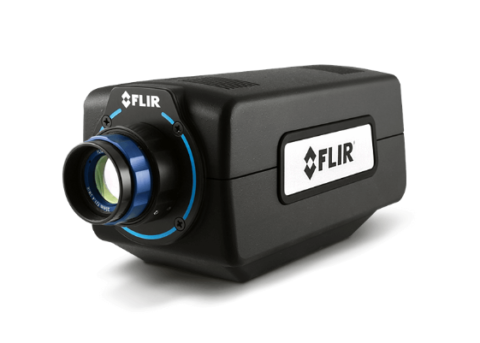
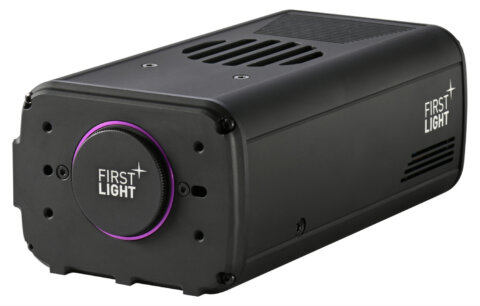
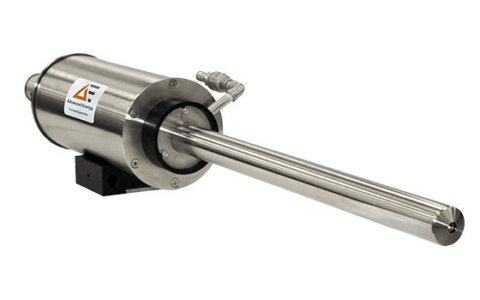
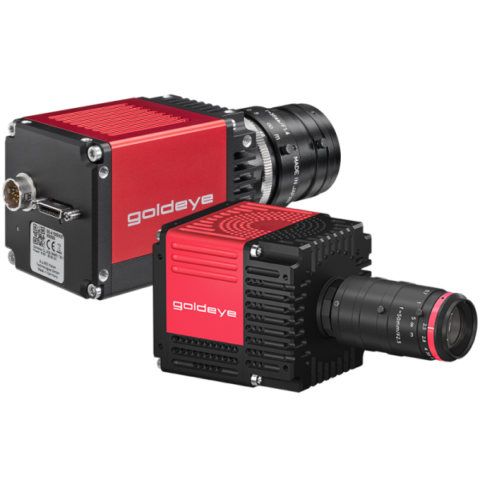
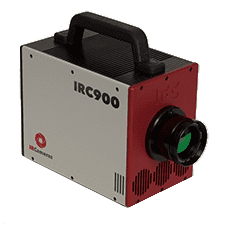
The IRC900 Series is a cooled mid-wave infrared camera range built around indium antimonide focal plane arrays. Its detector response extends from below 1.0 µm to 5.3 µm, with SWIR available as an optional filter configuration rather than as the detector material. Four variants allow engineers to prioritise spatial resolution, pixel pitch, well capacity or acquisition speed. Available image formats include 640 × 512, 1024 × 1024 and 1280 × 1024 pixels, with full-frame rates reaching 475 Hz on the IRC906HS. Snapshot acquisition, user-defined windowing and integration times below 150 ns provide flexibility when recording fast or rapidly changing events.
Camera Link, GigE, HDMI, GenICam-compatible control and hardware synchronisation support integration into laboratory equipment and larger measurement systems. Applications include spectroscopy, materials evaluation, range phenomenology, process analysis, quality assurance, scientific imaging and long-range observation. Closed-cycle cooling and a specified operating range of −40 °C to +55 °C support use in controlled test environments and suitable field installations.

Range features
A high level overview of what this range offers
- Cooled InSb focal plane array – Covers a spectral response from below 1.0 µm to 5.3 µm.
- Four documented camera variants – Allows resolution, pixel pitch and acquisition speed to be matched to the measurement.
- Full-frame rates up to 475 Hz – Supports the capture of fast thermal and physical events.
- Integration times below 150 ns – Helps control exposure during rapid or high-flux measurements.
- User-defined sub-windowing – Concentrates acquisition on the required region of interest.
- Selectable 14-bit or 13-bit operation – Balances digital depth against higher rates at small window sizes.
- Snapshot acquisition architecture – Supports consistent timing across the image array.
- Sync I/O and integration output – Enables alignment with external triggers and test equipment.
- Simultaneous Camera Link, GigE and HDMI outputs – Supports digital acquisition, network integration and local viewing.
- GenICam-compatible control – Simplifies cross-platform software integration.
- Up to 12 on-board correction tables – Allows multiple non-uniformity correction sets to be retained.
- Configurable cold filters and cold shields – Supports wavelength-specific optical arrangements.
- Optional four-position filter wheel – Enables controlled selection between spectral sub-bands.
- −40 °C to +55 °C operating range – Supports use across varied laboratory and field conditions.
What’s in this range?
All the variants in the range and a comparison of what they offer
Specifications
| Specification | IRC900 Series specification |
|---|---|
Detector type | Cooled indium antimonide focal plane array |
Spectral response | <1.0 µm to 5.3 µm |
Cooling architecture | Closed-cycle Stirling cooler; rotary or linear configuration depending on model |
Integration time | <150 ns to the full-frame period |
Digital depth | 14-bit, with a 13-bit option for increased frame rates at small window sizes |
Windowing | User-defined in 4 × 1 increments; minimum width 320 pixels and minimum height 32 pixels |
Integration type | Snapshot; automatic selection of integrate-while-read or integrate-then-read |
Synchronisation | Sync I/O and integration output |
Image outputs | Simultaneous Camera Link, GigE and HDMI |
Communications | Serial over Camera Link and GigE |
Software control | Cross-platform, GenICam compatible |
Image data stamping | Optional IRIG or GPS with on-board receiver |
Non-uniformity correction | Up to 12 on-board tables |
Standard camera f-number | f/2.3 and f/4.0; custom cold shields available |
Cold-filter options | 3.0–5.0 µm or no cold filter; optional SWIR, CO₂ or custom filters |
Optional filter wheel | Motorised four-position cold filter wheel for 25.4 mm diameter × 1.0 mm thick filters |
Operating temperature | −40 °C to +55 °C |
Storage temperature | −55 °C to +80 °C |
Environmental rating | IP51 |
Mounting holes | 2 × 1/4-20 and 4 × #10-24 |
Model Comparison
| Specification | IRC906 | IRC906HS | IRC910 | IRC912 |
|---|---|---|---|---|
Resolution | 640 × 512 | 640 × 512 | 1024 × 1024 | 1280 × 1024 |
Pixel pitch | 20 µm | 12 µm | 25 µm | 12 µm |
Full-frame rate | 119 Hz | 475 Hz | 76 Hz | 119 Hz |
NEdT | 18 mK | 30 mK | 18 mK | 30 mK |
Well capacity | 7 million electrons | 2 million electrons | 10 million electrons | 2 million electrons |
Operability | 99.8% | 99.6% | 99.6% | 99.6% |
Lens mount | Bayonet | Bayonet | Bolt-hole pattern | Bayonet |
Power at 24 VDC | 20 W | 25 W | 35 W | 28 W |
System weight | <7 lb | <7 lb | <10 lb | <7 lb |
Closed-cycle cooler | Rotary | Rotary | Linear | Rotary |
Dimensions | 5.1 × 5.8 × 8 in | 5.1 × 5.8 × 8 in | 6 × 6 × 9 in | 5.1 × 5.8 × 8 in |
FAQs
for Mid-wave 900 series SWIR Camera with InGaAs Detector
No. The camera range uses cooled indium antimonide focal plane arrays, with a spectral response from below 1.0 µm to 5.3 µm, so its principal classification is MWIR rather than a conventional InGaAs SWIR camera. A 3.0–5.0 µm cold filter or no cold filter is standard, while SWIR, CO₂ and custom filters can be specified. The optional SWIR filter changes the admitted wavelength band but does not change the detector material to InGaAs. For designs that mandate an InGaAs array, the requirement should be checked at detector level rather than selecting this range solely because a SWIR filter option is available.
Choose the variant by deciding whether temporal resolution, spatial format or charge capacity is the main constraint. The IRC906 provides 640 × 512 at 119 Hz with 20 µm pixels, 18 mK NEdT and a 7 million-electron well, while the IRC906HS retains 640 × 512 but uses 12 µm pixels and reaches 475 Hz with a 2 million-electron well. The IRC910 trades speed for a 1024 × 1024 format, 25 µm pixels, 18 mK NEdT and a 10 million-electron well at 76 Hz. The IRC912 provides 1280 × 1024 at 119 Hz with 12 µm pixels. In practice, the IRC906HS suits rapid transients, the IRC910 supports applications requiring greater charge handling, and the IRC912 provides the widest documented image format.
Windowing reduces the active image area so the acquisition system can concentrate on the region containing the event. The series supports user-defined windows in 4 × 1 increments, with a range-level minimum of 320 pixels wide by 32 pixels high, while integration can be set from below 150 ns up to the full-frame period. Snapshot operation and automatic integrate-while-read or integrate-then-read selection support different timing requirements. Sync I/O and an integration output allow exposure timing to be aligned with a trigger or measured event. The selected window, interface bandwidth and storage system must all sustain the required recording duration rather than relying only on the sensor’s stated maximum frame rate.
The optical setup should be selected alongside the spectral band because the cold shield, f-number and lens mount affect system compatibility. Standard series configurations list f/2.3 and f/4.0, with custom cold shields available where the optical train requires a different match. Standard cold-filter choices are 3.0–5.0 µm or no cold filter, while SWIR, CO₂ and custom filters can be requested for band-specific measurements. The IRC906, IRC906HS and IRC912 use bayonet mounts, whereas the IRC910 uses a bolt-hole pattern. In practice, the required wavelength band, lens interface, aperture and filter-switching method should be established before the camera position and surrounding mechanics are fixed.
The series supports simultaneous Camera Link, GigE and HDMI image outputs, with serial communications over Camera Link and GigE. GenICam-compatible control supports cross-platform software integration, while sync I/O and integration-out signals provide access to hardware timing. Optional IRIG or GPS data stamping can associate frames with timing or location information, depending on the selected configuration. Camera Link can support direct high-rate acquisition, GigE can simplify networked control and transfer, and HDMI provides local image viewing. Engineers should verify interface-card support, cable requirements, sustained storage throughput and trigger-level compatibility for the selected resolution and frame rate.
Yes, provided the installation is compatible with IP51 protection and the cooling, power and mechanical requirements. All four models have an operating range of −40 °C to +55 °C and a storage range of −55 °C to +80 °C, with 24 VDC power demand ranging from 20 W to 35 W. The IRC906, IRC906HS and IRC912 weigh less than 7 lb and measure 5.1 × 5.8 × 8 inches, whereas the IRC910 weighs less than 10 lb and measures 6 × 6 × 9 inches. Rotary coolers are used by the IRC906, IRC906HS and IRC912, while the IRC910 uses a linear cooler. Heat rejection, vibration paths, ingress protection and mounting stiffness should therefore be assessed as part of the installation design.
NEdT indicates the temperature difference the camera can resolve under its specified test conditions, while well capacity describes how much photo-generated charge a pixel can hold before saturation. The IRC906 and IRC910 are listed at 18 mK, compared with 30 mK for the IRC906HS and IRC912, and their respective well capacities are 7 million, 10 million, 2 million and 2 million electrons. The 14-bit digital path provides more output levels, while a 13-bit option is available to increase frame rate at small window sizes. Operability ranges from 99.6% to 99.8%, so correction strategy remains relevant for measurement applications. Selection should consider target contrast, expected flux, exposure time and calibration workflow together rather than treating one figure as decisive.