A6260-SWIR Camera with InGaAs Detector
- Technology
- SWIR cameras
- Partner
- Teledyne FLIR
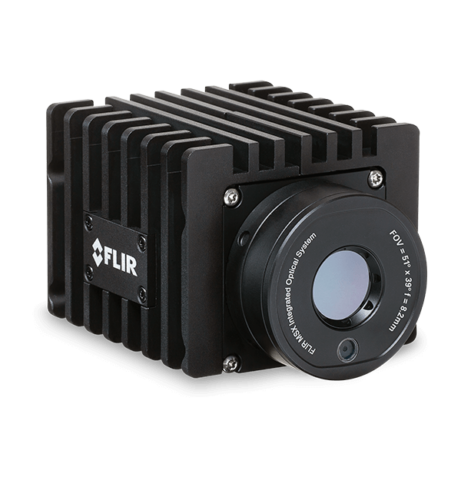
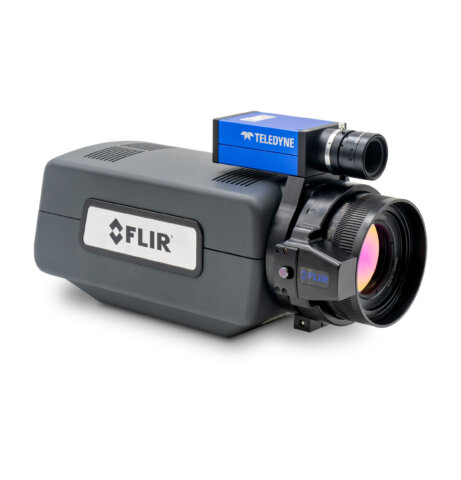
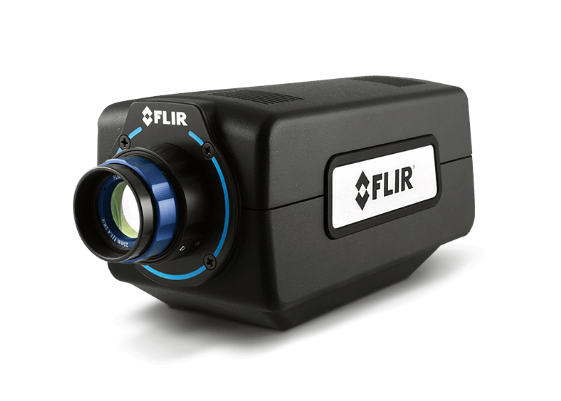
The A6260 is a laboratory and R&D SWIR camera for controlled image acquisition across the near-infrared and short-wave infrared bands. Its TEC-stabilised InGaAs detector provides 640 × 512 resolution, a 15 µm pixel pitch and 14-bit digital output. The range includes the A6261 for 0.9–1.7 µm operation and the A6262 for an extended 0.6–1.7 µm spectral response. Three gain states and adjustable integration controls accommodate high photon levels and low-light scenes.
Full-frame acquisition reaches 180 Hz without factory calibration or 125 Hz with factory calibration, while centred windowing enables substantially higher frame rates. GigE Vision 2.0 and GenICam interfaces support standard acquisition software and custom control systems. Applications include high-temperature measurement through suitable glass, laser beam profiling, thermal transient analysis, nightglow imaging and synchronised scientific testing.
Range features
A high level overview of what this range offers
- InGaAs SWIR detector: Covers spectral bands from 0.6 µm to 1.7 µm, depending on the selected variant.
- 640 × 512 detector format: Provides 327,680 measurement pixels with a 15 µm pitch.
- Three selectable gain states: Delivers a 75× overall gain factor for bright targets and low-light scenes.
- 14-bit digital image data: Preserves detector information for analysis and radiometric processing.
- Up to 180 Hz full-frame acquisition: Captures rapidly changing events across the complete detector area.
- Flexible centred windowing: Raises acquisition speed to as much as 26,150 Hz at 32 × 4 pixels, depending on the configuration.
- Adjustable integration width: Helps match exposure to target intensity and event duration.
- External synchronisation and triggering: Supports time-correlated acquisition with other instruments and test events.
- A6261 temperature calibration options: Enables measurements from 400°C to 1,200°C, with optional higher ranges.
- Built-in flat-field shutter and NUC functions: Support spatial uniformity and repeatable detector correction.
- GigE Vision 2.0 and GenICam control: Simplify integration with compatible acquisition software and custom applications.
- C-mount optical interface: Accommodates compatible manual-focus lenses and a rear filter holder.
What’s in this range?
All the variants in the range and a comparison of what they offer
A6260 technical specifications
| Category | Specification | Value |
|---|---|---|
Product range | Models | A6261 and A6262 |
Detector | Technology | InGaAs; backside-thinned InGaAs on A6262 |
Detector | Resolution | 640 × 512 pixels |
Detector | Total pixel count | 327,680 pixels |
Detector | Pixel pitch | 15 µm |
Detector | Spectral response | A6261: 0.9–1.7 µm; A6262: 0.6–1.7 µm |
Detector | Sensor stabilisation | Thermoelectric cooling at 30°C |
Detector | Operability | ≥99.5%; ≥99.8% typical |
Detector | Quantum efficiency | Greater than 60% from 1 µm to 1.6 µm |
Detector | Noise equivalent irradiance | Low gain: 8.35 × 10⁹ photons/s/cm²; medium gain: 2.89 × 10⁹ photons/s/cm² |
Gain | Selectable states | Low, medium and high; 75× overall gain factor |
Gain | Low-gain well capacity | 1.44 million electrons |
Gain | Medium-gain well capacity | 95,700 electrons |
Gain | High-gain well capacity | Approximately 19,000 electrons |
Acquisition | Integration mode | Snapshot |
Acquisition | Readout modes | Asynchronous integrate-while-read and asynchronous integrate-then-read |
Acquisition | Integration width | 480 ns minimum to approximately one full-frame period |
Acquisition | Integration adjustment resolution | 160 ns |
Acquisition | Programmable frame-rate range | 0.0015 Hz to the permitted maximum for the selected window and integration setting |
Acquisition | Maximum full-frame rate | 180 Hz without factory calibration; 125 Hz with factory calibration |
Acquisition | Maximum half-window rate | 631 Hz |
Acquisition | Maximum quarter-window rate | 1,666 Hz |
Acquisition | Maximum minimum-window rate | Up to 26,150 Hz at 32 × 4 pixels; 17,781 Hz is also specified, so the ordered configuration should be confirmed |
Acquisition | Pixel rate | 100 MHz burst rate |
Windowing | Window size | Flexible, down to 32 × 4 pixels |
Windowing | Step size | 32 rows and 4 columns |
Windowing | Position | Centred on the focal-plane array; no offset |
Image data | Digital depth | 14-bit |
Image data | Output selections | Raw, gain-and-offset corrected, or NUC-corrected with bad-pixel replacement |
Communications | Digital protocol | GigE Vision 2.0 |
Communications | Camera control | GenICam over 10/100/1000 Gigabit Ethernet |
Video | Monitoring outputs | SD-SDI 480i or 576i; HD-SDI 720p at 50/59.9 Hz or 1080p at 25/29.9 Hz |
Synchronisation | Frame-sync input | TTL via BNC, selectable polarity, greater than 160 ns pulse width and 5.5 V maximum |
Correction | NUC types | Non-volatile two-point correction, two-point correction with bad-pixel replacement and offset update |
Correction | NUC storage | Four active selectable NUCs and more than 100 NUCs in onboard flash |
Correction | NUC time | Less than 15 seconds |
Correction | NUC performance | 0.1% |
Optics | Lens interface | Standard C-mount |
Optics | C-mount back working distance | 17.526 mm |
Optics | Focus | Manual |
Optics | Calibrated aperture | Lens locked at f/4 with calibration; variable lens iris without calibration |
Optics | Rear filter holder | 25.4 mm diameter filter, designed for 1 mm thickness |
Power | Input | 24 V DC nominal; 20–28 V DC acceptable |
Power | Consumption | 19 W during normal operation; 21 W during stabilisation |
Power | Detector stabilisation time | Approximately 2 minutes |
Mechanical | Dimensions without lens | 21.8 × 10.2 × 10.9 cm |
Mechanical | Weight without lens | 2.26 kg |
Mechanical | Mounting points | Two 1/4-20 threads, one 3/8-16 thread and four 10-24 holes |
Environmental | Operating temperature | 0°C to 45°C |
Environmental | Shock | 40 g, 11 ms half-sine pulse |
Environmental | Vibration | 4.3 g RMS random vibration on all three axes |
Environmental | Humidity | Less than 95% relative humidity, non-condensing |
Environmental | Operating orientation | No orientation restriction |
A6261 and A6262 variant comparison
| Specification | A6261 | A6262 |
|---|---|---|
Part number | 29437-261 | 29437-262 |
Spectral response | 0.9–1.7 µm | 0.6–1.7 µm |
Detector material | InGaAs | Backside-thinned InGaAs, identified as VisGaAs |
Standard temperature range | 400°C to 1,200°C | No radiometric temperature range listed |
Optional temperature ranges | Up to 1,500°C or up to 2,200°C | No radiometric temperature range listed |
Available lens focal lengths | 16 mm, 25 mm, 35 mm, 50 mm and 100 mm | 25 mm |
FAQs
for A6260-SWIR Camera with InGaAs Detector
Select the A6261 when the application requires calibrated high-temperature measurement, particularly through a suitable glass viewing window. It operates from 0.9 µm to 1.7 µm and has a standard calibrated range of 400°C to 1,200°C, with optional ranges extending to 1,500°C or 2,200°C. The A6262 extends the lower spectral limit to 0.6 µm but has no listed radiometric temperature range. It is supplied around a 25 mm lens configuration, whereas the A6261 supports focal lengths from 16 mm to 100 mm. The final choice should therefore be based on whether calibrated temperature data or a broader short-wavelength response is the primary requirement.
Use full-frame acquisition when the complete 640 × 512 field is required, and reduce the window when temporal resolution is more important than image area. The camera reaches 180 Hz at full frame without factory calibration and 125 Hz with factory calibration. Centred windowing raises the listed rate to 631 Hz at half window, 1,666 Hz at quarter window and up to 26,150 Hz at 32 × 4 pixels. Window dimensions change in steps of 32 rows and 4 columns, and the window remains centred rather than being freely offset. At the minimum window, 17,781 Hz is also specified elsewhere, so the applicable firmware and ordered configuration should be confirmed before acquisition timing is finalised.
Low gain is appropriate for high photon levels where preventing saturation is more important than amplifying a weak signal, while high gain is intended for low-light scenes. The low-gain state provides a well capacity of 1.44 million electrons, compared with 95,700 electrons at medium gain and approximately 19,000 electrons at high gain. These states provide an overall gain factor of 75×, allowing one camera to address conditions ranging from laser beam profiling to nightglow imaging. Integration width should be adjusted alongside gain because either control can move the detector towards saturation or insufficient signal. Engineers should verify exposure using the actual target, lens, filter and frame-rate configuration rather than relying on gain selection alone.
The A6260 uses snapshot integration and can be synchronised with external test equipment through its BNC and auxiliary connections. Integration width can be set from 480 ns to approximately one frame period, with 160 ns adjustment resolution. The frame-sync input accepts a selectable-polarity TTL signal with a pulse width greater than 160 ns and a maximum level of 5.5 V. Auxiliary signals include record start, synchronisation output, integration-active output and serial control, while external trigger or lock-in functionality depends on the ordered option. This arrangement supports time-correlated recording of thermal transients, pulsed sources and other events, provided the signal levels and timing margins are checked during system integration.
A suitable A6261 configuration can measure a hot target through glass because many standard glass materials transmit part of the 0.9–1.7 µm band. Transmission still depends on glass composition, thickness, coatings, contamination and viewing angle, so the actual window must be characterised at the working wavelengths. The standard calibrated range is 400°C to 1,200°C, and a calibrated system uses a lens fixed at f/4. A 25.4 mm rear filter holder designed for a 1 mm thick filter is available when spectral or attenuation control is needed. Practical temperature accuracy also depends on target emissivity, reflected radiation, window transmission and whether the complete optical path is represented in the calibration.
The primary data and control connection is Gigabit Ethernet using GigE Vision 2.0 and GenICam. This allows 14-bit images to be acquired as raw data, gain-and-offset corrected data, or NUC-corrected data with bad-pixel replacement. The camera can operate with compatible software on PC, Mac or Linux systems, while an SDK and GenICam tools support custom control and acquisition workflows. SD-SDI and HD-SDI outputs can provide monitoring video, but the GigE stream should be used where full digital detector data is required. Network bandwidth, storage throughput and processing capacity should be calculated from the selected resolution, bit depth, frame rate and correction mode.
Provide a regulated 24 V DC supply, with an acceptable input range of 20–28 V DC and enough margin for start-up and connected accessories. The A6260 consumes approximately 19 W during normal operation and 21 W while the detector is stabilising, which takes about two minutes. The camera body measures approximately 21.8 × 10.2 × 10.9 cm without a lens and weighs 2.26 kg. It operates from 0°C to 45°C and uses a semi-sealed enclosure with forced-air heat exchange, so airflow around the housing should not be obstructed. Mechanical integration can use the two 1/4-20 threads, one 3/8-16 thread or four 10-24 mounting holes, while the C-mount optical path requires a 17.526 mm back working distance.
Non-uniformity correction should be reviewed whenever gain, integration settings, detector conditions or the optical configuration change enough to affect spatial uniformity. The available processes include non-volatile two-point correction, two-point correction with bad-pixel detection and replacement, and an offset update using the current gain. Offset work can use the internal ambient flag, while a full external correction source must cover the complete field of view. Four active NUC sets can be selected as presets, and more than 100 can be retained in onboard flash. A correction takes less than 15 seconds and has a listed performance of 0.1%, allowing several operating configurations to be prepared before a test sequence begins.