MIL-rated series high-speed cameras
- Technology
- High-speed cameras
- Partner
- AOS Technologies
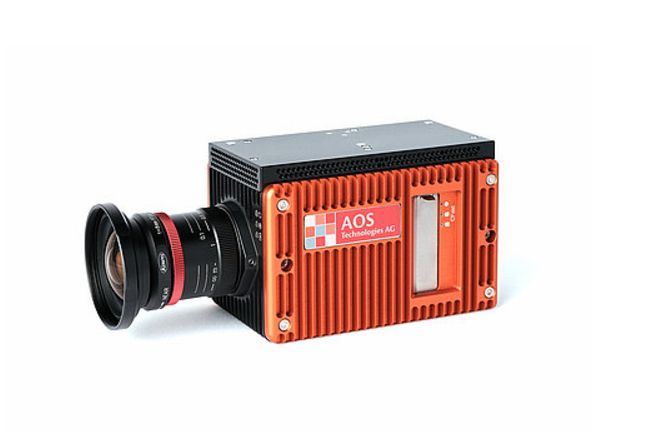
This three-model range comprises the N-EM, Q-EM and S-EM high-speed cameras for demanding mobile, airborne and harsh-environment applications. The N-EM records 1,920 × 1,400 images at 846 fps and increases to 1,096 fps at 1,920 × 1,080, combining Full HD performance with compact dimensions. The Q-EM provides a 2.90 MP image format at 500 fps, while the S-EM uses 14 μm pixels and supports selectable 5-, 8- or 10-bit operation. All three models provide Gigabit Ethernet, removable non-volatile media, internal image memory, IRIG-B timing,
GPIO and rechargeable battery operation. Recording functions include multi-camera synchronisation, pre- and post-trigger acquisition, automatic exposure, motion detection and configurable video outputs. Typical applications include airborne store-separation trials, range and ballistic analysis, on-vehicle recording and industrial research involving vibration, shock or temperature exposure.
Range features
A high level overview of what this range offers
- Three camera configurations: Match resolution, sensitivity, memory capacity and frame rate to the test requirement.
- MIL-STD-810 and MIL-STD-461 testing: Supports integration into systems exposed to environmental stress and electromagnetic interference.
- Progressive CMOS sensors with global shutters: Capture rapidly moving subjects without rolling-shutter distortion.
- Frame-rate scaling through reduced resolution: Record faster events by adjusting the region of interest.
- Internal circular recording buffer: Supports pre-trigger, post-trigger and delayed-trigger acquisition.
- Removable CF or CFast storage: Provides non-volatile retention and transfer of recorded image sequences.
- IRIG-B, trigger, status and synchronisation I/O: Aligns recordings with instrumentation, timing systems and other cameras.
- Built-in rechargeable battery: Provides temporary independent operation or recording-memory backup, depending on the model.
- Gigabit Ethernet interface: Supports camera configuration, live viewing and image transfer over a standard data connection.
- Configurable lens, connector and video options: Helps adapt the cameras to existing pods, vehicles and test equipment.
- Automatic exposure and motion detection: Supports unattended recording and operation under changing light conditions.
- High-G trigger option on the N-EM: Initiates recording in response to a shock event.
What’s in this range?
All the variants in the range and a comparison of what they offer
Range Specification Table
| Specification | Range-level details |
|---|---|
Models | N-EM, Q-EM and S-EM |
Product type | Digital MIL-rated high-speed camera series |
Sensor technology | Progressive CMOS; monochrome or colour versions |
Shutter | Global electronic shutter |
Full-resolution performance | 500 to 846 fps, depending on model and resolution |
Reduced-resolution performance | Up to 131,810 fps, depending on model and selected region of interest |
Pixel size | 6.6 μm, 8 μm or 14 μm |
Image memory | Internal DRAM circular buffer; capacity depends on model |
Non-volatile storage | Removable CFast or CF media |
Data interface | Gigabit Ethernet |
Timing and control | IRIG-B, GPIO, trigger, status and synchronisation signals |
Recording modes | Pre-trigger, post-trigger, delayed trigger and selectable region of interest |
Battery | Built-in rechargeable battery; extended packs available for selected models |
Lens interfaces | C-mount as standard or available; EF- and F-mount adaptation available for selected configurations |
Video output | HDMI, HD-SDI, SDI, digital or PAL/NTSC analogue, depending on model and option |
Environmental framework | MIL-STD-810 environmental and MIL-STD-461 EMI testing; exact revisions and methods vary by model |
Typical applications | Airborne testing, store separation, range and ballistic trials, vehicle testing and harsh-environment research |
Variant Comparison Table
| Specification | N-EM | Q-EM | S-EM |
|---|---|---|---|
Full-resolution frame rate | 846 fps at 1,920 × 1,400 | 500 fps at 1,696 × 1,710 | 500 fps at 1,280 × 1,024 |
Additional frame rate | 1,096 fps at 1,920 × 1,080; 1,530 fps at 1,280 × 720 | 1,546 fps at 1,280 × 720 | 718 fps at 1,280 × 720 |
Resolution | 2.69 MP | 2.90 MP | 1.31 MP |
Maximum reduced-resolution frame rate | 131,810 fps | 100,000 fps | 100,000 fps |
Sensor format | 1-inch | 1-inch | 4/3-inch |
Pixel size | 6.6 μm | 8 μm | 14 μm |
Light sensitivity | ISO 10,000 monochrome; ISO 5,000 colour without gain | ISO 2,000 monochrome; ISO 1,000 colour | ISO 3,200 monochrome; ISO 1,600 colour |
Bit depth | 10-bit monochrome; 30-bit colour output | 8-bit | Selectable 5-, 8- or 10-bit |
Minimum exposure time | 2 μs | 2 μs | 1 μs |
Image memory | 8 or 16 GB | 2.6 GB standard; 5.2 or 10.4 GB optional | 1.3 GB standard; 2.6, 5.2 or 10.4 GB optional |
Example recording duration | 4 seconds with 8 GB or 8 seconds with 16 GB at 1,920 × 1,080 and 1,000 fps | 1.8, 3.6 or 7.2 seconds at full resolution and 500 fps | 2, 4, 8 or 16 seconds at full resolution and 500 fps |
Non-volatile storage | Removable CFast; 64 GB flash storage | Built-in CF interface | Built-in CF interface |
Data interface | Lockable Gigabit Ethernet | Lockable Gigabit Ethernet | Lockable Gigabit Ethernet |
Battery | Rechargeable; up to 10 minutes for operation or memory backup | Rechargeable; 30 minutes, with a two-hour extended pack option | Rechargeable; three-hour extended pack option available |
Power input and consumption | 10–36 V DC; 30 W | 24–36 V DC; 14 W without data link or 18 W with data link | 24–36 V DC; 10 W without data link or 15 W with data link |
Shock resistance | 150 g for 10 ms on all axes; spikes up to 200 g | 100 g for 15 ms on three axes | 100 g for 15 ms on three axes |
Operating temperature | −51 to +49 °C | −45 to +49 °C | −51 to +49 °C |
Storage temperature | −51 to +70 °C | −55 to +80 °C | −51 to +70 °C |
Dimensions without lens or extensions | 75 × 75 × 123 mm | 71 × 71 × 137 mm | 71 × 71 × 137.5 mm |
Weight without lens or extensions | 1.25 kg | 950 g | 900 g |
Lens interface | C-mount; optional EF- or F-mount adapter | C-mount with adjustable back focus; 1-inch lens image circle | C-mount with adjustable back focus; full format requires an image circle larger than 1 inch |
Video output | HDMI or HD-SDI; HD-SDI to SMPTE 292M | Optional SDI digital or PAL/NTSC analogue | Optional SDI digital or PAL/NTSC analogue |
High-G trigger | Available | Not available | Not available |
Automatic exposure and motion detection | Available | Available | Available |
MIL test basis | MIL-STD-461E and MIL-STD-810 methods 500.4, 501.4, 502.4, 503.4, 507.4, 514.5 and 516.5 | MIL-STD-810 and MIL-STD-461 tested | MIL-STD-810 and MIL-STD-461 tested |
N-EM MIL Connector Backplane Options
| Specification | Single-connector version | Dual-connector version |
|---|---|---|
Signal arrangement | Ethernet and discrete I/O carried by one connector | Ethernet and discrete I/O use separate connectors |
Camera-side connector | MS27508E12F35PN | Ethernet: MS27508E10F35PN; discrete I/O: MS27508E12F35PN |
Mating cable-side connector | MS27473T12F35SN | Ethernet: MS27473T10F35SN; discrete I/O: MS27473T12F35SN |
Adapter cable | 2400152-1500 with push-pull connector | Ethernet: 3180001-0500 with RJ45; discrete I/O: 2200214-0050 with push-pull connector |
FAQs
for MIL-rated series high-speed cameras
The selection should be based on the required image format, frame rate and available illumination. The N-EM records 1,920 × 1,400 at 846 fps and 1,920 × 1,080 at 1,096 fps, making it suitable when Full HD analysis must exceed 1,000 fps. The Q-EM provides 2.90 MP at 500 fps and can reach 1,546 fps at 1,280 × 720. The S-EM records 1,280 × 1,024 at 500 fps and uses larger 14 μm pixels where light collection is a central consideration. Engineers should calculate the spatial resolution needed at the subject before selecting a model solely from its maximum frame rate.
All three cameras are identified for MIL-STD-810 environmental and MIL-STD-461 electromagnetic testing, but the complete installation must still be assessed separately. N-EM applies MIL-STD-461E and MIL-STD-810 methods covering altitude, high and low temperature, temperature shock, vibration, mechanical shock and humidity. Its mechanical shock figure is 150 g for 10 ms on all axes, with spikes up to 200 g, while Q-EM and S-EM are rated at 100 g for 15 ms on three axes. These values apply to the camera rather than automatically covering lenses, mounts, cables or external power equipment. Qualification planning should therefore include every installed component and the actual platform vibration spectrum.
Memory should be selected from the required resolution, frame rate, bit depth and duration surrounding the trigger event. N-EM provides four seconds with 8 GB or eight seconds with 16 GB when recording 1,920 × 1,080 at 1,000 fps. Q-EM provides approximately 1.8, 3.6 or 7.2 seconds at full resolution and 500 fps with 2.6, 5.2 or 10.4 GB respectively. S-EM provides approximately 2, 4, 8 or 16 seconds at full resolution and 500 fps across its four memory capacities. Reducing the region of interest or frame rate extends these durations, so test engineers should allow sufficient pre-trigger history as well as post-event recording time.
Hardware synchronisation and IRIG-B should be used when recordings must align with other cameras, sensors or range timing systems. Each model provides synchronisation, trigger, status and GPIO functions, while Gigabit Ethernet handles configuration, live viewing and data transfer. N-EM supports IRIG-B 122–127 AM and 002–007 DCLS for frame synchronisation and time stamping. Q-EM uses IRIG B 122 B2, while S-EM provides IRIG-B timing and a return connection on its I/O interface. For a multi-camera installation, the system design should define the timing master, cable delays, trigger polarity and required timestamp accuracy before wiring is finalised.
Lens selection must account for image-circle diameter, focal length, aperture control and the mechanical mount. N-EM uses a C-mount and can be fitted with EF- or F-mount adapters, including remote focus and aperture control for the EF option. Q-EM has an adjustable-back-focus C-mount, and a 1-inch lens is intended to cover its complete image area. S-EM also uses a C-mount, but its full 1,280 × 1,024 format requires a lens image circle larger than 1 inch; a 1-inch lens covers a reduced 800 × 600 format. Field of view and edge illumination should be verified with the intended resolution and enclosure window before procurement.
External power should remain the primary design basis unless the test requires temporary autonomous operation. N-EM accepts 10–36 V DC at 30 W and provides up to ten minutes of battery operation or memory backup. Q-EM accepts 24–36 V DC, consumes 14 W without the data link or 18 W with it, and provides a 30-minute internal battery with an optional two-hour pack. S-EM uses the same 24–36 V DC input range, consumes 10 or 15 W depending on data-link activity, and offers a three-hour extended pack. Vehicle and airborne installations should include voltage-transient protection, connector derating and enough reserve capacity for download or memory-backup activity after the event.
All three models use Gigabit Ethernet and separate camera-control connections, but the available connector arrangements differ. Standard N-EM connectivity includes a lockable RJ45 data port and a 14-pin I/O connector with trigger, armed, triggered, remote-on, synchronisation, strobe and IRIG-B functions. Its optional MIL backplane can combine Ethernet and discrete I/O in one MS27508E12F35PN connector or separate Ethernet and I/O through two connectors. Q-EM and S-EM use lockable RJ45 data ports and 14-pin LEMO or ODU I/O connector configurations. The selected arrangement should reflect available panel space, service access, cable separation requirements and the connector system already qualified for the platform.
Sensitivity and minimum exposure time determine how effectively the camera can freeze motion under the available lighting. N-EM is rated at ISO 10,000 monochrome and ISO 5,000 colour without gain, with exposure adjustable from 2 μs to one frame period. Q-EM provides ISO 2,000 monochrome and ISO 1,000 colour with a 2 μs minimum, while S-EM provides ISO 3,200 and ISO 1,600 respectively with a 1 μs minimum. Short exposures reduce motion blur but require more light, a wider aperture or increased gain. ISO values should be treated as a starting point because lens transmission, gain setting, colour filtration and scene reflectivity will affect the final exposure margin.