Function & clock generators
- Technology
- Generators
- Partner
- Stanford Research Systems (SRS)
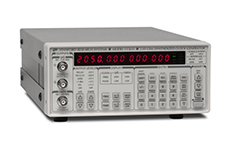
The CG635 and CG792 clock generators provide programmable square-wave timing signals for electronic development, validation and automated testing. The CG635 is a single-channel instrument with 16-digit frequency resolution, adjustable output levels and support for several common logic formats. The CG792 provides two independent channels as standard and can be extended to three or four synchronisable channels. Both models specify less than 1 ps rms jitter across a 1 kHz to 5 MHz measurement bandwidth, together with differential transition times below 100 ps.
Output arrangements cover differential, CMOS and application-specific clocking requirements, while optional timebases support tighter long-term frequency stability. Typical uses include high-speed ADC and DAC clocking, FPGA and ASIC development, serial-data testing, communications equipment validation and multi-instrument synchronisation. Selection depends mainly on whether the application prioritises single-channel frequency resolution and adjustable logic levels or multichannel control, modulation and network-based automation.
Range features
A high level overview of what this range offers
- Frequency coverage up to 2.2 GHz – Supports low-frequency timing tasks and high-speed digital clock applications.
- Less than 1 ps rms random jitter – Helps limit timing-related noise and data uncertainty in sensitive systems.
- Sub-100 ps differential transitions – Provides defined clock edges for high-speed logic and transmission-line testing.
- CG635 16-digit frequency resolution – Allows fine control of clock frequency across a 1 µHz to 2.05 GHz range.
- CG792 two to four synchronisable channels – Supports systems requiring several clocks with controlled phase relationships.
- Differential and CMOS outputs – Accommodates 50 Ω clock paths, standard logic inputs and adjustable-level applications.
- Standard, OCXO and rubidium timebases – Allows stability and ageing performance to be matched to the measurement requirement.
- Phase and modulation functions – Support timing-margin evaluation, jitter injection and susceptibility testing.
- PRBS generation – Enables serial-data and eye-pattern testing without a separate pattern generator in supported applications.
- Remote-control interfaces – Provide integration with laboratory software and automated test equipment.
Downloads
for Function & clock generators
What’s in this range?
All the variants in the range and a comparison of what they offer
Specifications
| Specification | Value |
|---|---|
Product range | CG635 single-channel synthesised clock generator; CG792 two- to four-channel clock synthesiser |
Clock frequency | CG635: 1 µHz to 2.05 GHz; CG792: 1 mHz to 2.2 GHz, or 500 Hz to 2.2 GHz with modulation enabled |
Frequency resolution | CG635: 1 pHz below 10 kHz and 16 digits at or above 10 kHz; CG792: 11 digits |
Number of channels | CG635: 1; CG792: 2 standard, expandable to 3 or 4 |
Random jitter | Less than 1 ps rms, measured from 1 kHz to 5 MHz |
Wander | Less than 20 ps peak-to-peak over 10 s |
Differential transition time | Less than 100 ps, measured from 20% to 80% |
CG635 differential outputs | Complementary BNC outputs from DC to 2.05 GHz; 0.2 V to 1.0 V amplitude; high level adjustable from −2.0 V to +5.0 V; 50 Ω source |
CG635 additional outputs | CMOS BNC to 250 MHz; rear RJ-45 with RS-485 to 105 MHz and LVDS to 2.05 GHz |
CG792 differential outputs | BNC outputs from 1 mHz to 2.2 GHz; 0 V to 1.2 V peak-to-peak; common-mode range from −3.0 V to +2.0 V; 50 Ω source |
CMOS outputs | CG635: DC to 250 MHz with 0.5 V to 6.0 V adjustable amplitude; CG792: 1 mHz to 250 MHz with 0 V and 3.3 V unterminated levels |
Standard timebase stability | Less than 5 ppm |
OCXO timebase stability | Less than 0.01 ppm, Option 02 |
Rubidium timebase stability | Less than 0.0001 ppm, Option 03 |
Timebase ageing | Standard: less than 5 ppm/year; OCXO: less than 0.2 ppm/year; rubidium: less than 0.0005 ppm/year |
External reference input | 10 MHz ±10 ppm; CG635: greater than 0.5 Vpp into 1 kΩ; CG792: 1 Vpp to 3 Vpp into 50 Ω |
Phase control | CG635: ±720° range with sub-20 ps resolution; CG792: ±360° range with channel synchronisation |
CG792 synchronisation | Less than 250 ps absolute accuracy; less than 25 ps repeatability |
CG635 time modulation | External ±5 ns range, 1 ns/V sensitivity and bandwidth from DC to greater than 10 kHz |
CG792 modulation | Internal and external frequency or phase modulation; internal jitter deviation up to 3 ms peak-to-peak |
PRBS | CG635: optional PRBS7 to 1.55 GHz; CG792: built-in PRBS31 to 100 MHz |
Remote interfaces | CG635: GPIB and RS-232; CG792: Ethernet, USB and RS-232 |
Line power | 90 VAC to 264 VAC, 47 Hz to 63 Hz |
Dimensions | CG635: 8.5 × 3.5 × 13 in; CG792: 8 × 3.5 × 13.5 in |
Weight | Less than 9 lb per instrument |
Specification ambient | +20 °C to +30 °C |
CG792 operating environment | +5 °C to +40 °C; up to 80% RH, non-condensing |
Model comparison
| Specification | CG635 | CG792 |
|---|---|---|
Frequency range and resolution | 1 µHz to 2.05 GHz; 16 digits | DC states and 1 mHz to 2.2 GHz; 11 digits |
Number of channels | 1 | 2 standard; 3 or 4 with additional channel options |
Differential output adjustment | 0.2 V to 1.0 V amplitude; −2.0 V to +5.0 V high level | 0 V to 1.2 V amplitude; −3.0 V to +2.0 V common mode |
CMOS output | To 250 MHz; 0.5 V to 6.0 V adjustable | To 250 MHz; fixed 3.3 V unterminated |
Modulation | External time modulation over ±5 ns | Internal and external frequency, phase and jitter modulation |
PRBS | PRBS7 to 1.55 GHz, optional | PRBS31 to 100 MHz, built in |
Remote interfaces | GPIB and RS-232 | USB, Ethernet and RS-232 |
Differential rise and fall times | Less than 100 ps | Less than 100 ps |
CMOS rise and fall times | Less than 1 ns | Less than 1 ns |
Random jitter | Less than 1 ps rms | Less than 1 ps rms |
Wander | Less than 20 ps peak-to-peak | Less than 20 ps peak-to-peak |
Spurious signals | Less than −70 dBc within 50 kHz of the carrier | Less than −70 dBc within 50 kHz of the carrier |
Timebase choices | Standard, OCXO or rubidium | Standard, OCXO or rubidium |
FAQs
for Function & clock generators
Choose the CG635 when the design needs one programmable clock, very fine frequency setting, adjustable CMOS levels or GPIB control. It covers 1 µHz to 2.05 GHz and provides 16-digit resolution above 10 kHz, while the CMOS output can be adjusted from 0.5 V to 6.0 V. Choose the CG792 when two or more related clocks must be generated and synchronised, because it provides two channels as standard and can be extended to four. The CG792 also adds internal and external frequency, phase and jitter modulation, together with Ethernet and USB. In practice, the decision is mainly between single-channel flexibility and multichannel synchronisation with broader automation connectivity.
Both models specify less than 1 ps rms jitter when measured over a 1 kHz to 5 MHz bandwidth. This figure is relevant when clock uncertainty contributes directly to ADC sampling noise, DAC reconstruction noise or the horizontal closure of a serial-data eye. For example, maintaining timing-induced error below half an LSB while digitising a full-scale 10 MHz signal with a 14-bit ADC can require clock jitter below 1 ps. The figure does not include every possible source of system jitter, such as cabling, termination, power noise or the target device itself. Engineers should therefore assess the complete clock path rather than treating the generator specification as the total system result.
Treat the high-speed differential outputs as controlled-impedance transmission-line signals. The CG635 complementary BNC outputs have 50 Ω source impedances and are intended for 50 Ω loads, while its rear LVDS and RS-485 outputs use 100 Ω differential paths over Category-6 cable. The CG792 differential BNC outputs are also specified for 50 Ω loading to ground on both sides. CMOS outputs require different handling: the CG635 CMOS output is intended to drive a high-impedance load through 50 Ω coaxial cable, and a 50 Ω termination halves its programmed level. The CG792 provides 3.3 V when unterminated and approximately 1.6 V with a 50 Ω termination, so the receiving logic threshold must be checked before connection.
Use the standard timebase when a stability figure below 5 ppm is sufficient for the measurement interval and operating environment. The OCXO option tightens stability to below 0.01 ppm, while the rubidium option reduces it to below 0.0001 ppm and also provides lower ageing. At a 1 GHz output, those stability limits correspond to nominal frequency uncertainties of 5 kHz, 10 Hz and 0.1 Hz respectively before other errors are considered. The CG792 specifies approximately 20 minutes of warm-up for the OCXO and one hour for the rubidium timebase. An external 10 MHz reference can instead be used when the clock generator must follow an existing laboratory or system frequency standard.
The CG635 is intended for detailed phase positioning on a single clock and provides a ±720° adjustment range with sub-20 ps phase resolution. The CG792 provides a ±360° phase range on each channel and adds automatic synchronisation between its independent clock channels. Its synchronisation specification is less than 250 ps absolute accuracy with less than 25 ps repeatability. Absolute accuracy describes how closely the final phase relationship approaches the requested value, whereas repeatability indicates how consistently the relationship can be recreated. For multi-clock FPGA, converter or instrumentation systems, the CG792 therefore offers direct channel alignment, while the CG635 is suited to controlled phase adjustment of one primary clock.
The CG635 accepts an external analogue time-modulation signal with a ±5 ns range, 1 ns/V sensitivity and bandwidth extending beyond 10 kHz. This allows controlled movement of clock edges when evaluating sensitivity to phase disturbance or injected jitter. The CG792 supports internal frequency modulation using sine, square, triangle and noise waveforms, with deviation up to 75 ppm of the carrier. It also provides internal jitter modulation up to 3 ms peak-to-peak and an external ±1 V analogue input with a DC to 35 kHz bandwidth for frequency or phase modulation. These functions can be used to establish timing margins, validate recovery behaviour and reproduce controlled clock disturbances during design verification.
The appropriate interface depends on the age and architecture of the test system. The CG635 provides GPIB and RS-232, making it suitable for established automated test platforms that already use IEEE-488 instrumentation. It can store and recall ten complete instrument configurations, which can shorten repeated bench or production setups. The CG792 provides Ethernet, USB and RS-232, with SCPI-based commands and IEEE 488.2 common-command support. Ethernet is useful for networked laboratories and remote racks, while USB provides a direct local connection without a separate GPIB controller. Existing software drivers, required command latency and network security policies should all be reviewed before selecting the interface.
The CG635 offers an optional PRBS7 generator operating to 1.55 GHz, with complementary LVDS clock and data outputs on SMA connectors. This configuration is suited to higher-rate eye-pattern testing where a shorter repeating sequence is acceptable. The CG792 includes PRBS31 generation as a standard function, but its specified maximum PRBS rate is 100 MHz. PRBS31 provides a much longer sequence and can expose pattern-dependent behaviour that may not appear with PRBS7. Selection should therefore be based on the required data rate, sequence length, output connector arrangement and whether the pattern function must be included without an additional option.