M-Pack® Backbone Cable Indoor / Outdoor MDU Drop Cable
- Technology
- Fibre optic cables, connectors and assemblies
- Partner
- Lightera (formerly OFS)
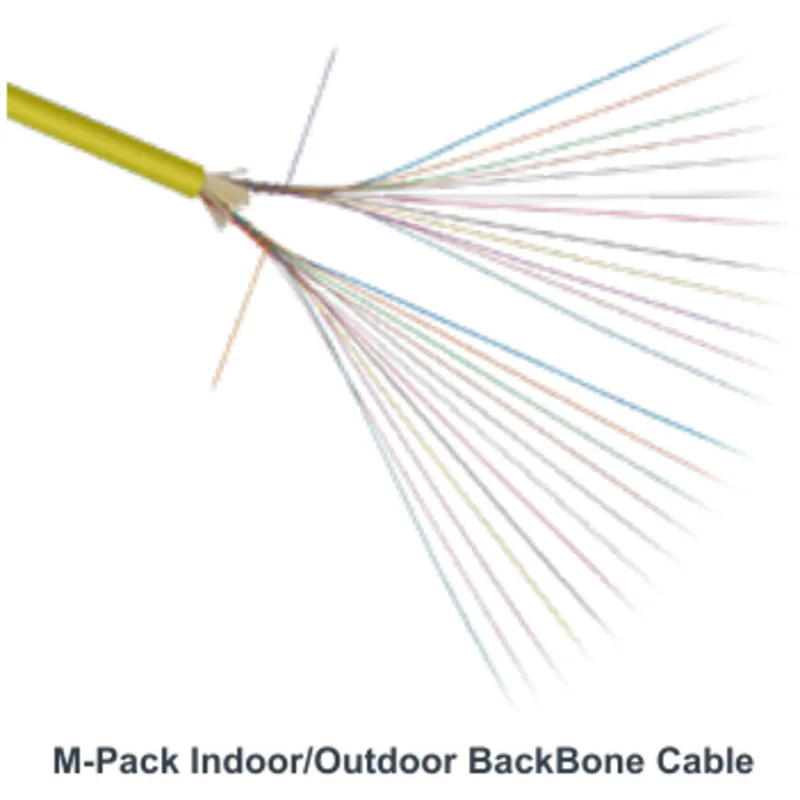
The M-Pack family offers a versatile solution for bringing fibre broadband into buildings and multi-dwelling units. It includes an indoor/outdoor backbone cable for horizontal distribution between telecom closets or data centres, and an MDU drop cable for routing fibre directly into individual flats or living units. Both cables are built to handle outdoor exposure and then continue indoors without transition points – thanks to rugged UV-resistant, water-blocked jackets and full flame-retardant ratings for plenum spaces. This means installers can run fibre from the street right into apartments or offices in one continuous span, saving time and avoiding extra connection joints.
Despite their robust construction, M-Pack cables are notably compact and lightweight, simplifying pulls through conduits and risers. The backbone cable comes in various diameters (as thin as 3.0 mm) and supports fibre counts up to 24, making it ideal for high-density backbones, campus links or data centre trunking with MPO connectors. The MDU drop cable carries single or multiple fibres (up to 24) in a slim profile that can be surface-mounted along walls and even stapled in place for neat indoor wiring. Both cable types feature bend-insensitive fibre technology (utilising ultra-bend optimised single-mode fibre), allowing tight bends around corners and hallway turns without excessive signal loss. Overall, the M-Pack range addresses the needs of modern FTTx deployments by providing reliable, installer-friendly cabling for both the building backbone and the final drop to each subscriber.
Range features
A high level overview of what this range offers
- Indoor/outdoor dual-rating – Each M-Pack cable is certified for outdoor exposure and indoor plenum use, enabling continuous runs from building exterior to interior without requiring transition splices or junction boxes.
- Compact size, high fibre density – Small outer diameters (as low as 3 mm) and options up to 24 fibres maximize duct utilisation and minimise congestion in cable trays or conduits, even in high-density installations.
- Bend-insensitive fibre technology – Incorporates ultra bend-optimised fibre (e.g. G.657.B3) so the cable can route around sharp corners and tight bends with negligible attenuation, simplifying installation in confined spaces.
- Plenum or LSZH jackets – Available with North American plenum-rated (OFNP) jackets or Low Smoke Zero Halogen jackets for international CPR fire safety compliance, ensuring adherence to building codes in various regions.
- Rugged yet lightweight construction – Aramid yarn strength members and robust jackets give the cables high tensile and crush resistance (e.g. drop cable is “staple-ready”), allowing direct fastening to surfaces and pulling through ducts without damage.
- MDU drop cable convenience – The drop variant’s slim, flexible design and water-blocked core allow it to run from an outdoor distribution point straight into apartments or offices, greatly speeding up FTTH/MDU deployments.
- Backbone cable versatility – The backbone cable supports horizontal in-building runs and short outdoor links between buildings, making it suitable for data centre interconnects, campus networks, and central office backbones with reduced cable tray clutter.
- Black or white jacket options – The MDU drop cable comes in either black (for discreet outdoor façade runs) or white (for blending with interior décor), providing aesthetic flexibility in visible installations.
Downloads
for M-Pack® Backbone Cable Indoor / Outdoor MDU Drop Cable
M-Pack® Indoor/Outdoor Backbone & MDU Drop Cable – Datasheet
DownloadWhat’s in this range?
All the variants in the range and a comparison of what they offer
| Specification | M-Pack Backbone Cable | M-Pack MDU Drop Cable |
|---|---|---|
Fibre count options | 2 to 24 fibres (various configurations) | 1 to 24 fibres (depending on version) |
Outer diameter (OD) | 3.0 mm, 3.8 mm, 4.5 mm or 5.4 mm (model-dependent) | 3.0 mm or 3.8 mm (for 12-fibre and 24-fibre versions) |
Weight (approx) | ~8–29 kg/km (depending on diameter & fibre count) | ~9–14 kg/km (for 3.0 mm and 3.8 mm versions) |
Max tensile load | 440 N (100 lb) for smaller variants; up to 660 N (150 lb) for larger variants | 222 N (50 lb) maximum pulling tension (all versions) |
Jacket material & rating | Plenum (OFNP) or LSZH jacket (CPR-rated versions available) | Plenum (OFNP) or LSZH jacket (CPR-rated versions available) |
Operating temperature | Install: -20 °C to 60 °C; Operate: -20 °C to 70 °C; Storage: -40 °C to 70 °C | Install: -20 °C to 60 °C; Operate: -40 °C to 70 °C; Storage: -40 °C to 70 °C |
Fibre type options | Single-mode (bend-optimised G.657.A2/B3) or Multimode OM2/OM3/OM4/OM5 available | Single-mode ultra bend-insensitive (G.657.B3) only (optimised for FTTH) |
Standards compliance | Meets Telcordia GR-409, ICEA S-83-596 / S-104-696 / S-115-730 and TIA-568 requirements (UL OFNP listed; LSZH models CPR compliant) | Meets Telcordia GR-409, ICEA S-83-596 / S-104-696 / S-115-730 and TIA-568 requirements (UL OFNP listed; LSZH models IEC 60332-3C compliant) |
FAQs
for M-Pack® Backbone Cable Indoor / Outdoor MDU Drop Cable
The backbone cable is designed for horizontal trunk runs within or between buildings – it supports higher fibre counts (up to 24 fibres) and offers multiple jacket sizes (3 mm to 5.4 mm) for different infrastructure needs. It’s suited to ladder racks, data centre backbones, and campus links. The MDU drop cable, on the other hand, is a slimmer cable intended to connect the building’s fibre distribution point directly into individual apartments or offices. It has a very compact form (3 mm or 3.8 mm OD) and is optimised for easy routing indoors (even stapling along walls) while still being tough enough for a short outdoor run. In summary, the backbone cable handles distribution between telecom rooms or buildings, whereas the drop cable serves the final leg into each dwelling unit.
Yes. Both the backbone and drop cables are built for indoor/outdoor use, meaning they have UV-stabilised, moisture-resistant outer jackets suitable for exposure to sunlight and weather. They also incorporate water-blocking elements (such as water-swellable aramid yarns) to prevent moisture ingress. While they are not armoured cables, they can be routed externally on building facades or through outdoor ducts for short distances without requiring conduit (beyond local code requirements). For typical fibre-to-the-building scenarios, you can route the M-Pack cable from an external FTTx distribution box into the building directly. Just ensure to follow the recommended installation guidelines (tension limits, bend radius, etc.) for a safe outdoor run.
Both cables use bend-insensitive fibre technology to handle tight bends with minimal signal loss. In the M-Pack drop cable, for example, the single-mode fibre is G.657.B3 compliant (marketed as ultra-bend-insensitive), which can tolerate very small bend radii ideal for in-home routing around corners or door frames. The backbone cable can also be ordered with bend-optimised fibres (G.657.A2/B3 for single-mode or specialized multimode fibers) that allow it to snake through trays and conduits in data centres without high attenuation. This means when you route these cables around sharp corners or in compact panels, the optical performance remains stable and within specifications, avoiding the steep loss that standard fibres would suffer under tight bends.
Yes – both M-Pack cable types come in a plenum-rated version. The standard construction uses an OFNP-rated jacket (Optical Fibre Nonconductive Plenum) which is UL-listed for safe use in building plenum spaces (e.g. above drop ceilings or in air handling zones). This means the cable meets strict fire-resistance and low-toxicity smoke generation requirements for indoor installs. Additionally, for regions requiring LSZH (Low Smoke Zero Halogen) materials, M-Pack cables are offered with LSZH jackets that comply with international fire safety standards (including CPR classifications in the EU). In practice, you choose the jacket type (Plenum or LSZH) based on the local fire code or project preference, and both will allow the cable to be routed inside premises safely.
The M-Pack backbone cable can be configured with a variety of fibre types and counts. It supports single-mode fibres (including ITU G.657.A2/B3 bend-optimised single-mode, which is backward compatible with G.652.D) as well as multimode fibres (OM2, OM3, OM4, OM5 grades for various bandwidth needs). Fibre counts range from as low as 2 fibres up to 24 fibres in one cable. By contrast, the M-Pack MDU drop cable is typically a single-mode cable, since FTTx access networks predominantly use single-mode fibre. It usually features one fibre for a simple drop, but versions with 2, 4, or even 12 and 24 fibres are available to serve multiple units through one cable if needed. This flexibility allows network designers to pick the appropriate cable variant – from a simple one-fibre drop to a high-fibre-count backbone – all within the M-Pack product family.
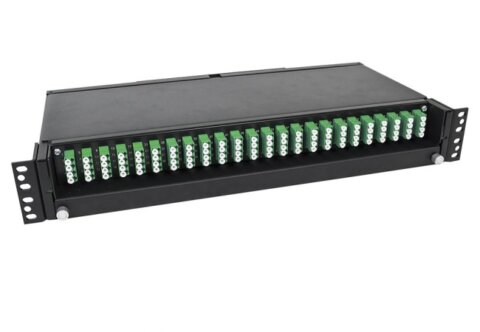
These cables are designed to be installer-friendly when it comes to termination. The backbone cable, with its multiple fibres, is often terminated using multifibre connectors (like MPO/MTP connectors for parallel optics in data centres) or broken out into individual connectors for each fibre. Its construction supports both splicing and connectorisation – you can strip the jacket and buffer tubes relatively easily to access fibres for fusion splicing in a patch panel or splice tray.
The MDU drop cable is a simple tight-buffered design, making field termination straightforward: it can be field-connectorised (for instance, by attaching an SC/APC connector directly to a fibre) or fusion-spliced to a pigtail. Because the drop cable is small and flexible, it’s also easy to route into indoor termination boxes or optical outlets. In practice, technicians often pull the drop cable to the room or unit, then splice its fibre to a pre-terminated lead or mount a connector, completing the last connection to the end user.
Yes. The drop cable is specifically designed for indoor surface runs – it’s “staple-ready”, meaning it has sufficient crush resistance to be gently secured with staples, cable tacks, or clamps to walls, baseboards, or ceilings. Its small size and round profile allow it to be neatly installed along mouldings and corners with minimal visual impact (especially when using the white jacket version on light-colored walls). Unlike many outdoor cables, the M-Pack drop cable doesn’t have messy gels, which facilitates clean indoor work. If you are running it along a wall, you can use standard cable staple guns or clips, taking care not to deform the cable with excessive force. The combination of a robust jacket and aramid strength members protects the optical fibre inside from the minor pressure of such fixings. This makes it very convenient for retrofitting fibre in existing buildings where hiding the cable in-wall isn’t feasible – you can simply surface-mount it neatly up the wall and across ceilings into each unit.
The M-Pack backbone cable is ideal for in-building backbones (connecting equipment racks, servers, or telecom closets on different floors) and for short-range campus links (e.g. between adjacent buildings in a business or residential complex). It’s also a great fit for data centre cabling, where its small size helps route many fibres through trays and its bend tolerance supports high-density patching. The M-Pack MDU drop cable is targeted at fibre-to-the-premises deployments, especially in MDUs or multi-floor office buildings – anywhere you need to take a fibre from an outdoor feed into multiple units. Typical use cases include running from a hallway distribution hub to individual flats, from an outdoor distribution point through the wall into a customer’s apartment, or even within a riser shaft to connect several apartments on different floors. In summary, the backbone cable covers the intermediate distribution, and the drop cable covers the final leg to each end user – together addressing the full range of indoor/outdoor fibre installation scenarios in FTTx networks.