FB2M5LRR 650 nm 10-250 MBd 50-80 m LC POF Transceiver
- Technology
- Fibre optic transceivers
- Partner
- Firecomms
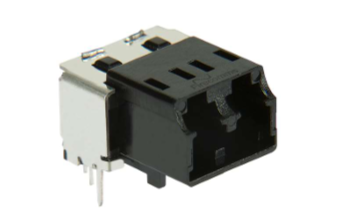
The FB2M5LRR duplex fibre-optic transceiver is designed for short-range data communication over plastic optical fibre. It offers a convenient LC duplex connector interface, making it easy to plug in standard POF cable assemblies for immediate optical links. Supporting data speeds from low-rate control signals up to 250 MBd (suitable for Fast Ethernet and other high-speed protocols), this module is versatile for both legacy systems and modern networks. Engineers can deploy it in industrial environments to replace copper connections and benefit from the immunity to electromagnetic interference and inherent galvanic isolation that optical fibre provides. The transceiver’s visible red 650 nm emitter helps with quick visual confirmation of an active link during installation and troubleshooting.
Built for reliability, it operates across a wide -40 °C to +85 °C temperature range, ensuring dependable performance in harsh or fluctuating conditions. Its compact, board-mounted package runs on a single 3.3 V supply and integrates easily into equipment, making the FB2M5LRR a practical solution for robust data communication in factories, vehicles, and other demanding applications.
Range features
A high level overview of what this range offers
- Standard LC duplex connector – Uses a two-fibre LC interface for full-duplex POF links, allowing quick and secure attachment of plastic fibre cables using off-the-shelf LC plug assemblies.
- 10–250 MBd data rate – Wide bandwidth supports low-speed control signals up to high-speed data (including 100 Mb/s Fast Ethernet), giving flexibility to accommodate legacy protocols and modern network needs.
- Visible 650 nm RCLED emitter – High-speed resonant-cavity LED source provides reliable optical transmission at 250 MBd and emits a red light that aids in alignment and link verification during installation.
- Optical link immunity – Fibre-optic communication is inherently immune to EMI and eliminates ground loops, ensuring noise-free signal integrity and safe isolation between devices in electrically noisy environments.
- Industrial temperature range – Rated for -40 °C to +85 °C operation, suitable for use in harsh industrial settings or outdoor applications where extended temperature tolerance is required.
- 3.3 V logic-level interface – Transmit and receive signals use standard 3.3 V CMOS/TTL levels, enabling direct connection to microcontrollers, FPGAs or other digital circuits without the need for external line drivers or level translators.
- Compact board-mount module – The transceiver’s small through-hole package is easy to integrate onto PCBs, simplifying system design and allowing straightforward inclusion of optical links in equipment.
Downloads
for FB2M5LRR 650 nm 10-250 MBd 50-80 m LC POF Transceiver
What’s in this range?
All the variants in the range and a comparison of what they offer
| Specification | Value |
|---|---|
Optical wavelength | 650 nm (visible red) |
Optical emitter | Resonant Cavity LED (RCLED) |
Optical receiver | PIN photodiode (integrated) |
Data rate | 10 MBd – 250 MBd (up to ~125 Mb/s throughput) |
Link distance | ~50 m typical (up to ~80 m at lower data rates) |
Fibre type | 1 mm core plastic optical fibre (step-index) |
Connector | LC duplex (IEC 61754-20 standard) |
Supply voltage | 3.3 V DC (single supply) |
Interface logic | 3.3 V CMOS/TTL digital I/O |
Operating temp. | -40 °C to +85 °C (industrial range) |
Mounting | PCB through-hole module (board mount) |
Compliance | RoHS compliant; UL 94 V-0 flame-retardant housing; Class 1 eye safety (IEC 60825-1) |
FAQs
for FB2M5LRR 650 nm 10-250 MBd 50-80 m LC POF Transceiver
It uses a duplex LC connector specifically designed for plastic optical fibre. The transceiver accepts standard LC duplex plugs that terminate 1 mm core POF cables (with ~2.2 mm outer diameter). This means you can plug in a twin-core POF patch cable with LC connectors to carry transmit and receive signals.
Yes. The FB2M5LRR is capable of supporting Fast Ethernet data rates. It can handle the 125 MBd signalling required for 100Base-FX Ethernet. In typical conditions it achieves around 50 metres of link length at 100 Mb/s over standard step-index POF, which covers many short-distance networking needs on factory floors or inside vehicles.
Under typical conditions the module supports about 50 metres of plastic fibre link at the highest data rate. In favourable conditions – for example, at lower baud rates or with excellent fiber quality and alignment – it can reach up to roughly 80 metres. Keep in mind that the maximum distance depends on the data rate and optical attenuation: slower signals or lower loss fibre runs can achieve the longer end of the range, whereas pushing 250 MBd may limit the reach to around 50 m to maintain a reliable link.
The transceiver offers standard 3.3 V logic-level interfaces for both its transmitter input and receiver output. In practice, this means you can drive the transmit pin directly from a microcontroller’s GPIO or communication port (with a 3.3 V CMOS/TTL signal), and the receive pin will output a 3.3 V digital signal that your controller or FPGA can read. No external optic driver or differential line interface is required – the module’s internal circuitry conditions the LED and photodiode signals to be compatible with typical digital electronics.
Using POF with an optical transceiver has several advantages in industrial and automotive contexts. First, optical fibre is immune to electromagnetic interference, so your data signal won’t be disturbed by electrical noise from machines, motors or radio sources. Second, the fibre link provides galvanic isolation between the two ends – there is no metal conduction, which eliminates ground potential differences and any risk of sparks or short circuits. Additionally, POF is lightweight and easy to install in tight spaces, and it isn’t prone to corrosion or electrical shorting. Overall, a POF link enhances reliability and safety for data communications in harsh electrical environments compared to conventional copper wiring.
Yes. The FB2M5LRR is a duplex transceiver, meaning it contains both a transmitter and a receiver. With the LC duplex fibre connection (two strands of POF), it can send and receive data simultaneously. One fiber carries outgoing light signals while the other carries incoming signals. This allows full-duplex communication, so data can flow in both directions at the same time, just like a standard Ethernet fiber link.
No – the FB2M5LRR is optimised for plastic optical fibre and should be used with POF cables. The optical design (including the LED wavelength and coupling optics) is matched to the large core (1 mm) and numerical aperture of POF. Standard glass fibres (such as multimode fibre with 50/125 µm core or single-mode fibre) are not compatible with this transceiver; they would not couple efficiently to the 650 nm source and would severely limit the link performance. For best results, use the intended POF medium with the appropriate LC connectors that fit the module’s interface.