ClearLite® 1310/1550 nm 0.16 NA Optical Fibre
- Technology
- Speciality fibre
- Partner
- Lightera (formerly OFS)
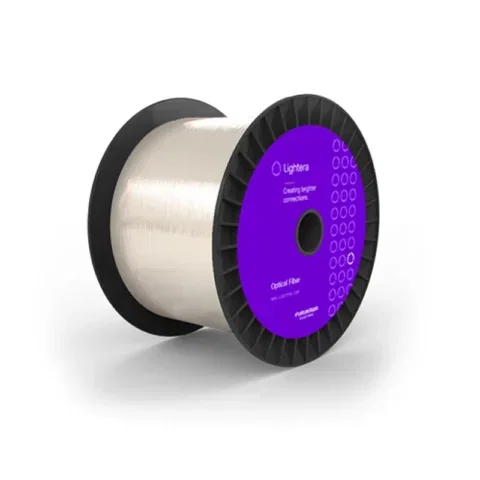
The ClearLite® 1310/1550 nm 0.16 NA Optical Fibre is a specialty single-mode optical fibre engineered for efficient operation at both the 1310 nm and 1550 nm wavelength bands. With a moderate numerical aperture of 0.16, it balances light confinement and acceptance to deliver reliable performance even under tight bending conditions. The fibre is protected by a dual UV acrylate coating that provides robust mechanical protection for harsh environments while remaining easy to strip and handle. This design is particularly suited for applications where fibres must be coiled in small diameters or subjected to mechanical compression. It performs well in fused WDM couplers, optical tap devices, and compact integrated modules that require tightly wound fibre with minimal loss.
The fibre is also commonly used in CATV optical distribution equipment and other photonic systems that demand stable low-loss transmission in confined spaces. Overall, the combination of dual-wavelength flexibility, high NA, and rugged construction makes this fibre well-suited for advanced optical components deployed in challenging conditions.
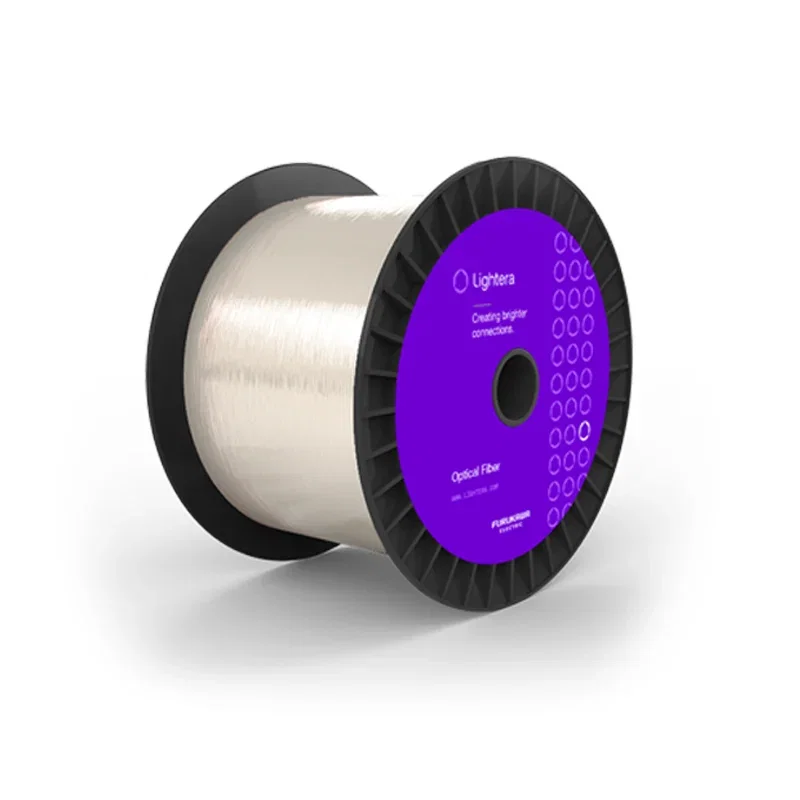
ClearLite® 1310/1550 nm 0.16 NA Optical Fibre is designed for single-mode transmission at both 1310 nm and 1550 nm while maintaining dependable performance in space-constrained optical assemblies.
Its 0.16 numerical aperture supports improved bend tolerance and efficient coupling, making it well suited for tightly coiled configurations used in couplers, tap devices, integrated photonic modules, and CATV optical distribution systems.
The dual UV acrylate coating adds mechanical robustness for harsh environments while preserving straightforward handling, stripping, and integration into demanding optical component designs.
Range features
A high level overview of what this range offers
- Dual 1310 nm and 1550 nm operation – Supports both standard telecom wavelength windows in a single fibre for flexible system design.
- 0.16 numerical aperture – Enables higher light acceptance and improved bend tolerance for compact optical packaging.
- Dual UV acrylate coating – Provides durable mechanical protection for harsh environments while remaining easy to strip and handle.
- High mechanical strength – Proof tested to ≥ 200 kpsi (1.38 GPa) to reduce risk during installation and use.
- Tight bend capability – Suitable for bends down to 5 mm short-term and 9 mm long-term for compact routing.
- Low attenuation at 1310 nm – Delivers ≤ 0.75 dB/km to help maintain efficient transmission.
- Wide operating temperature range – Designed for reliable use from –40 °C to +85 °C.
Downloads
for ClearLite® 1310/1550 nm 0.16 NA Optical Fibre
What’s in this range?
All the variants in the range and a comparison of what they offer
| Specification | Value |
|---|---|
Product Description | ClearLite® 1310/1550 nm 0.16 NA Optical Fibre (Single-Mode) |
Coating Material | Dual UV Acrylate |
Core Diameter (nominal) | 6.0 µm |
Cladding Diameter | 125 ± 1 µm |
Coating/Buffer Diameter | 250 ± 10 µm |
Clad Non-Circularity | ≤ 2.0 % |
Core/Clad Offset | ≤ 0.5 µm |
Type | Single-Mode |
Operating Wavelength | 1310 nm and 1550 nm |
Cutoff Wavelength | ≤ 1290 nm |
Mode Field Diameter @ 1310 nm | 6.7 ± 1.0 µm |
Mode Field Diameter @ 1550 nm | 7.5 ± 1.0 µm |
Attenuation @ 1310 nm | ≤ 0.75 dB/km |
Numerical Aperture (NA) | 0.16 |
Operating Temperature | –40 °C to +85 °C |
Short-Term Bend Radius | ≥ 5 mm |
Long-Term Bend Radius | ≥ 9 mm |
Proof Test Level | ≥ 200 kpsi (1.38 GPa) |
Order by Part Number | F9001 |
Product Description Code | SMB-D1310B |
Options (Customisable) | Buffer colour, Buffer material, Buffer size, Cutoff wavelength, Metallization, Proof test, Termination |
FAQs
for ClearLite® 1310/1550 nm 0.16 NA Optical Fibre
This single-mode fibre is commonly used in optical components that require small bend radii and dual-wavelength operation. Typical applications include fused fibre couplers such as WDM couplers and tap couplers, tightly coiled fibre modules in integrated photonic devices, and CATV optical distribution equipment. Its low-loss performance under tight bending makes it a strong fit for compact optical modules and coupler assemblies.
A numerical aperture of 0.16 allows the fibre to accept light at a wider angle than many standard telecom fibres. This improves bend tolerance and can make alignment and coupling easier during device assembly. In practical use, it helps the fibre maintain low loss when coiled into small diameters for dense optical packaging.
The dual UV acrylate coating uses two UV-cured polymer layers to protect the glass fibre. This structure helps resist micro-bending, abrasion, and environmental stress such as humidity, while still allowing straightforward stripping for splicing or termination. It combines rugged protection with installer-friendly handling.
The short-term bend radius of ≥ 5 mm indicates how tightly the fibre can be bent briefly during handling or installation without excessive loss or damage. The long-term bend radius of ≥ 9 mm is the recommended minimum for continuous service, helping preserve long-term reliability and stable attenuation performance.
A 200 kpsi proof test means each fibre has been tensile-tested to withstand at least 200,000 psi, equivalent to about 1.38 GPa of stress. This indicates strong mechanical integrity and a reduced likelihood of failure during cabling, installation, or operation under tension.
Yes. Available customisation options include buffer colour, buffer material, buffer size, cutoff wavelength, metallization, proof test level, and termination. These options allow the fibre to be adapted for specific environmental, mechanical, or integration requirements.
The cutoff wavelength marks the threshold below which the fibre may support multiple modes. With a cutoff wavelength of ≤ 1290 nm, the fibre operates in single-mode behaviour at both 1310 nm and 1550 nm, helping ensure stable signal quality and avoiding higher-order mode propagation in its intended operating range.
Yes. The fibre uses a 125 µm cladding diameter, which matches the standard size used by most single-mode optical fibres. That makes it compatible with common fusion splicing equipment, sleeves, connectors, and related fibre handling tools used in standard optical assembly workflows.