HCS® 400 µm 0.43 NA Step-Index Low OH Optical Fibre
- Technology
- Speciality fibre
- Partner
- Lightera (formerly OFS)
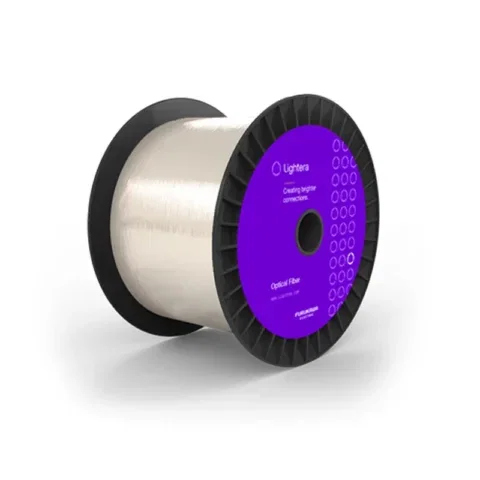
This 400 µm Hard-Clad Silica (HCS) optical fibre is designed for robust performance in demanding industrial and technical applications. It features a polymer-clad silica core that provides high mechanical strength and bend tolerance, allowing the fibre to maintain signal integrity even when routed through tight spaces. With its 0.43 NA step-index design, the fibre can capture and transmit light from LEDs and lasers at wide angles, simplifying alignment and improving coupling efficiency. The silica core is manufactured with low hydroxyl (Low OH) impurity levels, resulting in low attenuation especially at near-infrared wavelengths such as 850 nm. This makes it suitable for data links and sensing over longer distances than standard high-OH fibres. Typical applications include industrial data communication, optical sensors, spectroscopy instruments, and laser light delivery in medical or scientific equipment. The tough polymer coating protects the large core from abrasions and chemicals while also supporting simple crimp-and-cleave field termination. This helps enable quick and reliable connector installation on-site without epoxy or polishing.
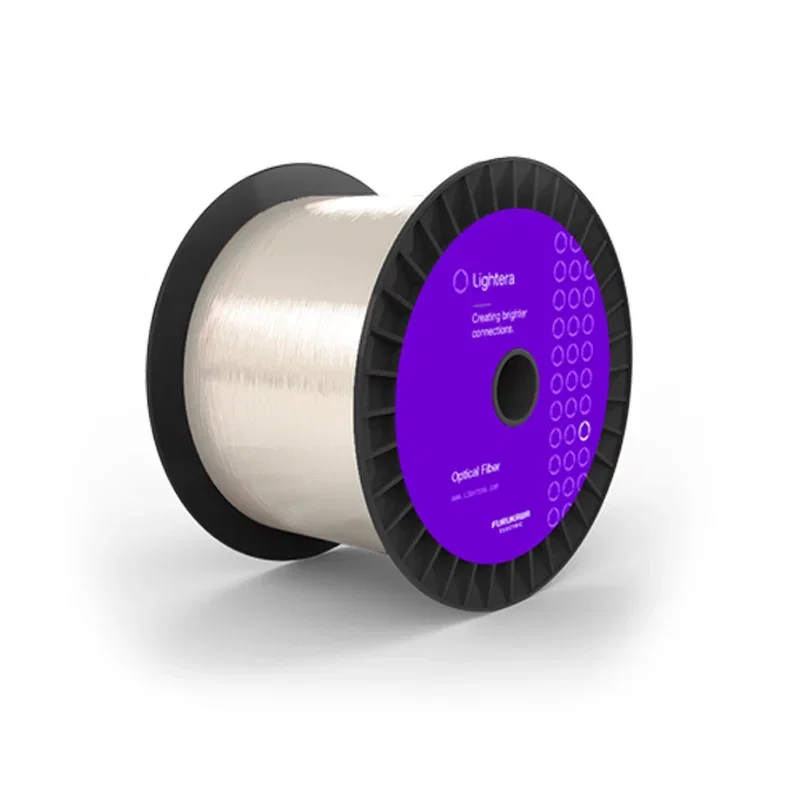
The HCS® 400 µm 0.43 NA Low OH optical fibre is engineered for applications that need high light capture, rugged handling, and dependable performance in harsh environments. Its large 400 µm silica core and hard polymer cladding combine the optical advantages of glass with the durability and field practicality of a polymer-clad construction.
This fibre is well suited to industrial communications, sensing, spectroscopy, and laser light delivery, especially where installers benefit from easy coupling, flexible routing, and fast crimp-and-cleave termination.
Range features
A high level overview of what this range offers
- Large 400 µm core: Supports high light throughput and easier coupling with LEDs and laser diodes.
- High 0.43 numerical aperture: Accepts light over a wide angle for simpler alignment and reliable signal capture.
- Low OH silica core: Reduces attenuation in the near-infrared range, including typical use around 850 nm and 1060 nm.
- Hard polymer cladding: Improves resistance to bending, crushing, and twisting in demanding installations.
- Bend-tolerant design: Helps preserve optical performance when routing through tighter spaces.
- ETFE buffer protection: Offers durability against abrasion, oils, solvents, and many industrial chemicals.
- Wide operating temperature range: Designed for use from -65 °C to +125 °C.
- Crimp & Cleave termination: Enables fast, epoxy-free field connectorisation with basic tools.
- Long service life: Rugged materials and construction help reduce maintenance and replacement frequency.
Downloads
for HCS® 400 µm 0.43 NA Step-Index Low OH Optical Fibre
HCS® 400 µm 0.43 NA Low OH Optical Fibre – Datasheet
DownloadWhat’s in this range?
All the variants in the range and a comparison of what they offer
Category | Specification |
Product Description | 400 µm core, 0.43 NA, Low OH Step-Index Fibre |
Core Diameter | 400 ± 8 µm |
HCS® Cladding Diameter | 430 +5/–10 µm |
Cladding Material | Hard-Clad Silica polymer (fluoroacrylate) |
ETFE Buffer Diameter | 730 ± 30 µm |
Buffer Material | ETFE (thermoplastic polymer) |
Crimp & Cleave Compatible | Yes (supports field crimp termination) |
Core/Clad Offset | ≤ 8.0 µm |
Fibre Type | Multimode Step-Index (glass core) |
Numerical Aperture (NA) | 0.43 (High NA, wide acceptance angle) |
Attenuation @ 850 nm | ≤ 8 dB/km (typical, low-OH for NIR) |
Water Content | Low OH (low hydroxyl content silica) |
Operating Temperature | -65 °C to +125 °C |
Short-Term Bend Radius | ≥ 29 mm |
Long-Term Bend Radius | ≥ 47 mm |
Proof Test Level | ≥ 100 kpsi (0.689 GPa) |
Order by Part Number | CF05578-03 |
Description Code | HCP-M0400T |
Options Available | Buffer Colour, Buffer Diameter, Buffer Material, Proof Test level, and other customisations on request |
Specification notes
- All dimensions are nominal.
- Low OH indicates optimisation for visible to near-infrared use, approximately 600–1100 nm.
- A High OH version is available for UV–visible applications.
- Bend radius values are the minimum recommended radii to avoid excessive loss or long-term damage.
FAQs
for HCS® 400 µm 0.43 NA Step-Index Low OH Optical Fibre
HCS fibres use a hard polymer cladding over a silica glass core rather than an all-glass cladding structure. This makes them mechanically tougher and more resistant to bending and crushing in practical use. It also enables simple crimp-and-cleave termination, allowing fast connector attachment without epoxy. In short, HCS fibre combines the optical advantages of a silica core with the ruggedness and easier handling of a polymer-clad design.
Low OH means the silica core contains reduced hydroxyl ion content. Lower hydroxyl levels help reduce absorption losses in the near-infrared region, making the fibre better suited to wavelengths such as 850 nm and 1060 nm. This supports longer transmission distances or improved signal strength in data communication and sensing applications compared with high-OH alternatives.
A 0.43 NA allows the fibre to accept light over a wide cone angle. This makes it easier to couple light from LEDs or laser diodes, even when alignment is not perfect. It also helps the fibre perform more reliably in installations where some bending or source divergence is expected, giving greater flexibility in system design.
Yes, it can be used with common connector styles such as ST, SC, FC, or SMA, provided compatible components for 400 µm polymer-clad fibre are used. The fibre supports Crimp & Cleave termination, where the connector is crimped onto the cladding after buffer stripping and the fibre end is then cleaved flush. This avoids epoxy and polishing, making field termination faster and simpler.
This type of large-core step-index multimode fibre is typically used for moderate-speed, short-distance communications, analog transmission, sensing, and light delivery rather than high-speed long-haul networking. It is well suited to industrial links, instrumentation, proprietary sensor systems, and applications that benefit from a large core and robust handling. It can also be used for visibly aligned laser light or illumination in scientific and medical equipment.
The fibre is designed for demanding conditions, with hard polymer cladding and an ETFE buffer that help protect against abrasion, mechanical stress, and many industrial chemicals. It also supports operation across a wide temperature range of -65 °C to +125 °C. Combined with bend radius guidance for both short-term and long-term use, this makes it a strong choice for factory, outdoor, and heavy-duty technical environments.
Not exactly. POF usually has an all-plastic core and is intended for shorter distances and lower-performance links. This HCS fibre uses a silica glass core, which provides lower attenuation and better signal quality over longer distances, while the polymer cladding still adds mechanical toughness. It effectively sits between typical POF and conventional glass fibre in terms of handling and performance.
Yes. The fibre can be jacketed, bundled, or incorporated into custom cable assemblies as needed. Its robust construction and optional buffer variations make it adaptable for different harnessing or identification requirements. When integrating it into assemblies, installers should still follow the specified bend radius and load limits to maintain optical and mechanical performance.
Although HCS fibres are easier to handle than many smaller telecom fibres, good fibre practices still apply. Avoid bends tighter than the recommended bend radius, use proper stripping tools during termination, and ensure a clean cleave for best optical performance. If signal quality drops, inspect and clean connectors and end faces with suitable fibre optic cleaning tools. Under normal operating conditions, the fibre requires minimal maintenance.