CP-124MCMC-E 1490 nm DFB 20 km CSFP Dual Transceiver
- Technology
- Fibre optic transceivers
- Partner
- Coretek
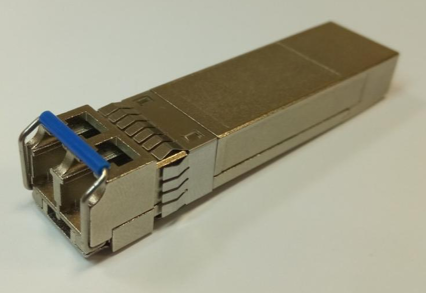
The CP-124MCMC-E CSFP dual transceiver is designed for high-density fibre-optic networks that require maximum port efficiency in space-constrained systems. It fits into a standard SFP slot but contains two bidirectional optical channels, effectively doubling the number of Gigabit links per port. Each channel operates on a single-mode fibre using wavelength-division multiplexing (1490 nm for transmit and 1310 nm for receive), which halves the fibre count compared to conventional dual-fibre links.
With support for link distances up to 20 km, this module is ideal for metro access networks, FTTx deployments, and other long-reach Gigabit Ethernet applications. It features an industrial temperature range (-40 °C to +85 °C) and digital diagnostic monitoring, ensuring reliable operation in outdoor cabinets and harsh environments with real-time link health feedback. Compliant with the Compact SFP MSA and Gigabit Ethernet standards, the CP-124MCMC-E can be seamlessly integrated into existing network equipment (with host support for dual-channel SFP) to increase capacity without additional fibre infrastructure.
Range features
A high level overview of what this range offers
- Dual-channel compact design – Houses two full-duplex 1.25 Gbps transceivers in one module, doubling fibre port density per slot
- Bidirectional WDM operation – Uses 1490 nm/1310 nm on each channel to send and receive over one fibre, reducing fibre cabling by 50%
- Up to 20 km reach per link – Supports long-distance Gigabit connections (10–20 km) suitable for metro and access network needs
- Industrial temperature range – Reliable performance from -40 °C to +85 °C, making it suitable for outdoor and industrial installations
- Digital diagnostics (DDMI) – Real-time monitoring of key parameters (Tx/Rx power, temperature, voltage) for proactive network maintenance
- Hot-pluggable SFP form factor – Easy installation and swap-out under power, simplifying upgrades and minimising downtime
- Standard LC duplex interface – Uses a common LC duplex connector (two fibres for two channels) for convenient integration with existing single-mode fibre infrastructure
Downloads
for CP-124MCMC-E 1490 nm DFB 20 km CSFP Dual Transceiver
What’s in this range?
All the variants in the range and a comparison of what they offer
| Specification | CP-124MCMC-E Dual CSFP Module |
|---|---|
Form factor | Compact SFP (CSFP), dual-channel module |
Data rate per channel | 1.25 Gbps (Gigabit Ethernet) |
Wavelengths (Tx/Rx) | Tx: 1490 nm (DFB laser); Rx: 1310 nm |
Reach (maximum) | 20 km over single-mode fibre |
Channels | 2 independent bidirectional links |
Fibre type | Single-mode fibre (SMF), one core per channel |
Connector | LC duplex (carries 2× SMF links) |
Digital diagnostics | Yes (SFF-8472 compliant monitoring) |
Operating temperature | -40 °C to +85 °C (industrial grade) |
Power supply | 3.3 V DC, <1.5 W typical consumption (estimated) |
Standards compliance | CSFP MSA Option 2; SFP MSA; IEEE 802.3 (1000BASE-BX) |
Laser safety | Class 1 laser product (IEC 60825-1 compliant) |
FAQs
for CP-124MCMC-E 1490 nm DFB 20 km CSFP Dual Transceiver
A CSFP transceiver like the CP-124MCMC-E can carry two independent links in the space of one, effectively doubling the port density. This means network devices can support more fibre connections without adding extra slots or hardware, which is highly beneficial in space-constrained environments.
Internally, the module contains two separate transmitter/receiver pairs with integrated WDM filters. Each pair operates at 1490 nm and 1310 nm on its own fibre, allowing two full-duplex data channels to run through a single compact module. The host system interfaces with the module’s dual channels through a specialised CSFP connector and pin assignment.
Each channel uses a separate single-mode fibre. The module’s LC duplex connector accommodates two fibre cores — one for each channel. On each fibre, data is sent and received simultaneously (bidirectionally) using the two wavelengths. This design halves the fibre count per link compared to traditional dual-fibre solutions, but you still need one fibre per channel.
The CP-124MCMC-E uses a standard duplex LC connector. It mates with two single-mode fibres (SMF), each carrying one channel. Because it’s a bidirectional module, each of those fibres handles both transmit and receive signals (using 1490 nm and 1310 nm wavelengths). Single-mode fibre is required to achieve the specified reach (up to 20 km).
Yes, in terms of optical and protocol standards, it supports 1000BASE-BX Gigabit Ethernet over single-mode fibre. However, to fully utilise both channels, the host device must support compact SFP modules (CSFP Option 2). In a standard SFP slot that doesn’t recognize dual-channel operation, only one channel may function. When used in compatible switches or optical line terminals designed for CSFP, it will operate transparently for network protocols.
Yes. The CP-124MCMC-E includes digital diagnostics (DDMI) as per SFF-8472. This allows the host to monitor parameters such as each channel’s optical transmit power, receive power, module temperature, supply voltage, and bias current via the I²C management interface. These real-time diagnostics help with preventative maintenance and troubleshooting by providing insight into the transceiver’s performance and health.
Absolutely. This module is rated for an industrial temperature range of -40 °C to +85 °C, meaning it can operate reliably in extreme cold or hot conditions. It’s suitable for outdoor telecom cabinets, roadside units, or factory settings. The robust design and extended temperature components ensure stable performance even under harsh environmental conditions.
Dual-channel BiDi transceivers are commonly used in telecom and networking scenarios where fibre resources and space are limited. Examples include FTTx deployments (such as fibre-to-the-home (FTTH) systems), metropolitan-area networks, mobile backhaul equipment, and high-density switches in data centres or central offices. By using the CP-124MCMC-E, network operators can double their link count in existing chassis slots and reduce fibre runs, making it a cost-effective solution for expanding network capacity without major infrastructure changes.