HCS® 300 µm 0.37 NA Low OH Optical Fibre
- Technology
- Speciality fibre
- Partner
- Lightera (formerly OFS)
The HCS® 300 µm 0.37 NA Low OH Optical Fibre is a robust Hard-Clad Silica multimode fibre engineered for reliable use in industrial, medical, and scientific applications. It combines a 300 µm core diameter with polymer cladding for improved mechanical strength and easier handling compared with standard all-glass fibres. Its 0.37 numerical aperture supports efficient light capture from LEDs and lasers over a wide acceptance angle, simplifying alignment and reducing system complexity. The low-OH pure silica core helps minimise attenuation at near-infrared wavelengths, making the fibre effective at 650 nm and 850 nm as well as across a broader spectral range. The durable construction is suitable for harsh conditions, including exposure to bending, crushing, and industrial chemicals. It operates across a wide temperature range from -65°C to +125°C. The fibre also supports fast crimp-and-cleave field termination without epoxy or polishing. This makes it well suited to factory automation, short-range data communication, fibre optic sensing, spectroscopy, and laser delivery systems.
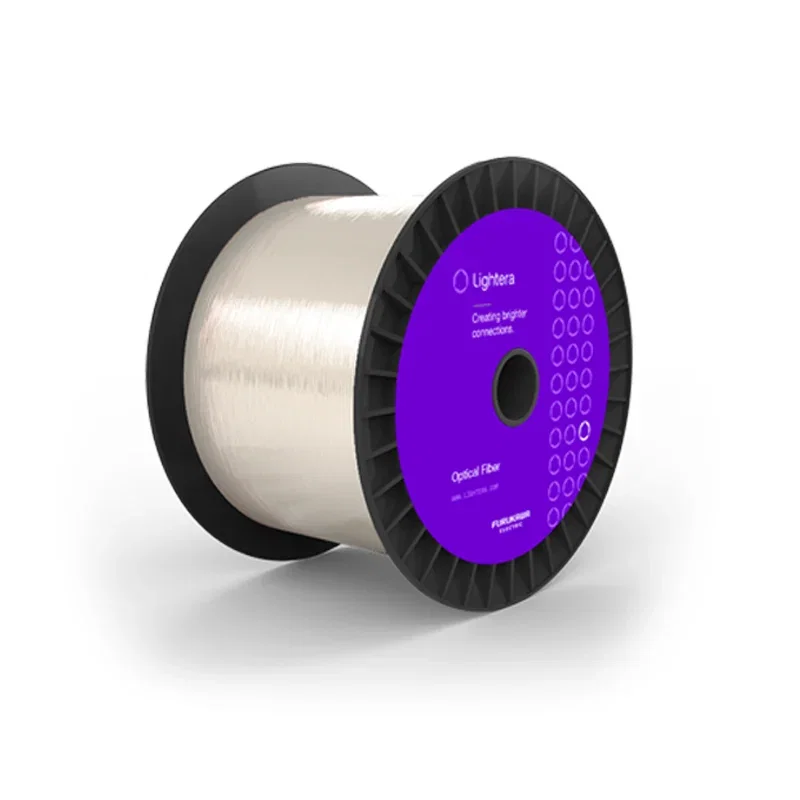
The CF01493-11 HCS 300 µm 0.37 NA Low OH Optical Fibre is a rugged multimode Hard-Clad Silica fibre developed for applications where optical performance and mechanical durability are equally important. Its large 300 µm core and high 0.37 NA make coupling from LEDs and lasers easier, while the low-OH silica core supports efficient transmission at 650 nm and 850 nm.
With polymer cladding and an ETFE buffer, this fibre is easier to handle than fragile all-glass alternatives and is suitable for industrial routing, sensing setups, spectroscopy systems, and harsh-environment installations. A major practical advantage is its crimp-and-cleave termination capability, enabling fast field connectorisation without epoxy or polishing.
Range features
A high level overview of what this range offers
- High mechanical strength: Withstands installation stress and repeated handling, helping reduce fibre breakage risk.
- Bend-insensitive performance: Maintains low signal loss during tighter routing in compact installations.
- Crimp-and-cleave termination: Enables quick on-site connector installation without epoxy or polishing.
- Chemical resistance: Suitable for industrial environments where exposure to solvents or harsh chemicals may occur.
- Wide operating temperature range: Performs from -65°C to +125°C for cold and high-heat applications.
- Crush and twist resilience: Durable construction supports stable operation under mechanical stress.
- Long-term reliability: Designed for dependable optical performance over extended service life.
- Easy handling: Thick polymer cladding and ETFE buffer simplify stripping, routing, and installation.
Downloads
for HCS® 300 µm 0.37 NA Low OH Optical Fibre
HCS 300 µm Low OH Optical Fibre – Datasheet
DownloadWhat’s in this range?
All the variants in the range and a comparison of what they offer
Parameter | Value |
Product Description | 300 µm 0.37 NA Low OH |
Core Diameter | 300 ± 6 µm |
HCS® Cladding Diameter | 330 +5/–10 µm |
ETFE Buffer Diameter | 650 ± 30 µm |
Core/Clad Offset | ≤ 6.0 µm |
Crimp & Cleave Compatible | Yes |
Cladding Material | HCS fluoroacrylate polymer |
Buffer Material | ETFE |
Fibre Type (Profile) | Multimode Step-Index |
Numerical Aperture (NA) | 0.37 |
Attenuation @ 850 nm | ≤ 8 dB/km |
Water Content | Low OH (low hydroxyl) |
Operating Temperature | –65 to +125 °C |
Short-Term Bend Radius | ≥ 15 mm |
Long-Term Bend Radius | ≥ 24 mm |
Proof Test Level | ≥ 150 kpsi (1.03 GPa) |
Order by Part Number | CF01493-11 |
Description Code | HCP-M0300T |
Options | Buffer Colour, Buffer Diameter, Buffer Material, Proof Test |
FAQs
for HCS® 300 µm 0.37 NA Low OH Optical Fibre
Low OH means the silica core contains a low level of hydroxyl ions. This matters because OH impurities absorb light at certain infrared wavelengths. A low-OH fibre therefore shows reduced attenuation in the near-infrared range, helping it transmit signals at 850 nm and beyond with lower loss. In practical use, this supports efficient transmission across a broad spectrum for visible and NIR light sources.
This fibre is optimised for 650 nm and 850 nm operation. Its low-OH pure silica core also supports useful transmission further into the short-wavelength infrared range, making it suitable for visible red light and broader NIR applications.
An HCS fibre uses a polymer cladding bonded to the silica core instead of a conventional glass cladding. This improves toughness, flexibility, and handling compared with standard all-glass fibres. It also allows simpler field termination using crimp-based methods rather than epoxy, curing, and polishing.
A 0.37 NA allows the fibre to accept light over a wider angle. This makes coupling from LEDs and lasers easier, reduces alignment sensitivity, and supports more forgiving installation. It also helps with bend performance in practical routing conditions.
The fibre is designed for rugged use with an operating range of -65°C to +125°C, strong resistance to crushing, twisting, and flexing, and good tolerance to industrial chemicals. Its ETFE buffer and hard polymer cladding help protect the fibre in challenging industrial and environmental conditions.
This fibre supports crimp-and-cleave termination, allowing fast field installation without epoxy or polishing. A compatible connector is crimped onto the fibre and the protruding fibre is then cleaved flush. This simplifies installation and repair work in the field using basic hand tools.
Typical applications include factory automation networks, short-range data links, PLC/SCADA systems, fibre optic sensing, spectroscopy instruments, and laser delivery systems. It is especially useful where easy alignment, high coupling efficiency, and mechanical durability are important.
The recommended short-term bend radius is ≥ 15 mm, while the long-term bend radius is ≥ 24 mm. Keeping within these limits helps minimise bend-related attenuation and mechanical stress, preserving performance and service life.