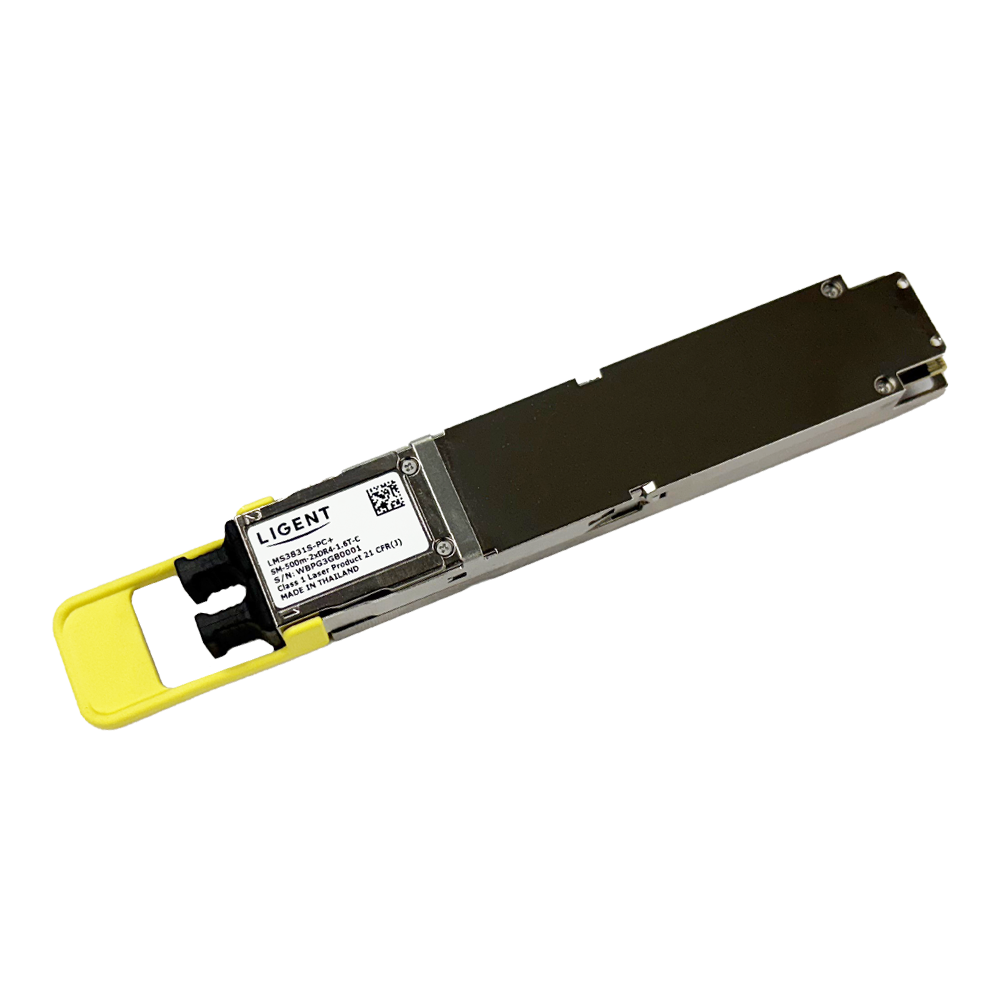
LMS3831S-PC+ OSFP Transceiver 8x200G DR8 500m
- Technology
- Fibre optic transceivers
- Partner
- Ligent
The LMS3831S-PC+ is an 800G OSFP optical transceiver module designed for next-generation data centre and high-performance computing networks. It supports 800 Gigabit Ethernet links over single-mode fibre distances of up to 500 m (using host-side KP4 FEC), making it ideal for interconnecting switches, routers, and server clusters within campuses or large data halls. The module utilises eight parallel optical lanes (PAM4-modulated, ~106.25 Gbps each) operating around 1310 nm to deliver an aggregate 800 Gb/s throughput. On the transmit side, it integrates advanced EML lasers (CWDM wavelengths in the 1310 nm band) with a PAM4 re-timer ASIC and driver arrays, while the receive side employs PIN photodiodes and transimpedance amplifiers for each channel – ensuring reliable high-speed signal conversion.
The dual MPO-12 optical interface simplifies fibre cabling by handling the eight fibre pairs through two connectors. Fully compliant with the OSFP MSA and IEEE 802.3ck/802.3cu standards, this hot-pluggable module assures interoperability across compatible 800G network equipment. It also features built-in digital diagnostics monitoring (DDM), giving network engineers real-time insight into key parameters like optical power, temperature, and voltage for proactive management and optimisation of link performance.
Range features
A high level overview of what this range offers
- 800G over 500 m SMF with host FEC – Supports 800 GbE links up to 500 metres on single-mode fibre (with KP4 forward error correction), allowing reliable high-throughput connections within data centres.
- Dual MPO-12 optical connectors – Uses two MPO-12 ports to carry eight fibre channels, simplifying parallel fibre management and enabling straightforward breakout to multiple lower-rate links if needed.
- Multi-rate operation – Capable of supporting various data rates or breakout configurations (in addition to 800G aggregate), offering flexibility for different network architectures and future scalability.
- 1310 nm EML transmitters – Utilises electro-absorption modulated laser sources on the CWDM 1310 nm wavelength band, providing efficient optical transmission for each channel and compatibility with standard single-mode fibre.
- PIN photodiodes with TIA arrays – High-speed PIN receivers and integrated 4-channel TIA amplifier arrays on the receive side deliver sensitive optical detection and signal amplification for stable performance across all lanes.
- PAM4 DSP and pre-emphasis – Integrated PAM4 re-timer and programmable output equalisation ensure signal integrity by minimising distortion and jitter, resulting in reliable high-speed electrical interfaces to the host device.
- Power consumption < 16 W – Designed to operate within a 16 W power envelope, fitting standard OSFP power constraints and reducing heat output for easier cooling in dense network hardware.
- Commercial operating temp 0–70 °C – Rated for a 0 to 70 °C case temperature range, suitable for typical indoor data centre environments and ensuring consistent performance under normal operating conditions.
- Safety and compliance – Meets key certifications (TUV, UL, FDA) for laser safety and quality, and is RoHS compliant, affirming the module’s adherence to international safety standards and environmental regulations.
Downloads
for LMS3831S-PC+ OSFP Transceiver 8x200G DR8 500m
What’s in this range?
All the variants in the range and a comparison of what they offer
| Parameter | Value |
|---|---|
Form factor | OSFP (800G hot-pluggable optical module) |
Total data rate | 800 Gbps (Gigabit Ethernet, full-duplex) |
Optical lanes | 8 × 100 Gbps (PAM4 per lane) |
Wavelengths | 1310 nm CWDM (8-channel parallel) |
Reach distance | Up to 500 m over SMF (with KP4 FEC) |
Optical connectors | Dual MPO-12 (single-mode fibre, APC polish) |
Transmitter lasers | EML (Electro-Absorption Modulated Lasers) |
Receiver detectors | PIN photodiode arrays with TIAs |
Power consumption | < 16 W |
Power supply voltage | 3.3 V DC nominal (OSFP standard) |
Operating case temperature | 0 °C to +70 °C (commercial range) |
Protocol / standards | OSFP MSA; IEEE 802.3ck / 802.3cu (800GBASE-DR8) |
Digital diagnostics | Supported (real-time monitoring via I²C) |
Safety certifications | IEC/EN 60825 (Laser Class 1); TUV, UL, FDA compliant |
RoHS compliance | Yes (RoHS 6) |
FAQs
for LMS3831S-PC+ OSFP Transceiver 8x200G DR8 500m
“DR8” denotes an 800 GbE short-reach specification using 8 parallel optical lanes at 1310 nm. In practical terms, the LMS3831S-PC+ uses eight fibres (via two MPO-12 connectors) to deliver 800 Gbps over single-mode fibre. It’s a short-range (500 m) solution requiring host FEC, as opposed to longer-reach variants (like FR or LR) that use fewer wavelengths over longer distances.
Yes, in many cases 800G DR8 optics can be broken out into dual 400G DR4 links. Since an 800G DR8 transceiver has eight 100G lanes (split across two MPO-12 connectors), it can connect to two separate 400G DR4 transceivers (each using four lanes) with the appropriate MPO-to-MPO breakout cable. Each group of four lanes will form a 400G link, provided the host hardware and cabling support this split and the proper FEC is in place for each 400G channel.
Yes. The 800G DR8 module is designed to operate with KP4 FEC on the host (switch or NIC). The host-generated RS(544,514) FEC helps to achieve error-free transmission over 500 m by correcting errors introduced in the high-speed PAM4 signal. The transceiver expects the host to provide this FEC encoding/decoding as per the IEEE 802.3ck standard for 800GAUI-8 interfaces.
It uses single-mode fibre (SMF), typically standard G.652.D (9/125 µm) duplex fibres. The transceiver has dual MPO-12 APC connectors, each carrying 4 transmit and 4 receive fibre lanes (8 fibres per connector). To deploy it, you’ll use two 12-fibre MPO patch cables (angled polished for low reflection) connecting the module to your patch panel or directly to another module or breakout harness.
These modules are aimed at very high-bandwidth interconnects inside data centres and large-scale computing environments. Common use cases include connecting core switches, routers, or director-class Ethernet equipment within a data hall, as well as clustering high-performance computing or AI/ML systems where multiple 100G/400G links can be aggregated. The 500 m reach covers most intra-building links, such as between racks or adjacent rooms in a data centre campus.
The transceiver is primarily intended for 800 GbE operation, but it is multi-rate capable. This means it could potentially support breakout configurations or lower aggregates, such as operating as 2 × 400 GbE or 8 × 100 GbE, if the host system and networking gear are configured accordingly. In practice, any multi-rate support (like using fewer lanes or reduced data rates) would depend on the host port’s capabilities and firmware – the module itself can handle various lane configurations as long as they conform to the supported electrical interface standards.
OSFP modules including this one are designed with an integrated heat-sink and must be used in systems with adequate cooling and airflow. The LMS3831S-PC+ has a maximum power draw of under 16 W, which is within the OSFP specification for cooling. Network equipment typically provides forced-air cooling over the module slots; as long as the host chassis is designed for 800G optics and not over-populated beyond its cooling capacity, it will maintain the module’s case temperature within the 0–70 °C range. It’s also hot-swappable, so it can be inserted or removed without shutting down the system, but you should ensure the cage is clear of dust and that airflow isn’t obstructed to allow proper heat dissipation.
Yes, this transceiver supports digital diagnostic monitoring accessible via the I²C-based management interface. It can report real-time metrics such as transmitter and receiver optical power levels, module temperature, supply voltage, and TX bias currents for each laser. These DDM readings allow operators to monitor link health and performance, and the host system can raise alarms if any parameter goes out of the specified range, aiding in preventative maintenance and troubleshooting.