CT-0155TSP-KBBL-E 1550 nm DFB 200 km SFP Transceiver w. DDMI
- Technology
- Fibre optic transceivers
- Partner
- Coretek
The CT-0155TSP-KBBL-E is a Small Form-Factor Pluggable (SFP) optical transceiver module built for ultra-long reach communications over single-mode fibre. It utilises a 1550 nm DFB laser to support fibre spans up to 200 km, far beyond typical SFP ranges, without the need for intermediate repeaters. Equipped with digital diagnostics, the module allows engineers to monitor key parameters like optical power and module temperature in real time for proactive maintenance. Its extended operating temperature (-40°C to +85°C) ensures reliable performance in harsh environments such as outdoor installations, industrial sites, or power substations.
Fully compliant with the SFP MSA (Multi-Source Agreement), it can be seamlessly integrated into standard SFP ports on compatible networking or teleprotection equipment. This transceiver is particularly suited for 2 Mb/s links (IEEE C37.94) used in utility communications, teleprotection systems, and other specialised low-rate, long-haul data connections where distance and reliability are paramount.
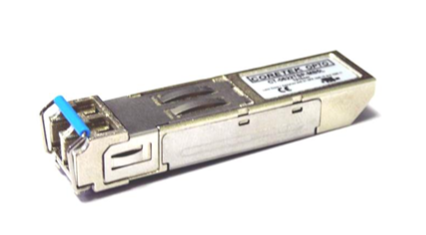
Range features
A high level overview of what this range offers
With a high-power 1550 nm DFB laser, extended -40°C to +85°C design, and digital diagnostics (DDMI), this transceiver provides ultra-long 200 km reach and reliable performance for critical remote communications.
- 200 km reach over single-mode fibre – Enables very long-distance communications without repeaters, suitable for connecting remote sites or substations
- 1550 nm DFB laser technology – Provides low fibre attenuation and stable output, ensuring minimal signal loss over extended links
- Digital Diagnostics (DDMI) – Allows real-time monitoring of TX/RX power, temperature, and voltage for proactive maintenance and quick fault isolation
- Extended temperature range (-40°C to +85°C) – Industrial-grade design for reliable operation in extreme cold, heat or outdoor environments
- MSA-compliant SFP form factor – Standard hot-swappable module fits any MSA-compatible SFP slot, allowing easy integration and replacement without downtime
- Duplex LC optical connector – Uses a common duplex LC interface for convenient fibre patching and compatibility with standard single-mode fibre cabling
- RoHS and Class 1 laser compliant – Meets environmental regulations (RoHS) and laser safety standards (IEC 60825 Class 1), ensuring safe operation and global compliance
- IEEE C37.94 support – Designed to interface with 2.048 Mb/s C37.94 optical links, ensuring compatibility with teleprotection and legacy multiplexer systems in power utilities
Downloads
for CT-0155TSP-KBBL-E 1550 nm DFB 200 km SFP Transceiver w. DDMI
What’s in this range?
All the variants in the range and a comparison of what they offer
| Parameter | Value |
|---|---|
Part Number | CT-0155TSP-KBBL-E |
Form Factor | SFP (Small Form-Factor Pluggable) |
Data Rate | 2.048 Mb/s (IEEE C37.94 standard) |
Transmission Distance | Up to 200 km (single-mode fibre) |
Tx Wavelength / Laser | 1550 nm (DFB laser) |
Rx Detector | APD photodiode (high-sensitivity receiver) |
Optical Connector | Duplex LC |
Digital Diagnostics | Yes (DDMI support) |
Operating Temperature | -40°C to +85°C (extended industrial range) |
Supply Voltage | 3.3 V DC |
Optical Output Power | 0 to +5 dBm |
Receiver Sensitivity | ≤ -36 dBm (for BER < 1×10⁻⁹) |
FAQs
for CT-0155TSP-KBBL-E 1550 nm DFB 200 km SFP Transceiver w. DDMI
This transceiver is targeted at specialised long-distance links that operate at around 2 Mb/s. A typical use case is teleprotection and substation communications in the power utility industry, where the IEEE C37.94 standard is used to connect protective relays over fibre. It can also be used in other legacy PDH/SDH telecommunication systems or any application that requires a low-rate data link bridging very long distances (hundreds of kilometres) over single-mode fibre.
The CT-0155TSP-KBBL-E uses a combination of a high-quality 1550 nm DFB laser with relatively high optical output power and an APD (Avalanche Photodiode) receiver with very high sensitivity. At 1550 nm, fibre attenuation is low, which helps minimise signal loss over distance. The low 2 Mb/s data rate greatly reduces the impact of dispersion in the fibre, so the signal can travel farther without degradation. Thanks to these factors, and assuming low-loss single-mode fibre and good splices/connectors, the module can span up to 200 km without optical amplification. It essentially provides a very large optical power budget, allowing extremely long runs between sites.
Mechanically and electrically, it is an MSA-compliant SFP module, so it will fit in any standard SFP slot. However, the host device must support the 2.048 Mb/s data rate and associated framing (IEEE C37.94 or similar) for the transceiver to function correctly. Unlike common SFPs for Gigabit Ethernet or OC-3, this module is designed for a much lower bitrate. Many general network switches or routers do not support 2 Mb/s SFP links, so this transceiver is typically used in specialised equipment (such as teleprotection terminals, multiplexers, or interface converters) that are built for C37.94 or PDH optical interfaces. Always check that your device can handle a 2 Mb/s SFP before deployment.
This module supports DDMI (Digital Diagnostic Monitoring Interface) functions as per the SFP standard. It can report real-time information on parameters such as transmit optical power, receive optical power, laser bias current, supply voltage, and module temperature. Engineers can access these readings via the host device to facilitate troubleshooting and to monitor link health over time. For example, you can set up alarms if the received optical power drops or if the module temperature exceeds a threshold, which helps in preventive maintenance of the fibre link.
IEEE C37.94 is a standard defining optical communications at 2.048 Mb/s for protecting power systems equipment (often used to connect teleprotection relays to multiplexers). A transceiver compliant with C37.94 will support the specific data rate and optical characteristics required by these protective relay systems. In practical terms, it means this SFP can plug into devices using the C37.94 protocol and provide a compatible optical link. It ensures interoperability – for instance, you can use this module to link a protection relay on one end to a C37.94 interface on a communications multiplexer on the other end, and they will communicate reliably. The transceiver’s design (including jitter performance and latency) meets the needs of teleprotection signals, which often have strict timing requirements.
Yes. The CT-0155TSP-KBBL-E is specified for an industrial temperature range from -40°C to +85°C. This means it’s built with components that can withstand extreme cold in winter and high heat in summer, as well as the temperature swings in outdoor enclosures. It’s suitable for use in outdoor cabinets, roadside telecom huts, substations, or factory floors. The module’s robust design ensures stable performance even in environments with wide temperature variation, which is crucial for reliability in mission-critical infrastructure.
The 1550 nm wavelength is chosen for long-distance fibre links because it has lower optical attenuation in standard silica fibre compared to shorter wavelengths (like 1310 nm). This means signals at 1550 nm can travel farther before the fibre’s loss significantly weakens them. Additionally, a DFB (Distributed Feedback) laser provides a narrow spectral width and stable wavelength, which helps minimise chromatic dispersion over long spans. DFB lasers also typically can output higher power than simple FP lasers. Together, these characteristics make a 1550 nm DFB laser ideal for an ultra-long reach module – it delivers a strong, stable optical signal that can propagate 200 km with minimal dispersion and loss. In short, using a 1550 nm DFB laser is key to achieving the extended reach and reliability required for this product’s target applications.
Despite its high optical power and long reach, the transceiver is classified as a Class 1 laser product, meaning it’s eye-safe under normal operating conditions (no harmful accessible laser radiation). It adheres to IEC 60825-1 laser safety standards and relevant FDA 21 CFR regulations. The module is also designed to meet typical EMI/EMC standards (such as FCC Part 15 Class B and EN55022) so that it won’t interfere with other equipment and can be deployed in both industrial and residential environments. Additionally, the unit is RoHS compliant, indicating it’s manufactured without hazardous substances. All these compliance measures ensure that the transceiver can be safely and legally integrated into communication systems worldwide.