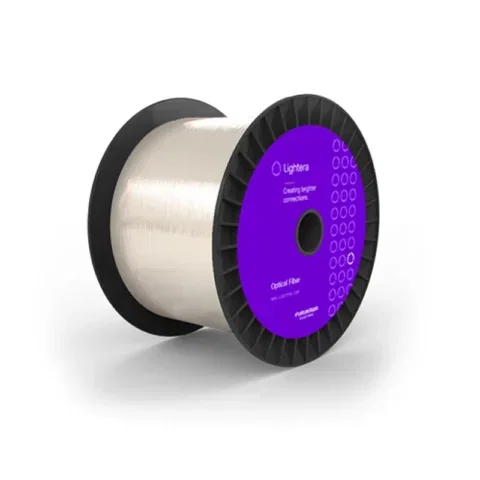
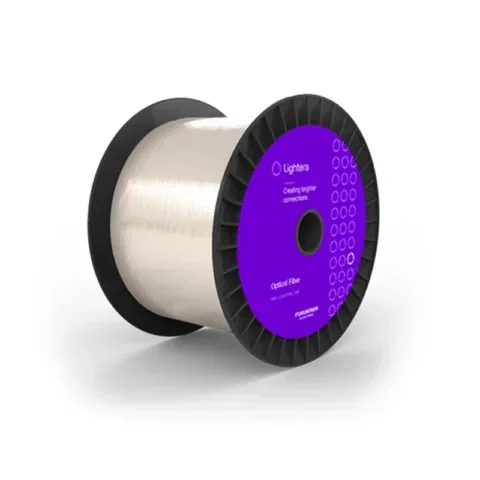
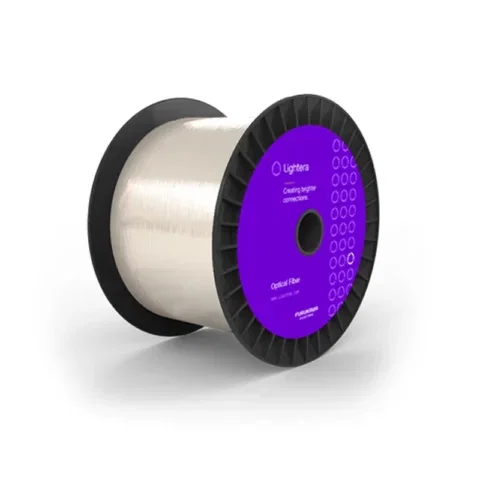
ClearLite® 1550 nm 0.17 NA Optical Fibre
- Technology
- Speciality fibre
- Partner
- Lightera (formerly OFS)
The BF06158 ClearLite 1550 nm 0.17 NA Single-Mode Optical Fibre is a specialty telecom-grade fibre designed for efficient signal transmission at 1550 nm. Its nominal 0.17 numerical aperture supports strong light confinement and improved coupling characteristics for demanding photonic systems. The longer cut-off wavelength design helps deliver better bend tolerance than standard single-mode fibres, making it suitable for compact routing and tightly wound fibre coils.
A dual UV acrylate coating protects the glass and supports reliable handling in challenging environments. With a standard 125 µm cladding diameter, the fibre integrates easily with common connectors and fusion splicing equipment. Typical applications include optical sensor systems, fibre-optic payout and coil assemblies, medical imaging devices, and WDM couplers. The product is also available with custom buffer, proof test, metallisation, and termination options for specialised integration needs.
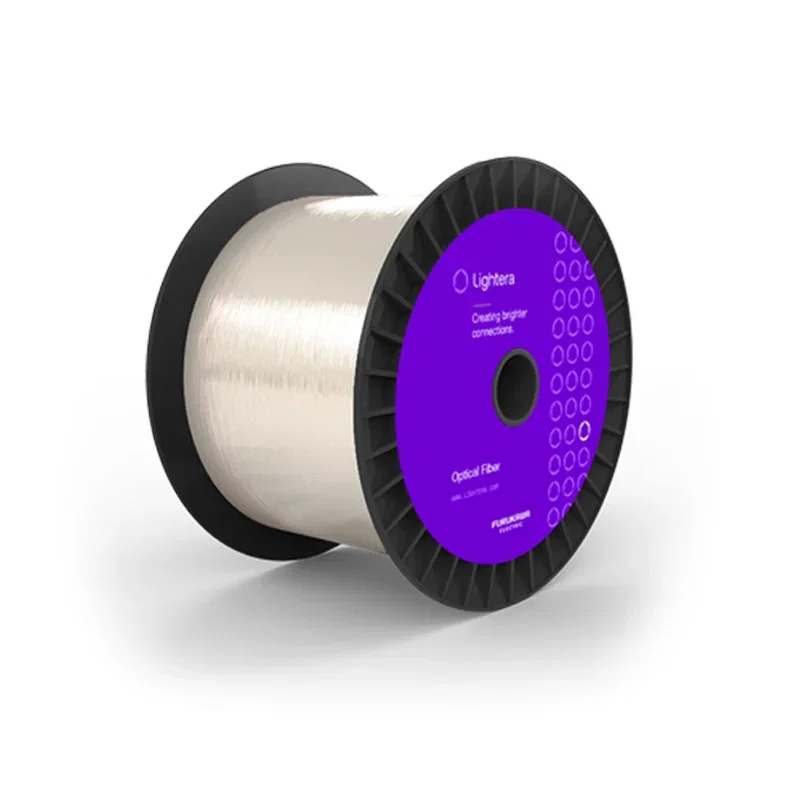
The BF06158 ClearLite® 1550 nm 0.17 NA Single-Mode Optical Fibre is engineered for high-performance transmission at the 1550 nm telecom window. It combines single-mode guidance, improved bend tolerance, and durable dual acrylate protection in a format that remains compatible with standard fibre handling and interconnection processes.
This makes it a strong choice for compact photonic assemblies, precision sensor systems, fibre coils, medical devices, and WDM-related components where dependable optical performance and mechanical reliability are both essential.
Range features
A high level overview of what this range offers
- Optimised for 1550 nm operation: Supports single-mode performance at a key telecom wavelength used in C-band systems, sensors, and photonic assemblies.
- Nominal 0.17 numerical aperture: Helps improve coupling behaviour and supports better bend tolerance in compact fibre routing.
- Longer cut-off wavelength design: Enables tighter coiling and improved bend performance with minimal additional loss compared with standard single-mode fibre.
- Dual UV acrylate coating: Protects the fibre against mechanical and environmental stress for dependable long-term use.
- Standard 125 µm cladding diameter: Simplifies integration with conventional connectors, stripping tools, and fusion splicing equipment.
- High proof test level: Rated at ≥ 100 kpsi for strong mechanical reliability during installation and operation.
- Customisable options: Available with different buffer materials, colours, sizes, metallisation, proof test levels, and terminations for application-specific requirements.
Downloads
for ClearLite® 1550 nm 0.17 NA Optical Fibre
ClearLite 1550 nm 0.17 NA Optical Fibre – Datasheet
DownloadWhat’s in this range?
All the variants in the range and a comparison of what they offer
Specification | Value |
Product Description | ClearLite 1550 nm 0.17 NA Optical Fibre |
Physical Characteristics | |
Coating Material | Dual UV Acrylate |
Core Diameter (Nominal) | 6.5 µm |
Cladding Diameter | 125 ± 2 µm |
Coating/Buffer Diameter | 245 ± 15 µm |
Clad Non-Circularity | ≤ 2.0% |
Core/Clad Offset | ≤ 0.75 µm |
Optical Characteristics | |
Type | Single-mode |
Operating Wavelength | 1550 nm |
Cut-off Wavelength | ≤ 1500 nm |
Mode Field Diameter @ 1550 nm | 7.5 ± 0.75 µm |
Attenuation @ 1550 nm | ≤ 0.6 dB/km |
Numerical Aperture (Nominal) | 0.17 |
Mechanical and Environmental | |
Operating Temperature | –40 to +85 °C |
Short-Term Bend Radius | ≥ 10 mm |
Long-Term Bend Radius | ≥ 17 mm |
Proof Test Level | ≥ 100 kpsi (0.689 GPa) |
Order by Part Number | BF06158 |
Product Description Code | SMB-E1550B |
Options | Buffer Colour, Buffer Material, Buffer Size, Cut-off Wavelength, Metallisation, Proof Test, Termination |
FAQs
for ClearLite® 1550 nm 0.17 NA Optical Fibre
A nominal numerical aperture of 0.17 allows the fibre to accept light over a wider angle than many standard single-mode fibres. This can improve coupling efficiency from light sources or other fibres and helps maintain signal integrity when the fibre is bent or routed through compact assemblies.
This fibre is designed with a longer cut-off wavelength and slightly higher NA, which together improve bend tolerance compared with conventional telecom fibres. It can tolerate short-term bends down to 10 mm radius, while a 17 mm radius is recommended for long-term use, helping reduce attenuation in tightly coiled or compact systems.
The fibre is optimised for operation around 1550 nm and intended to be single-mode in that region. Because the cut-off wavelength is around 1500 nm, operation at 1310 nm would not maintain the intended single-mode performance, so it is best used in the 1550 nm window.
It uses a dual UV acrylate coating with a softer inner layer and a tougher outer layer. This combination helps protect the glass from micro-bends, abrasion, moisture, and handling stress while remaining compatible with standard stripping, splicing, and termination processes.
Yes. The fibre can be supplied with a range of custom options including different buffer materials, colours, sizes, metallisation, proof test levels, and end terminations. This flexibility helps tailor the product to specific integration, environmental, or performance requirements.
A proof test level of ≥ 100 kpsi means the fibre has been tensile-tested to confirm strong mechanical integrity. In practical terms, this provides confidence that the fibre can withstand normal installation and operational stresses with a reduced risk of failure caused by tensile loading.
The specified minimum short-term bend radius is 10 mm, while the minimum long-term bend radius is 17 mm. Short-term values apply to temporary handling or installation, whereas the long-term value should be respected for continuous service to minimise stress and excess loss.
Yes. With a standard 125 µm cladding diameter and conventional acrylate coating, the fibre is compatible with common connectors and standard fusion splicing processes. It can be stripped, cleaved, spliced, and connectorised using typical single-mode fibre tools and methods.
Yes. Its improved bend performance, 1550 nm optimisation, and moderate 0.17 NA make it well suited to fibre-optic sensors, tightly wound coils, and WDM coupler assemblies. These characteristics help support efficient coupling, compact routing, and reliable optical performance in precision photonic applications.