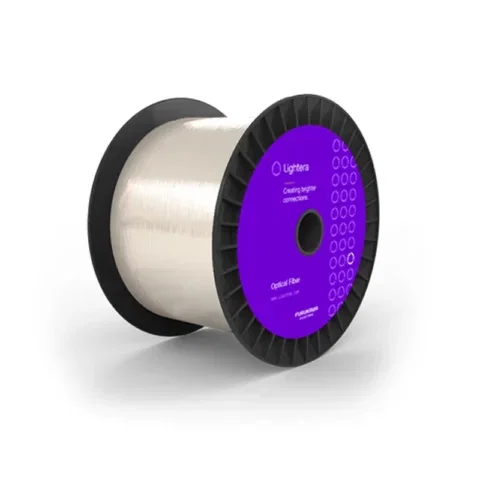
105/125 µm Multi-mode 0.15 NA Step-Index Low OH Launch Optical Fibre
- Technology
- Speciality fibre
- Partner
- Lightera (formerly OFS)
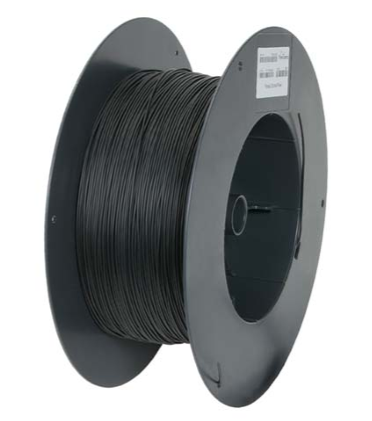
The 105/125 µm Multi-mode Step-Index Low OH Launch Optical Fibre is a large-core optical fibre designed for demanding light launch and coupling tasks. With its 105 µm core diameter and 125 µm cladding, it offers a standard fibre geometry that simplifies connecting to common connectors and equipment. The fibre’s low OH (low hydroxyl) formulation minimises absorption losses around the 1.38 µm water peak, making it well-suited for near-infrared applications such as 1064 nm and 1550 nm wavelengths while still transmitting visible light. Engineers often use this fibre as a launch lead in optical test setups to condition the output of an optical source or improve the accuracy of OTDR measurements by providing a consistent modal launch. Its step-index multimode design produces a predictable modal distribution, ensuring stable and repeatable performance when coupling light into sensitive systems. Overall, this fibre serves as a reliable interface between high-power or broadband optical sources and the rest of your system, combining broad wavelength capability with easy handling and integration.
Range features
A high level overview of what this range offers
- Large 105 µm core diameter – Permits efficient coupling of light from broad-area or high-power sources, simplifying alignment and allowing higher launch power.
- Standard 125 µm cladding – Ensures compatibility with industry-standard connectors, ferrules, and fusion splicing tools for seamless integration into existing setups.
- Step-index multimode profile – Provides consistent, well-defined modal distribution for stable launch conditions and predictable optical performance, especially over short fibre lengths.
- Low OH silica composition – Minimises absorption loss in the near-infrared range around the 1380 nm water peak, enabling use at longer wavelengths such as 1310 nm and 1550 nm with lower attenuation.
- 0.15 numerical aperture (NA) – Offers a narrow acceptance angle, limiting high-order modes and improving signal uniformity and fidelity when launching light into the fibre.
Downloads
for 105/125 µm Multi-mode 0.15 NA Step-Index Low OH Launch Optical Fibre
What’s in this range?
All the variants in the range and a comparison of what they offer
Specification | Value |
Core/Cladding Diameter | 105 µm core, 125 µm cladding |
Numerical Aperture (NA) | 0.15 |
Fibre Type | Multimode, step-index, low OH silica |
Coating Diameter | ≈250 µm (acrylate protective coating) |
Attenuation @ 850 nm | Not specified |
Attenuation @ 1300 nm | Not specified |
Attenuation @ 1550 nm | Not specified |
FAQs
for 105/125 µm Multi-mode 0.15 NA Step-Index Low OH Launch Optical Fibre
A launch optical fibre is a short length of fibre used at the beginning of an optical link or test setup to condition the light input. By inserting a launch fibre between a light source or test instrument and the main fibre under test, the light distribution becomes stabilised, helping ensure consistent modal excitation. This improves measurement repeatability and reduces uncertainty, especially in OTDR testing.
Low OH means the fibre’s silica contains a low concentration of hydroxyl groups. Reducing these impurities lowers absorption around 1380 nm, often called the water peak, which improves transmission in the near-infrared region. This makes the fibre well-suited for wavelengths such as 1310 nm and 1550 nm.
Typical applications include OTDR launch and receive leads, optical test and measurement setups, laser delivery systems, and laboratory instruments. The large core supports efficient coupling from broadband, high-power, or broad-area light sources into spectrometers, analytical equipment, and other optical systems.
Yes. Because the fibre uses a 125 µm cladding diameter, it is compatible with many standard connector ferrules, cleaving tools, and fusion splicing equipment. This simplifies integration into existing fibre-optic assemblies and test setups.
This fibre is optimised for the near-infrared and performs particularly well around 1060 nm, 1310 nm, and 1550 nm. It can also transmit visible light, but its low OH formulation is especially beneficial for applications in the approximate 700 nm to 1600 nm range.
An NA of 0.15 means the fibre accepts light within a relatively narrow cone angle. This helps limit higher-order modes and can improve launch consistency, beam uniformity, and signal fidelity over short lengths. It also means the input light generally needs to be more carefully focused or collimated for efficient coupling.
A step-index design uses a uniform core refractive index with an abrupt change at the cladding boundary. This provides predictable modal behaviour and a stable launch profile, which is especially useful for short patch leads and test fibres. While step-index multimode fibres are not ideal for long-distance high-bandwidth links, they are very effective for controlled light delivery over short distances.
The 105 µm core can generally support higher optical power than smaller-core fibres because the light is distributed over a larger area, reducing power density. However, no specific maximum power rating is provided. Actual power handling depends on termination quality, connector condition, splice quality, coating limits, and thermal management in the intended application.