CT-0155TSP-MB5L-E 1310 nm FP 20 km SFP Transceiver w. DDMI
- Technology
- Fibre optic transceivers
- Partner
- Coretek
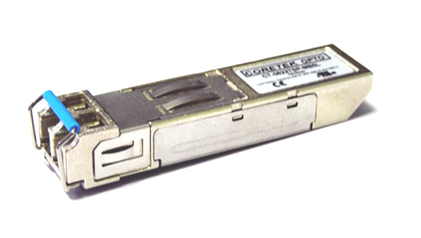
The CT-0155TSP-MB5L-E SFP transceiver is a compact hot-swappable optical module for extending network connectivity over single-mode fibre. It operates at a 1310 nm wavelength with an FP laser, supporting links up to 20 km in length. Built for industrial environments, it withstands extreme temperatures from -40°C to +85°C, ensuring stable operation in harsh conditions.
The module’s integrated DDMI capability allows network engineers to monitor key parameters (like optical power and device temperature) in real time, aiding preventative maintenance and system optimisation. Compliant with the standard SFP Multi-Source Agreement (MSA), this transceiver is compatible with a wide range of network equipment and protocols. It is commonly used to provide reliable fibre connections in industrial Ethernet, telecommunication infrastructure, and other applications that require robust medium-speed optical links over long distance.
Range features
A high level overview of what this range offers
- 1310 nm FP laser transmitter – Provides a stable single-mode fibre link up to 20 km for reliable long-distance connectivity.
- Extended operating temperature (-40°C to +85°C) – Ensures dependable performance in extreme industrial or outdoor environments.
- Digital Diagnostics (DDMI) support – Allows real-time monitoring of transceiver status (such as temperature, voltage, and optical power), simplifying troubleshooting and maintenance.
- Hot-swappable SFP form factor – Enables easy installation or replacement without downtime, improving serviceability in the field.
- Duplex LC fibre connector – Uses a standard LC duplex interface for straightforward integration with single-mode fibre cabling.
- Up to 155 Mb/s data rate – Supports Fast Ethernet (100BASE-FX) and other optical data links, offering flexibility for various legacy and modern networking standards.
- MSA compliant design – Adheres to industry-standard SFP specifications for broad compatibility across different networking devices and vendors.
Downloads
for CT-0155TSP-MB5L-E 1310 nm FP 20 km SFP Transceiver w. DDMI
What’s in this range?
All the variants in the range and a comparison of what they offer
| Specification | Value |
|---|---|
Form factor | SFP (Small Form-factor Pluggable), duplex module |
Wavelength | 1310 nm (FP laser diode) |
Fiber type | Single-mode fibre (SMF) |
Reach (distance) | Up to 20 km |
Data rate support | Up to 155 Mb/s (e.g. 100 Mbps Fast Ethernet, OC-3) |
Connector | Duplex LC |
Digital diagnostics | Yes (DDMI, SFF-8472 compliant) |
Operating temperature | -40°C to +85°C (industrial temperature range) |
Supply voltage | +3.3 V DC |
Standards compliance | SFP MSA compliant; supports IEEE 802.3u 100BASE-FX |
Hot-swappable | Yes |
Dimensions | SFP standard dimensions (approximately 55 x 13 x 9 mm) |
FAQs
for CT-0155TSP-MB5L-E 1310 nm FP 20 km SFP Transceiver w. DDMI
This transceiver is designed for data rates up to 155 Mb/s. It can seamlessly support 100 Mbps Fast Ethernet (100BASE-FX) links and is also suitable for other standards in the OC-3/STM-1 range (155 Mb/s). Because it’s multi-rate, it can operate at lower speeds as needed for applications like teleprotection (C37.94) or other sub-rate optical links, provided the host device supports those rates.
The module is intended for single-mode fibre (SMF) use. It uses a 1310 nm FP laser and achieves distances of up to 20 km over standard single-mode fibre cabling. It has a duplex LC connector, meaning it uses two fibres (one for transmit, one for receive) to establish the link.
DDMI provides real-time access to the module’s internal measurements. This includes parameters like transmitter optical power, receiver signal level, laser bias current, supply voltage, and module temperature. By monitoring these via the network device’s interface, maintenance teams can proactively detect issues (such as fiber attenuation or overheating) and ensure the transceiver is operating within specifications. It greatly aids in troubleshooting and preventive maintenance for critical links.
Yes. The transceiver is MSA-compliant, meaning it follows the industry’s Small Form-factor Pluggable specifications. It can plug into any standard SFP slot on switches, routers, media converters, or other network devices. Because it adheres to common standards (including the SFP hardware dimensions and the communication interface for DDMI), it is interoperable with equipment from various manufacturers. For example, it can be used to replace or augment a Fast Ethernet fibre port on industrial switches or to connect to SDH/SONET equipment that accepts SFP optics.
The CT-0155TSP-MB5L-E is built for industrial temperature ranges. It operates reliably from -40°C to +85°C, making it suitable for outdoor installations or harsh industrial environments where standard commercial-grade optics (typically 0°C to 70°C) would fail. Its robust design ensures stable performance despite wide temperature swings, which is crucial for deployments in traffic cabinets, factory floors, or remote enclosures without climate control.
No special setup is required to use the basic optical link – it’s largely plug-and-play. Once inserted into a compatible SFP slot and connected with the proper single-mode fibre, it will establish a link if the remote end is using a matching transceiver. To utilise the DDMI features, the host device (switch or router) should support reading SFP diagnostics (most modern managed switches do). Users can then check the diagnostics via the device’s management interface. There’s no need for additional configuration on the module itself; it automatically provides optical and electrical data to the host.
The part number suffix encapsulates key characteristics of the module. “MB5L-E” typically signifies a 1310 nm wavelength FP laser designed for a reach of around 20 km (“5L” often correlates with ~20 km) and the “E” denotes extended temperature range support. The “2M” at the end is associated with the product’s intended application category – in this case it hints at compatibility with 2 Mb/s optical interfaces (such as the IEEE C37.94 standard used in utility communications), distinguishing it from higher-rate categories. In essence, the code helps differentiate this model from variants with different distances, temperature ratings, or data-rate categories.
Yes. Because it supports up to 155 Mb/s and standard optical specs, this SFP can be used for Fast Ethernet links (100 Mb/s) as well as in SDH/SONET systems that operate at STM-1/OC-3 rates (155 Mb/s). It is quite versatile and can also handle intermediate rates down to a few Mb/s. Always ensure the host equipment is compatible with the SFP’s specifications (wavelength, reach, DDMI capability if needed). In practice, many network devices and multiplexers accept this type of SFP for both data networking and specialised telecom circuits, making it a flexibly deployable module.
This model is a single-mode SFP transceiver. Clues to this include the specified 1310 nm wavelength (which is typical for single-mode fibre) and the long reach (20 km is only feasible on single-mode fibre). Multi-mode SFPs usually use wavelengths like 850 nm and are limited to much shorter distances (a few hundred metres to 2 km). Additionally, single-mode transceivers often use FP or DFB lasers as in this module, whereas multi-mode versions might use VCSELs or LEDs. The duplex LC connector is common to both types, so it’s the optical specs that determine fibre type compatibility.
Like most SFP modules, it runs on a +3.3 V DC supply provided by the host device. The power consumption is very low – typically well under 1 W (often around 0.5 W for a 155 Mb/s class SFP). This minimal power draw means the module generates little heat of its own, though it will warm slightly during operation (especially at the high end of the temperature range, some heat is normal). The low power requirement and heat output make it easier to deploy in dense networking equipment or enclosures without needing special cooling for the SFP.