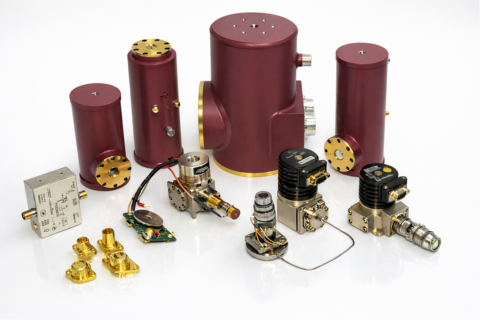
InSb/HgCdTe 2 Colour Infrared Detectors
- Technology
- Infrared photodetectors
- Partner
- Infrared Associates
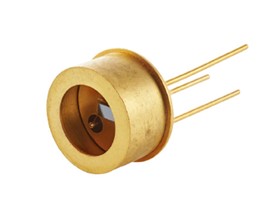
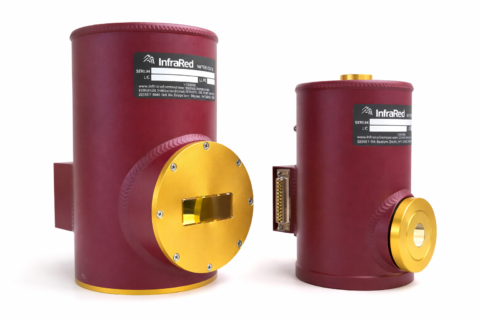
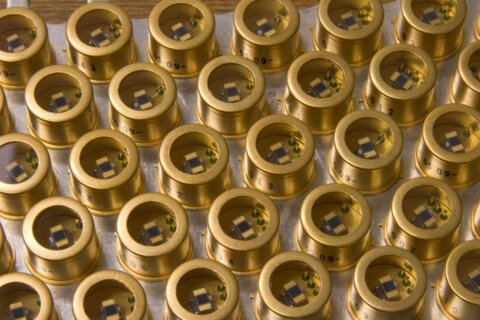
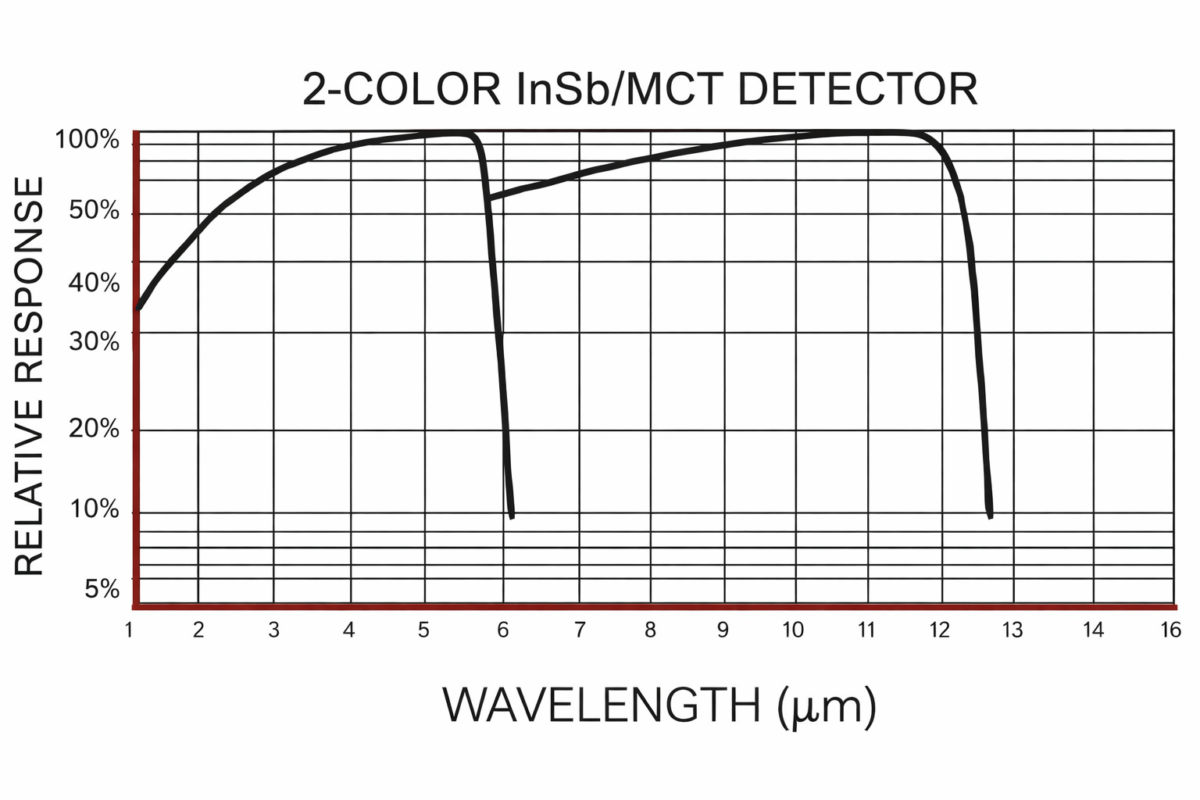
InSb/HgCdTe 2 colour infrared detectors integrate two different semiconductor infrared sensors – Indium Antimonide (InSb) and Mercury Cadmium Telluride (HgCdTe) – into a single cryogenically cooled unit. This dual-colour design allows simultaneous detection of two adjacent infrared bands: one channel covers the mid-wave IR (~1 µm to 5.5 µm) and the other covers the long-wave IR (~5.5 µm to 12.5 µm). Both detector elements share the same optical focal point. A built-in dichroic beam-splitter directs the shorter wavelength IR to the InSb photodiode and the longer wavelengths to the MCT sensor, ensuring they observe the identical field of view. The result is a two-channel infrared detector that provides broad spectral coverage and high sensitivity across both bands. These devices are operated at liquid-nitrogen temperatures (around 77 K) to achieve very low noise performance. Engineers employ such dual-colour detectors in applications ranging from thermal imaging and radiometric measurement to FTIR spectroscopy and advanced IR microscopy. By capturing two spectral channels at once, the detector enables techniques like real-time background radiation discrimination and multi-band target analysis in both industrial and defence sensing systems.
Range features
A high level overview of what this range offers
- Dual-band spectral coverage – Monitors mid-wave (~1–5.5 µm) and long-wave (~5.5–12.5 µm) infrared bands simultaneously with one sensor assembly, eliminating the need for multiple separate detectors
- Co-aligned two-channel design – Both detector elements share a common focal point, ensuring they see the same field of view for accurate two-band imaging
- High sensitivity in each band – Delivers very high detectivity (D* on the order of 1×10^11 cm·√Hz/W in mid-IR and ~10^10 cm·√Hz/W in long-IR at 77 K) to detect extremely faint infrared signals in both spectral ranges
- Customisable long-wave response – HgCdTe detector can be tailored to extend its upper wavelength limit beyond 12.5 µm (up to ~25 µm) for specialised far-infrared requirements
- Multiple active area options – Offered in sizes from 0.25 mm to 2.0 mm, allowing users to choose smaller detectors for faster response or larger detectors for higher total signal capture
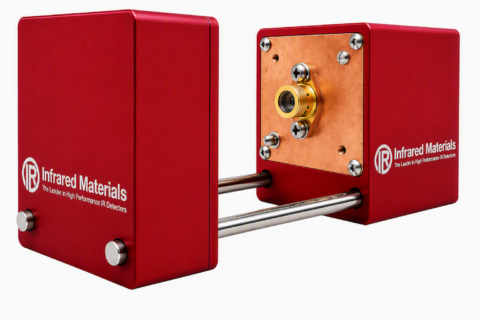
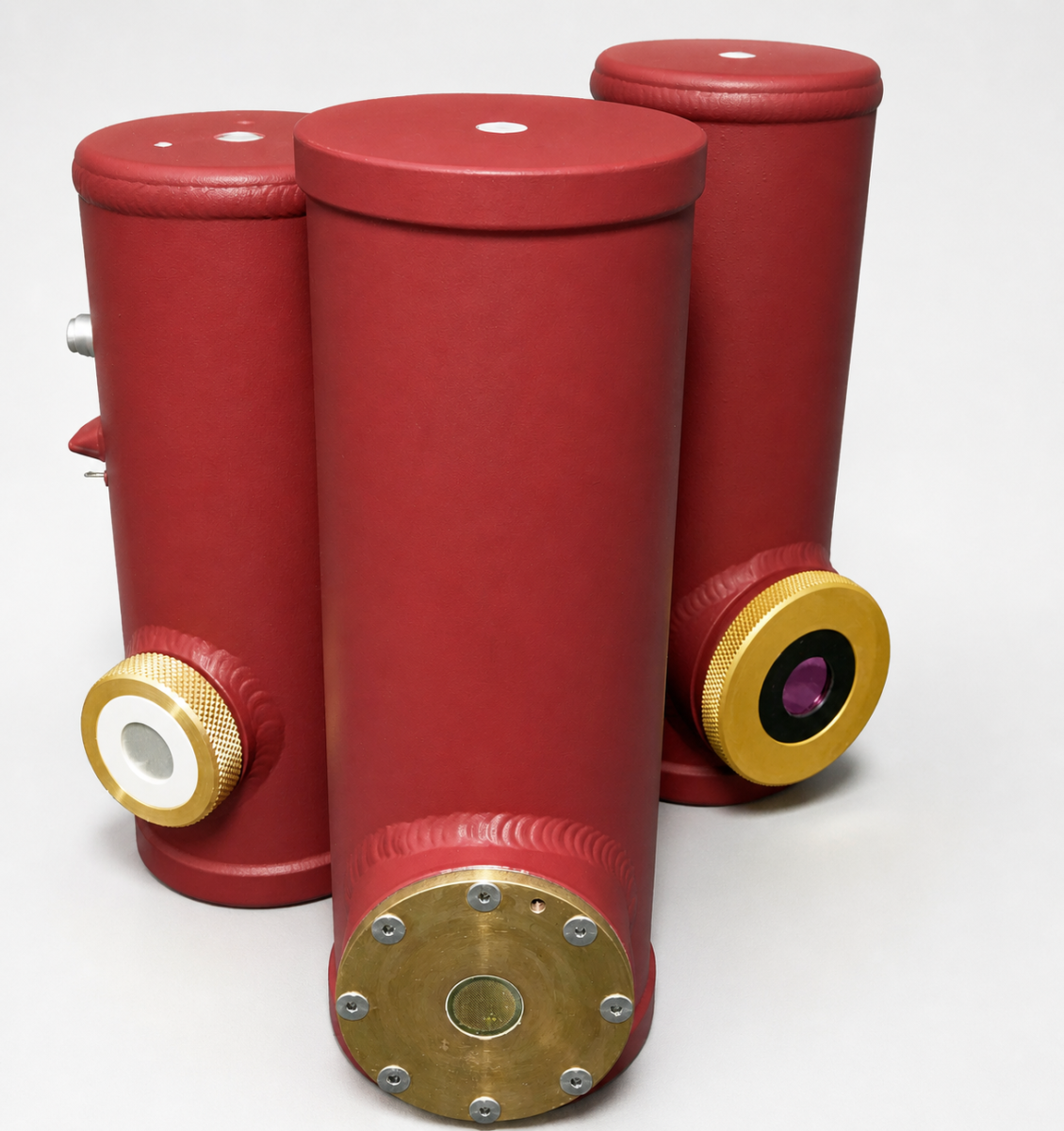
- Liquid-nitrogen cooled operation – Uses LN2 cryogenic cooling (77 K) in a vacuum dewar to minimise thermal noise, with side-looking or down-looking cryostat designs available (8 h to 24 h hold time)
- Simultaneous dual outputs – Provides two synchronous output channels (one per spectral band) for real-time background subtraction, ratio measurements, or other multi-band analysis techniques
Principle
The HgCdTe (MCT) detector and the InSb detector are arranged at 90°. A dichroic mirror directs the shorter wavelength IR radiation to the InSb detector and the longer wavelength radiation to the MCT detector. Therefore, the best possible sensitivity is obtained over the whole IR range.
The HgCdTe element can be customised to extend its long wavelength response beyond 25mm. Custom configurations are available.
Downloads
for InSb/HgCdTe 2 Colour Infrared Detectors
What’s in this range?
All the variants in the range and a comparison of what they offer
| Specification | 2C-0.25 | 2C-0.5 | 2C-1.0 | 2C-2.0 |
|---|---|---|---|---|
Active area (InSb / MCT) [mm] | Ø0.25 / 0.25×0.25 | Ø0.5 / 0.5×0.5 | Ø1.0 / 1.0×1.0 | Ø2.0 / 2.0×2.0 |
Spectral response range (µm) | 1–5.5 / 5.5–12.5 | 1–5.5 / 5.5–12.5 | 1–5.5 / 5.5–12.5 | 1–5.5 / 5.5–12.5 |
Peak specific detectivity D* (cm·√Hz/W) | ≥ 1.0 × 10^11 / ≥ 3.0 × 10^10 | ≥ 1.0 × 10^11 / ≥ 3.0 × 10^10 | ≥ 1.0 × 10^11 / ≥ 3.0 × 10^10 | ≥ 1.0 × 10^11 / ≥ 2.0 × 10^10 |
Peak responsivity (InSb / MCT) | ≥ 3 A/W / ≥ 5000 V/W | ≥ 3 A/W / ≥ 3000 V/W | ≥ 3 A/W / ≥ 2000 V/W | ≥ 3 A/W / ≥ 1000 V/W |
Operating temperature | 77 K (LN2 cooled) | 77 K (LN2 cooled) | 77 K (LN2 cooled) | 77 K (LN2 cooled) |
Dewar package options | MSL-8, MSL-12, MDL-8, MDL-12 | MSL-8, MSL-12, MDL-8, MDL-12 | MSL-8, MSL-12, MDL-8, MDL-12 | MSL-8, MSL-12, MDL-8, MDL-12 |
Window material | ZnSe (transmits ~2–14 µm) | ZnSe (transmits ~2–14 µm) | ZnSe (transmits ~2–14 µm) | ZnSe (transmits ~2–14 µm) |
FAQs
for InSb/HgCdTe 2 Colour Infrared Detectors
In an InSb/HgCdTe dual-colour detector, two IR sensor elements are integrated in one assembly to split the incoming infrared radiation by wavelength. Typically, a dichroic mirror or beam-splitter directs the shorter-wave IR to the InSb photodiode and the longer-wave IR to the HgCdTe detector. This way, the device produces two separate electrical outputs simultaneously – each corresponding to a different portion of the IR spectrum.
The Indium Antimonide (InSb) channel is sensitive to approximately 1 µm up to about 5.5 µm wavelength (covering the short-wave/mid-wave IR region). The Mercury Cadmium Telluride (HgCdTe) channel responds from around 5.5 µm to roughly 12.5 µm (covering the longer-wave IR region). Together, these two channels span the mid-wave and long-wave infrared bands. (Note: 5.5 µm is the approximate 20% cut-off wavelength for the InSb and MCT channels in the standard configuration.)
Yes. By adjusting the alloy composition of the HgCdTe material, the long-wave cutoff can be pushed beyond 12.5 µm. In practice, custom two-colour detectors have been made that detect up to roughly 20–25 µm on the long-wave channel (though there may be some trade-offs in performance at the far end of the spectrum).
A dual-band (two-colour) detector ensures that both IR bands are measured from the exact same optical path, which is hard to achieve with two separate detectors. Because the two sensing elements are built into one package and share the same field of view, there are no alignment errors and the data from both bands is inherently synchronised in time. This simplifies the optical design (no need for a second aperture or optics) and enables techniques like real-time signal ratioing or background subtraction without having to calibrate two different devices.
These detectors are designed for cryogenic cooling. They typically operate at liquid nitrogen temperature (~77 K) to minimise thermal noise. Each unit comes sealed in a vacuum dewar (cryostat) for LN2 cooling, with options for either a side-looking window or a down-looking window configuration. Standard dewars offer hold times of about 8 or 12 hours before refilling, and there are extended dewar designs that can provide up to 24 hours hold time.
The InSb element is a photovoltaic infrared photodiode (it generates a current when IR light hits it), whereas the HgCdTe element in this detector is a photoconductive sensor. The MCT photoconductor needs a bias voltage and its electrical resistance changes with incoming IR, producing a measurable voltage change. By contrast, the InSb photodiode typically operates near zero bias and produces a photocurrent proportional to the incident IR flux.
At 77 K, the InSb channel generally achieves a higher specific detectivity (D) than the HgCdTe channel. For example, the peak D of the InSb detector is on the order of 10^11 cm√Hz/W, whereas the HgCdTe channel typically reaches on the order of 10^10–10^11 cm√Hz/W (depending on its cutoff wavelength and detector size). Both channels are very sensitive, but the short-wave InSb tends to have a slight edge in detectivity compared to the long-wave MCT, especially for the larger-area detector variants.
Yes, each detector channel typically needs appropriate low-noise amplification to read out its signal. The InSb photodiode output is usually routed into a transimpedance preamplifier (to convert the photocurrent to a voltage) for optimal sensitivity. The HgCdTe photoconductive channel requires a bias circuit and a low-noise amplifier to measure the change in voltage or current as its resistance varies with IR exposure. Using specialised preamplifiers matched to each channel is important to maintain low-noise performance and fully exploit the detector’s sensitivity.
Choosing the detector size depends on your optical setup and signal requirements. Smaller active-area devices (e.g. 0.25 mm or 0.5 mm) have lower capacitance, giving faster response and lower noise, but they capture less total infrared flux – which can be a drawback if your target is large or not tightly focused. Larger area detectors (1.0 mm or 2.0 mm) collect more of the incoming IR beam (useful for extended scenes or diffuse sources) and produce a stronger overall signal, but they tend to have slightly lower detectivity and slower response due to higher capacitance. In essence, if your IR spot size is small and you need the fastest, lowest-noise measurement, a smaller detector is advantageous; if you need to gather as much signal as possible from a wide area or target, a larger detector is the better choice.
These dual-colour IR detectors are used wherever simultaneous two-band infrared sensing is beneficial. For example, thermal imaging systems can use them to capture mid-IR and long-IR images of the same scene for improved temperature measurement or target recognition. Radiometry instruments employ them to measure IR intensity in multiple bands at once, and FTIR spectrometers use them for broad infrared coverage with a single detector. They are also found in infrared microscopes and in certain military or security sensors, particularly where distinguishing an object’s signal from background heat (background discrimination) is important. In general, any application requiring concurrent mid-wave and long-wave IR data from the same field of view can leverage a two-colour detector.