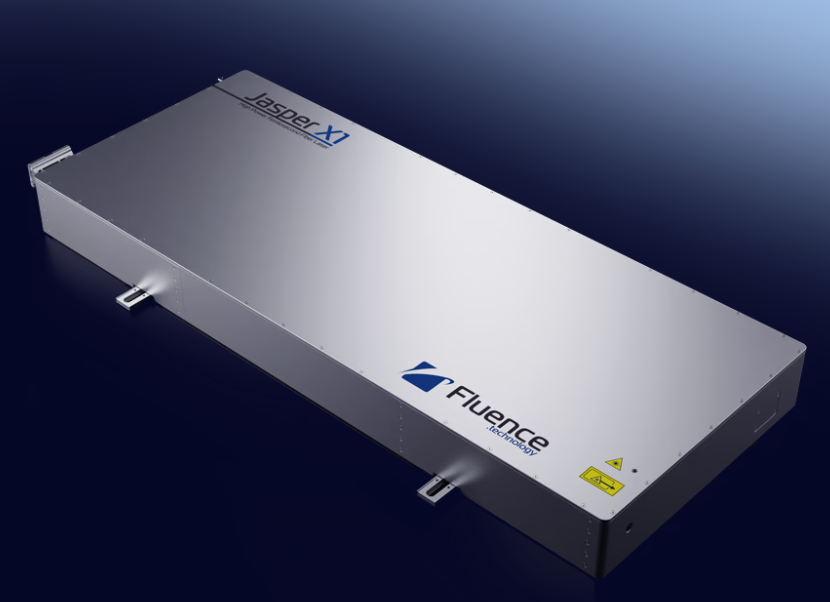
Jasper X1 Single-box High-Power Femtosecond Fibre Laser
- Technology
- Fibre lasers
- Partner
- Fluence Technology
The Jasper X1 femtosecond fibre laser is a 1030 nm industrial ultrafast source for precision material processing and OEM machine integration. The range includes 30 W and 60 W versions, with up to 200 µJ single-pulse energy and up to 400 µJ maximum burst energy, depending on the model. Pulse width is below 270 fs and can be tuned to 8 ps or 20 ps, while the repetition-rate range extends from single-shot operation to 20 MHz. Standard variants use pulse-picker-based Pulse-on-Demand and can provide burst sequences of up to 80 pulses, with Custom Envelope Burst included or optional according to the model. P-suffix variants add Advanced Pulse-on-Demand with less than 50 ns jitter and external triggering up to 1 MHz in Stabilised Energy Mode.
The all-fibre, SESAM-free architecture is intended to support continuous operation with reduced optical maintenance requirements. Typical uses include microelectronics processing, through-glass via drilling, medical-device manufacture, surface functionalisation, cutting, drilling and trimming. Horizontal or vertical mounting, water cooling, multiple control interfaces and an optional automated harmonic module support integration into industrial workstations.
Range features
A high level overview of what this range offers
- Up to 60 W average power – Supports higher processing throughput where the material and process window permit.
- Up to 200 µJ single-pulse energy – Provides energy options for ablation, drilling, cutting and internal material modification.
- Maximum burst energy up to 400 µJ – Extends the available energy range for burst-based processes on selected models.
- Pulse width below 270 fs with tuning to 8 ps or 20 ps – Allows the pulse duration to be matched to the material response.
- Single-shot to 20 MHz repetition rate – Supports both low-rate, higher-energy processing and high-rate scanning.
- Advanced Pulse-on-Demand with less than 50 ns jitter – Improves pulse positioning during position-synchronised scanning.
- Custom Envelope Burst with up to 80 pulses – Enables adjustment of individual pulse amplitudes within a burst on compatible models.
- Beam quality below M² 1.2 – Supports consistent focusing for fine-feature machining.
- All-fibre, SESAM-free design – Reduces dependence on free-space oscillator components and routine optical alignment.
- Horizontal or vertical mounting – Gives machine builders more flexibility when arranging the laser head.
- USB, RS232, TTL and analogue interfaces – Support local operation and integration with industrial motion and control systems.
- Optional automated harmonic module – Adds 515 nm, 343 nm and nominally 258 nm outputs for wavelength-dependent processes.
- Two-year laser and five-year oscillator warranties – Define the standard support periods for the complete system and oscillator.
What’s in this range?
All the variants in the range and a comparison of what they offer
General specifications
| Category | Specification | Value |
|---|---|---|
Optical output | Central wavelength | 1030 ± 5 nm |
Optical output | Pulse width | <270 fs; <240 fs typical |
Optical output | Pulse repetition-rate range | Single shot to 20 MHz |
Optical output | Maximum oscillator repetition rate | 20.0 ± 0.5 MHz |
Optical output | Pulse picking | Up to 2 MHz |
Advanced triggering | Advanced Pulse-on-Demand | External triggering up to 1 MHz with <50 ns jitter |
Beam | Beam quality | M² <1.2; 1.1 typical |
Beam | Beam circularity |
|
Beam | Beam diameter | 2.5 ± 0.5 mm at 1 m, measured at 1/e² |
Beam | Beam divergence | <1 mrad |
Beam | Beam pointing stability | <20 µrad/°C |
Beam | Polarisation | Linear vertical, PER >28 dB |
Stability | Long-term power stability | <0.5% over 100 hours under stable environmental conditions |
Stability | Pulse-to-pulse energy stability | <1% over 24 hours under stable environmental conditions |
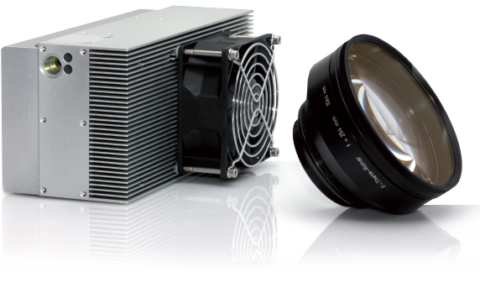
Mechanical | Laser-head dimensions | 1096 × 446 × 100 mm |
Mechanical | Laser-head weight | 50 kg |
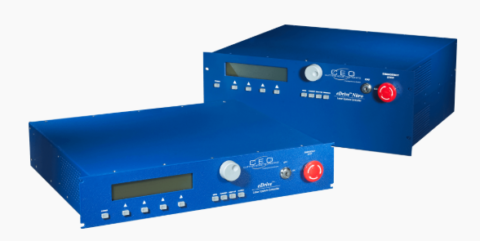
Mechanical | Power-supply dimensions | 3U 19-inch rack unit, 376 × 485 × 133 mm |
Mechanical | Power-supply weight | 13 kg |
Mechanical | Mounting orientation | Horizontal or vertical |
Mechanical | Umbilical | 5 m, detachable |
Environmental | Cooling | Water |
Environmental | Operating temperature | 15–30°C |
Environmental | Relative humidity | 10–80%, non-condensing |
Electrical | Input supply | 100–240 V AC, single phase, 50–60 Hz |
Electrical | Power consumption | <620 W |
Control | Triggering | Internal or external |
Control | Interfaces | GUI via USB, SCPI via RS232, TTL via BNC and analogue via BNC |
Options | Harmonic wavelengths | 515 nm, 343 nm and nominally 258 nm; confirm the shortest-wavelength designation when ordering |
Options | Additional hardware | Automated mechanical shutter |
Warranty | Complete laser | Two years |
Warranty | Oscillator | Five years |
Model comparison
| Specification | JX30-100 | JX30-200 | JX30-200P | JX60-200 | JX60-200P |
|---|---|---|---|---|---|
Central wavelength | 1030 ± 5 nm | 1030 ± 5 nm | 1030 ± 5 nm | 1030 ± 5 nm | 1030 ± 5 nm |
Average power | 30 W class; >28 W standard, >30 W on request | 30 W class; >28 W standard, >30 W on request | 30 W class; >28 W standard, >30 W on request | 60 W | 60 W |
Maximum pulse energy | 100 µJ | 200 µJ | 200 µJ | 200 µJ | 200 µJ |
Nominal PRR | 300 kHz | 150 kHz | 150 kHz | 300 kHz | 300 kHz |
Pulse width | <270 fs | <270 fs | <270 fs | <270 fs | <270 fs |
Pulse-duration tuning | <270 fs to 8 ps | <270 fs to 20 ps | <270 fs to 20 ps | <270 fs to 20 ps | <270 fs to 20 ps |
PRR range | Single shot to 20 MHz | Single shot to 20 MHz | Single shot to 20 MHz | Single shot to 20 MHz | Single shot to 20 MHz |
Pulse-on-Demand | Standard, pulse-picker based | Standard, pulse-picker based | Advanced, 1 MHz and <50 ns jitter | Standard, pulse-picker based | Advanced, 1 MHz and <50 ns jitter |
Maximum burst energy | 100 µJ; High Energy Burst available on request | 300 µJ | 300 µJ | 400 µJ | 400 µJ |
Pulses in MHz Burst Mode | 2–80 | 2–80 | 2–12 | 2–80 | 2–12 |
Custom Envelope Burst | Optional | Included | Not included | Included | Not included |
FAQs
for Jasper X1 Single-box High-Power Femtosecond Fibre Laser
Select the model according to average power, pulse energy, nominal repetition rate and the required triggering method. The JX30-100 provides 100 µJ at a nominal 300 kHz and tunes to 8 ps, while the JX30-200 models provide 200 µJ at 150 kHz and tune to 20 ps. The JX60-200 models combine 60 W average power, 200 µJ pulse energy and a nominal 300 kHz rate. P-suffix versions add Advanced Pulse-on-Demand with less than 50 ns jitter but use shorter burst sequences of 2–12 pulses. Standard versions are generally the closer fit when long, configurable bursts are central to the process, while P versions suit highly dynamic position-synchronised scanning.
Advanced Pulse-on-Demand is intended for applications where each optical pulse must follow an external trigger with tightly controlled timing. Standard versions select pulses through a pulse picker, whereas the advanced versions specify jitter below 50 ns and external operation up to 1 MHz in Stabilised Energy Mode. This helps maintain more consistent pulse spacing when a scanner or stage changes velocity around corners, edges or short features. It also allows the laser to work with position-synchronised output from compatible motion-control equipment. In practice, the JX30-200P and JX60-200P should be considered where pulse-placement accuracy is more important than access to an 80-pulse Custom Envelope Burst.
The Jasper X1 can vary the pulse duration from below 270 fs to either 8 ps or 20 ps, depending on the selected model. This allows engineers to evaluate how different pulse durations affect ablation behaviour, thermal loading, surface finish and removal efficiency for a particular material. Standard models support 2–80 pulses in MHz Burst Mode, while P variants support 2–12 pulses. Custom Envelope Burst allows the amplitude of individual pulses within a burst to be adjusted on compatible variants, rather than applying an identical energy profile throughout the sequence. The useful setting remains material- and geometry-dependent, so process trials are advisable before finalising production parameters.
The laser head measures 1096 × 446 × 100 mm and weighs 50 kg, so the machine frame and mounting surface must provide adequate support and maintain optical alignment. It may be mounted horizontally or vertically and connects to a 13 kg, 3U rack-format power supply through a detachable 5 m umbilical. The system requires water cooling, a 100–240 V AC single-phase supply and less than 620 W electrical input. The specified operating environment is 15–30°C with 10–80% non-condensing relative humidity. USB, RS232, TTL and analogue connections allow the laser to be incorporated into supervisory control, scanner and motion-synchronisation architectures.
The output has an M² value below 1.2, with 1.1 stated as typical, which indicates a beam suitable for tight focusing when paired with correctly selected optics. Beam diameter is 2.5 ± 0.5 mm at 1 m using the 1/e² definition, while divergence is below 1 mrad and circularity is above 87%. The output is vertically polarised with a polarisation extinction ratio above 28 dB, so downstream components should be selected and orientated for linear polarisation. Pointing stability is specified below 20 µrad/°C. Engineers should use these figures when calculating aperture clearance, scan-head input requirements, focal-spot behaviour and sensitivity to thermal changes within the workstation.
The harmonic module should be considered when 1030 nm does not provide the required absorption, feature control or process window for the target material. It adds automated outputs at 515 nm, 343 nm and nominally 258 nm, subject to the ordered configuration. With the Jasper X1, conversion efficiency is specified above 40% for 515 nm and above 20% for 343 nm, with typical values of approximately 50% and 30% respectively. The module accepts pump power below 60 W and pulse energy below 200 µJ, while harmonic pulse duration remains below 300 fs. This gives process developers additional wavelength options for glass, polymers, semiconductor materials, surface structuring and fine medical-device features without replacing the fundamental laser source.
The all-fibre, SESAM-free construction is designed to reduce routine optical maintenance and support continuous 24-hour operation. Long-term power stability is specified below 0.5% over 100 hours, while pulse-to-pulse energy stability is below 1% over 24 hours under stable environmental conditions. Maintaining the required water-cooling performance, ambient temperature and non-condensing humidity is therefore important when assessing these limits. The complete laser has a standard two-year warranty, with a five-year warranty applying to the oscillator. These stability and warranty figures should be considered alongside the planned duty cycle, preventive-maintenance strategy and accessibility of the laser head within the machine.