Laser gain diode-pumped modules
- Technology
- DPSS lasers
- Partner
- Cutting Edge Optronics (CEO)
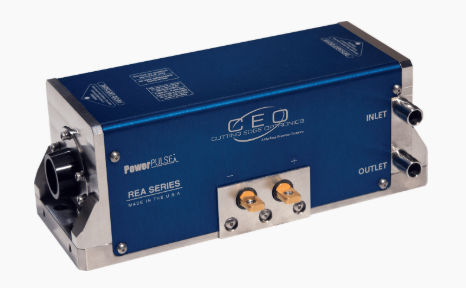
This configurable range covers laser resonator and amplifier modules rather than a single product with one fixed specification. The RBAT series supports resonator duties using rod diameters from 2 to 4 mm, while the REA series addresses amplifier stages with diameters from 4 to 32 mm. Both series are available with CW or QCW diode pumping and standard YAG or YLF gain media. RBAT modules support CW powers up to 150 W and long-pulse energies up to 500 mJ, depending on the selected configuration.
REA modules extend these range-level capabilities to 650 W CW and 8 J. Applications include airborne lidar, pulsed MOPA systems, nanosecond and picosecond amplification, 532 nm Q-switched lasers, flow diagnostics, laser peening, Ti:Sapphire amplifier pumping and OPCPA pumping. Selection should account for the required oscillator or amplifier function, gain material, rod geometry, pump mode, optical configuration and thermal loading.
Range features
A high level overview of what this range offers
- RBAT resonator series: Supports oscillator stages for pulsed MOPA, Q-switched and lidar laser architectures.
- REA amplifier series: Accommodates nanosecond and picosecond amplifier stages, unstable resonators and laser-peening systems.
- CW and QCW pumping options: Allows the pump format to be matched to the intended laser operating cycle.
- YAG and YLF gain media: Provides a material choice based on thermal, pulse-energy and wavefront requirements.
- Rod diameters from 2 to 32 mm: Covers smaller resonator apertures and larger high-energy amplifier stages.
- Up to 650 W CW power: Supports high-average-power system designs within the applicable configuration limits.
- Up to 8 J long-pulse energy: Provides an option for high-pulse-energy amplification architectures.
- MRF processing for large YLF crystals: Helps control transmitted wavefront error in frequency-conversion and parametric-pumping systems.
- Orthogonally arranged A-cut rod pairs: Can reduce thermal birefringence distortion in multi-stage amplifier chains.
What’s in this range?
All the variants in the range and a comparison of what they offer
RBAT/REA series specifications
| Specification | RBAT series | REA series |
|---|---|---|
Product role | Laser resonator module | Laser amplifier module |
Pump modes | CW and QCW | CW and QCW |
Standard gain media | YAG and YLF | YAG and YLF |
Rod diameter | 2–4 mm | 4–32 mm |
Maximum CW power | 150 W | 650 W |
Maximum long-pulse energy | 500 mJ | 8 J |
Typical system roles | Single-mode oscillators, pulsed MOPA systems, CW-pumped 532 nm nanosecond Q-switched lasers and lidar lasers | Nanosecond and picosecond MOPA amplifiers, unstable oscillator resonators and laser-peening systems |
CW short-cavity test configuration | Cavity: 165 mm + 5 mm; high reflector: 0.75mCC; output coupler: 80% | Cavity: 280 mm + 5 mm; high reflector: 0.75mCC; output coupler: 70% |
QCW short-cavity test configuration | Cavity: 165 mm + 5 mm; high reflector: 0.75mCC; output coupler: 40% | Cavity: 280 mm + 5 mm; high reflector: 0.75mCC; output coupler: 40% |
RBAT CW variant comparison
| Specification | RBAT20-0.33C2 | RBAT20-0.66C2 | RBAT20-1C2 | RBAT250-1C2 | RBAT30-1C2 | RBAT24-1C2 | RBAT254-1C2 | RBAT34-1C2 | RBAT34-1C2-FO1 (YLF) | RBAT35-1C2 |
|---|---|---|---|---|---|---|---|---|---|---|
Rod diameter | 2.00 mm | 2.00 mm | 2.00 mm | 2.50 mm | 3.00 mm | 2.00 mm | 2.50 mm | 3.00 mm | 3.00 mm | 3.00 mm |
Peak pump power | 60 W | 120 W | 180 W | 180 W | 180 W | 240 W | 240 W | 240 W | 240 W | 300 W |
Output power | 10 W | 20 W | 35 W | 40 W | 50 W | 50 W | 65 W | 75 W | 35 W | 100 W |
The output-power values in this comparison relate to the RBAT CW short-cavity test configuration and should not be treated as universal system outputs.
FAQs
for Laser gain diode-pumped modules
Choose RBAT for oscillator or resonator duties at smaller apertures, and REA for amplifier stages requiring larger rods or higher energy. RBAT covers rod diameters from 2 to 4 mm, with range-level limits of 150 W CW power and 500 mJ long-pulse energy. REA extends from 4 to 32 mm and supports up to 650 W CW or 8 J, with typical roles in nanosecond and picosecond MOPA amplifiers, unstable resonators and laser-peening systems. The overlap at 4 mm means that optical role and cavity architecture matter as much as rod diameter. Define the required oscillator or amplifier function, pulse energy, average power and beam aperture before choosing the series.
Select the pump mode according to the intended operating cycle, thermal load and cavity configuration. Both RBAT and REA diode-pumped laser gain modules are offered in CW and QCW versions, but their short-cavity test arrangements use different output couplers. RBAT uses an 80% output coupler for CW testing and 40% for QCW, while REA uses 70% for CW and 40% for QCW. The corresponding cavity entries are 165 mm + 5 mm for RBAT and 280 mm + 5 mm for REA, with a 0.75mCC high reflector. These differing optical conditions mean that CW and QCW output figures cannot be compared as though only the electrical drive has changed. Confirm the pulse format, repetition rate, average thermal loading and cavity optics for the exact part number.
Select YAG when robustness, homogeneity and high-frequency operation are the main priorities, while YLF can suit designs requiring high saturation fluence and reduced pulse distortion. YAG has a high stimulated-emission cross-section and a correspondingly low stored-energy density, but thermal lensing and thermally induced stress birefringence can constrain average power under high thermal load. YLF offers relatively weak thermal astigmatism, although transmitted wavefront error and its lower thermal-fracture limit require careful consideration. For large YLF amplifiers, MRF processing and orthogonally oriented pairs of increasingly larger A-cut rods can be used to control wavefront error and thermal birefringence. This material decision can affect beam quality, second-harmonic generation conversion and Ti:Sapphire, OPA or OPCPA pumping performance across the 2–32 mm rod range.
Treat the output values as short-cavity test results tied to defined optical conditions rather than as automatic outputs in every laser system. Within the ten RBAT CW variants, a 2.00 mm rod with 60 W peak pump power produces a listed 10 W output, while a 2.00 mm version at 240 W reaches 50 W. At the same 240 W pump level, the 2.50 mm and 3.00 mm YAG variants reach 65 W and 75 W respectively, whereas the 3.00 mm YLF variant is listed at 35 W. These comparisons show that rod diameter and gain-medium configuration influence performance alongside pump power. Scaling should therefore not be based on pump power or diameter alone. Use the intended cavity, output coupler, cooling arrangement and optical mode size when predicting system performance.
RBAT aligns with smaller-rod resonator applications, while REA is intended for higher-energy amplifier and large-resonator duties. Typical RBAT roles include single-mode oscillators for pulsed MOPA systems, CW-pumped 532 nm nanosecond Q-switched lasers and lidar transmitters. REA is suited to nanosecond and picosecond MOPA amplification, unstable oscillator resonators and laser peening. The range-level limits of 500 mJ and 150 W for RBAT, compared with 8 J and 650 W for REA, indicate the different energy and average-power scales addressed by the two series. The wider application set includes airborne lidar, pulse-train amplification, flow diagnostics and pumping for Ti:Sapphire, OPA and OPCPA systems. Final selection should be based on pulse format, aperture, required gain, repetition rate and downstream conversion requirements.
Before committing to a module, confirm the gain medium, rod diameter and length, diode-bar count, pump mode, drive conditions, cavity optics and cooling arrangement for the selected part number. Gain material, rod geometry and diode-bar count are configurable, so a series designation alone is insufficient for an interface-controlled design. The ten RBAT CW variants in the comparison cover rod diameters from 2.00 to 3.00 mm, peak pump powers from 60 to 300 W and outputs from 10 to 100 W, while the broader series extend to 4 mm for RBAT and 32 mm for REA. Mechanical mounting, coolant connections, electrical interfaces, coatings, polarisation and wavelength requirements also need an exact variant definition. Chassis, driver and thermal-control hardware should not be finalised using family-level limits alone. Use part-specific interface and qualification data during the final design review.