NL230 series High Energy Q-switched DPSS Nd:YAG Lasers
- Technology
- DPSS lasers
- Partner
- Ekspla
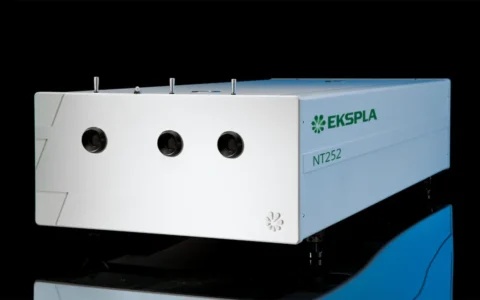
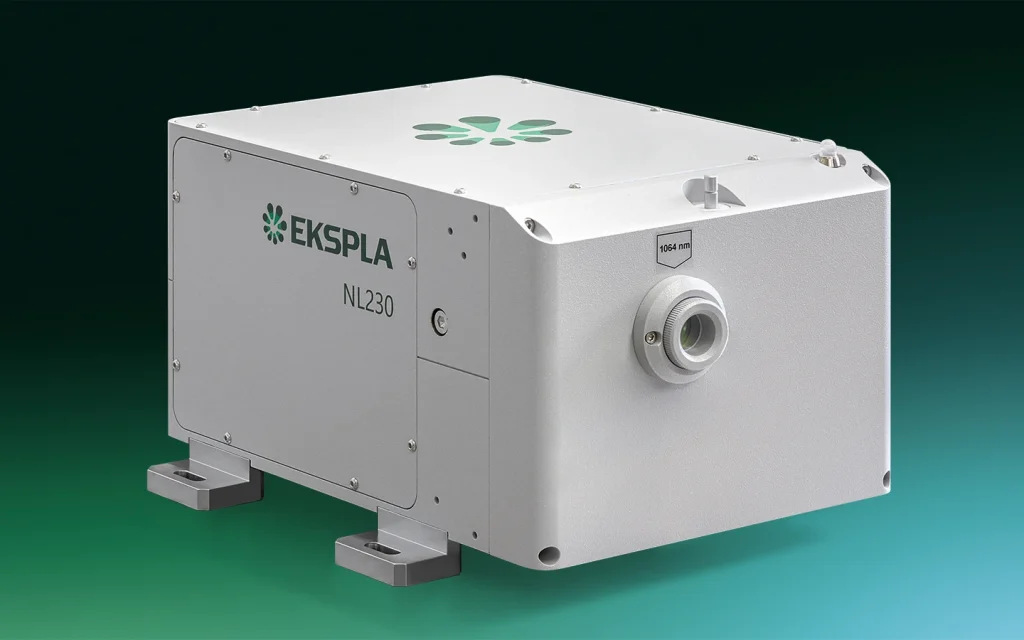
The NL230 series is a family of high-energy, Q-switched, diode-pumped solid-state Nd:YAG lasers developed for short-pulse nanosecond applications. It comprises the NL231-50 and NL231-100 models, which provide repetition rates of 50 Hz and 100 Hz respectively. Maximum specified pulse energy at 1064 nm is 190 mJ for the 50 Hz model and 150 mJ for the 100 Hz model. Output specifications are also provided for 532, 355 and 266 nm, with the selected wavelengths delivered separately rather than simultaneously.
A 3–6 ns pulse duration, less than 0.8 mrad beam divergence and a Top Hat near-field profile support applications that depend on concentrated pulse energy and controlled spatial distribution. Typical uses include LIBS, material ablation, LIDAR, remote sensing, laser-induced fluorescence, mass spectroscopy and the pumping of OPO, Ti:Sapphire or dye laser systems. The sealed monolithic aluminium laser head, remote-control interfaces and external triggering support integration into automated laboratory and industrial equipment.
Range features
A high level overview of what this range offers
- 50 Hz and 100 Hz models – Choose between higher pulse energy per shot and a higher pulse rate.
- Up to 190 mJ at 1064 nm – Supports applications requiring high pulse energy from a diode-pumped platform.
- 3–6 ns pulse duration – Enables short-duration interaction with samples in LIBS and material-ablation processes.
- 1064, 532, 355 and 266 nm specifications – Allows the wavelength configuration to be matched to the material, detector or pumping process.
- Pulse-energy stability from less than 1% to less than 5% – Supports repeatable operation across the specified fundamental and harmonic wavelengths.
- Top Hat near-field beam profile – Promotes controlled spatial distribution at the output aperture.
- Less than 0.8 mrad beam divergence – Supports beam transport and focusing over practical optical-path lengths.
- Beam-pointing stability of 60 µrad RMS or less – Reduces movement of the focused beam centroid during operation.
- Optical pulse jitter below 0.5 ns standard deviation – Supports synchronisation with gated detectors, scanners and other timed equipment.
- USB, RS232, LAN, WLAN and REST API control – Enables local or remote integration with different control architectures.
- Sealed monolithic aluminium laser cavity – Supports alignment stability in laboratory and industrial environments.
- Optional harmonic generators and electromechanical shutter – Adapts the system to the required wavelength and control arrangement.
- Replaceable output window – Simplifies servicing of the optical exit interface.
- Two-year warranty – Provides a defined standard coverage period for lifecycle planning.
Downloads
for NL230 series High Energy Q-switched DPSS Nd:YAG Lasers
What’s in this range?
All the variants in the range and a comparison of what they offer
| Specification | NL231-50 | NL231-100 |
|---|---|---|
Pulse energy at 1064 nm, not less than | 190 mJ | 150 mJ |
Pulse energy at 532 nm, not less than | 110 mJ | 90 mJ |
Pulse energy at 355 nm, not less than | 55 mJ | 40 mJ |
Pulse energy at 266 nm, not less than | 3 mJ | 1.2 mJ |
Pulse-energy stability at 1064 nm, standard deviation | <1% | <1% |
Pulse-energy stability at 532 nm, standard deviation | <2.5% | <2.5% |
Pulse-energy stability at 355 nm, standard deviation | <3.5% | <3.5% |
Pulse-energy stability at 266 nm, standard deviation | <5% | <5% |
Pulse repetition rate | 50 Hz | 100 Hz |
Power drift | <±3% | <±3% |
Pulse duration, FWHM | 3–6 ns | 3–6 ns |
Linewidth at 1064 nm | <1 cm⁻¹ | <1 cm⁻¹ |
Beam profile | Top Hat in the near field; close to Gaussian in the far field | Top Hat in the near field; close to Gaussian in the far field |
Near-field Top Hat fit at output aperture |
|
|
Beam divergence, full angle at 1/e² | <0.8 mrad | <0.8 mrad |
Beam-pointing stability, RMS | ≤60 µrad | ≤60 µrad |
Polarisation at 1064 nm | Linear, >90% | Linear, >90% |
Typical beam diameter at 1064 nm, 1/e² | 5 mm | 5 mm |
Internal-trigger optical pulse jitter, standard deviation | <0.5 ns | <0.5 ns |
External-trigger optical pulse jitter, standard deviation | <0.5 ns | <0.5 ns |
Typical warm-up time | 10 min | 10 min |
Laser-head dimensions, W × L × H | 251 × 290 × 167 mm, ±3 mm | 251 × 290 × 167 mm, ±3 mm |
Desktop power-supply dimensions, W × L × H | 449 × 390 × 140 mm, ±3 mm | 449 × 390 × 140 mm, ±3 mm |
19-inch power-supply dimensions, W × L × H | 483 × 390 × 140 mm, ±3 mm | 483 × 390 × 140 mm, ±3 mm |
Umbilical length | 3 m | 3 m |
Cooling requirement | External chiller | External chiller |
Ambient operating temperature | 18–30 °C | 18–30 °C |
Relative humidity | 20–80%, non-condensing | 20–80%, non-condensing |
Electrical supply | 100–240 V AC, single phase, 50/60 Hz | 100–240 V AC, single phase, 50/60 Hz |
Power consumption | <1.0 kW | <1.0 kW |
Room cleanliness | ISO Class 9 or cleaner | ISO Class 9 or cleaner |
Control and communication | Keypad, REST API, USB, RS232, LAN and WLAN | Keypad, REST API, USB, RS232, LAN and WLAN |
Optional components | Temperature-stabilised second- and third-harmonic generators; electromechanical shutter | Temperature-stabilised second- and third-harmonic generators; electromechanical shutter |
Laser safety classification | Class 4 | Class 4 |
Warranty | Two years | Two years |
Specification notes
- Unless otherwise indicated, parameters apply at 1064 nm to the basic system without options.
- Wavelength outputs are not simultaneous.
- Custom models may be available on enquiry with pulse energies up to 350 mJ at 50 Hz or 250 mJ at 100 Hz.
- Pulse-energy stability is averaged over pulses emitted during a 30-second interval.
- Power drift is measured over eight hours after a 20-minute warm-up, with ambient temperature variation below ±2 °C and humidity variation below ±5%.
- Adequate room air conditioning is required in addition to the external chiller.
- The ordering code combines the model designation with the optional harmonic-generator module code; an example configuration is NL231-H230THC.
FAQs
for NL230 series High Energy Q-switched DPSS Nd:YAG Lasers
Choose the NL231-50 when pulse energy per shot is the main requirement, and the NL231-100 when a higher event rate is more important. At 1064 nm, the 50 Hz model delivers not less than 190 mJ per pulse, compared with 150 mJ at 100 Hz; the same trade-off continues at 532, 355 and 266 nm. Both models retain the 3–6 ns FWHM pulse duration, less than 0.8 mrad divergence and the same stated stability limits. For LIBS or ablation with a high threshold per pulse, the NL231-50 may be the more suitable starting point, whereas the NL231-100 can support faster sampling or scanning. Custom versions are available on enquiry with pulse energies up to 350 mJ at 50 Hz or 250 mJ at 100 Hz.
The specified outputs are 1064, 532, 355 and 266 nm, but they are not emitted simultaneously. Pulse energy depends on the selected wavelength and model, ranging from 190 or 150 mJ at 1064 nm to 3 or 1.2 mJ at 266 nm. Harmonic configurations are available, including temperature-stabilised second- and third-harmonic generator options. A user-selectable single-axis output can simplify beam routing when an experiment needs to alternate between wavelengths, but the connected optics and detectors must be suitable for every configured output. The required wavelength combination should therefore be defined during ordering because pulse energy, optical coatings and laser-safety measures change with the selected configuration.
The NL230 series combines 3–6 ns FWHM pulses with pulse energies up to 190 mJ at 1064 nm, providing short-duration energy delivery for plasma generation and material interaction. Its near-field beam has a Top Hat fit above 80%, while the far-field distribution is described as close to Gaussian. Beam divergence is below 0.8 mrad, and RMS beam-pointing movement is limited to 60 µrad or less. Pulse-energy stability is below 1% standard deviation at 1064 nm and remains within the stated limits at the harmonic wavelengths. Together, these parameters can support repeatable sample coupling, although the resulting ablation depth or LIBS response will also depend on focusing, spot size, material properties and the surrounding atmosphere.
Both internal and external triggering provide optical pulse jitter below 0.5 ns standard deviation. This timing performance supports coordination with gated spectrometers, cameras, motion systems, scanners, OPO stages and other time-dependent equipment. Communication options include USB, RS232, LAN and WLAN, while REST API commands allow integration from controllers running different operating systems. A keypad is also available for direct local control when a separate host controller is unnecessary. System designers should still account for delays introduced by cables, trigger electronics, detector response and software because the optical jitter value represents only one element of the complete timing chain.
The NL230 series is intended for pumping OPO, Ti:Sapphire and dye laser systems where nanosecond pulse energy and beam control are required. At 1064 nm, it provides a linewidth below 1 cm⁻¹, linear polarisation above 90%, a typical 5 mm beam diameter and a 3–6 ns pulse duration. The Top Hat near-field distribution can support controlled illumination of the pumped medium, while the close-to-Gaussian far field and divergence below 0.8 mrad assist downstream beam transport. Selection between 50 and 100 Hz should be made against the pump medium’s energy threshold, thermal loading and required conversion rate. The pump optics must also be matched to the selected fundamental or harmonic wavelength because the available outputs are not simultaneous.
The system requires an external chiller and operates from a 100–240 V AC, single-phase, 50/60 Hz supply with power consumption below 1.0 kW. The specified operating environment is 18–30 °C, 20–80% non-condensing relative humidity and ISO Class 9 cleanliness or better, with adequate room air conditioning. The laser head measures 251 × 290 × 167 mm with a tolerance of ±3 mm and connects through a 3 m umbilical. Desktop and 19-inch power-supply formats are available, measuring 449 × 390 × 140 mm and 483 × 390 × 140 mm respectively. Installation planning should provide suitable clearance for the laser head, power supply, external chiller, cable routing and unrestricted beam access.
Typical warm-up time is 10 minutes, although the eight-hour power-drift specification is based on a 20-minute warm-up period. The system is intended to remain connected to mains electricity continuously; after a mains interruption longer than one hour, several hours of warm-up may be required before normal operation. The laser is designed for continuous industrial operation, while the stated diode-pump estimate indicates more than three years of maintenance-free use at approximately eight working hours per day. A sealed monolithic cavity and replaceable output window are intended to reduce routine intervention around the laser head. Applications requiring high uptime should account for continuous mains availability, chiller operation and the two-year warranty period in their maintenance plan.
The NL230 series is classified as a Class 4 laser system and can produce visible and invisible radiation. Depending on the selected configuration, the optical output may cover ultraviolet, visible or near-infrared wavelengths from 266 to 1064 nm, so the safety assessment must address every installed wavelength. An electromechanical shutter is available as an option, but this component alone does not define a complete machine or laboratory safety chain. Interlock architecture, beam enclosure, controlled access and wavelength-specific protective equipment are not included in the stated system specification. These measures must therefore be defined for the final installation by the organisation responsible for laser safety and system integration.