Podview series EOIR camera system
- Technology
- EOIR pan-tilt-zoom (PTZ) cameras
- Partner
- Overview LTD
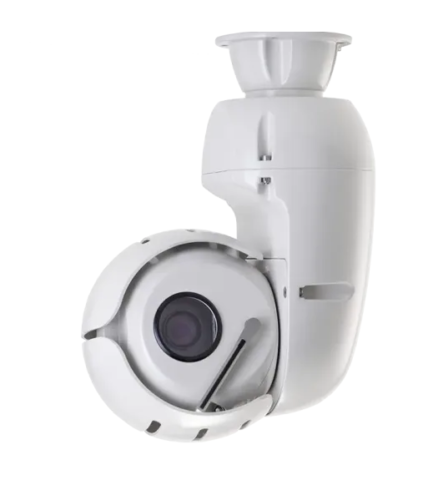
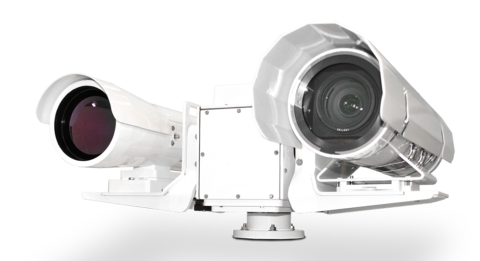
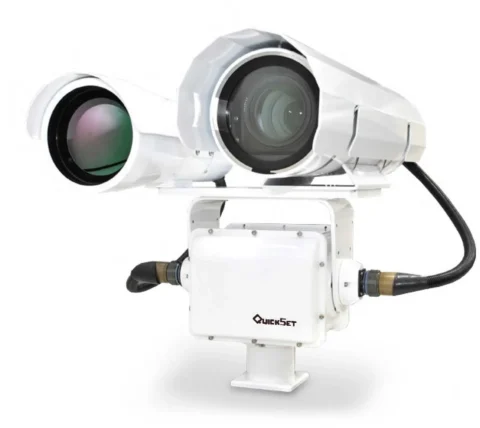
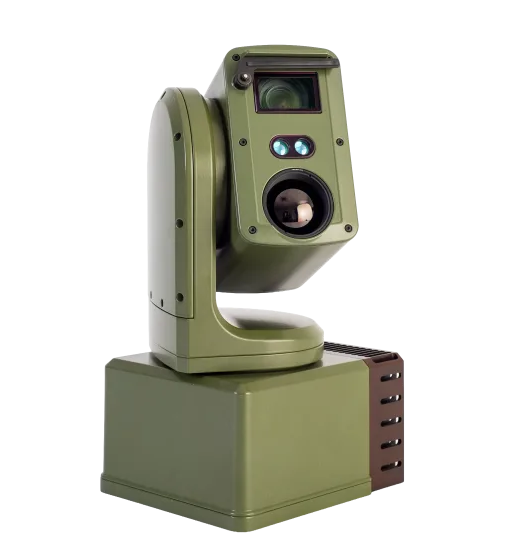
The PodView2600 is a networked sensing platform for remote surveillance, autonomous observation and target acquisition. Its configurable payload can combine an 8.40 MP electro-optical camera with an LWIR thermal imager, laser range finder and integrated position and motion sensors. A Jetson Orin AGX module enables compatible AI and machine-learning models to analyse sensor data locally for detection, classification and tracking.
The direct-drive platform provides continuous pan and tilt rotation at speeds from 0.05°/s to 720°/s. Mechanical and electronic stabilisation help maintain usable imagery on fixed structures, vehicles, vessels and uncrewed platforms. IP connectivity, a web interface and support for ONVIF Profile S, SAPIENT and TAK simplify integration with command, control and video-management environments. Applications include force protection, counter-UAS, deep reconnaissance, maritime monitoring, security, emergency response and wildlife protection.
Range features
A high level overview of what this range offers
- 8.40 MP UHD electro-optical camera: Provides 4K video at 30 fps for visual observation and target assessment.
- Configurable multispectral payload: Combines EO, LWIR and laser-ranging functions for day, night and distance-measurement tasks.
- Jetson Orin AGX edge processor: Runs compatible detection, classification and tracking models locally.
- Interchangeable AI/ML models: Allows software capabilities to be updated without replacing the complete sensor system.
- 0.05°/s to 720°/s movement: Supports controlled scanning and rapid repositioning from the same platform.
- Continuous pan and tilt rotation: Avoids hard stops during persistent tracking and wide-area surveillance.
- Mechanical and electronic stabilisation: Helps limit the effects of vibration and platform movement on captured imagery.
- 1,850 m laser-ranging capability: Measures distance with a stated accuracy of ±1 m against a NATO 2.3 m target.
- IP-based integration: Supports connection to compatible C2, VMS and battle-management environments.
- 2 TB onboard storage: Provides local capacity for events, imagery and full-motion video.
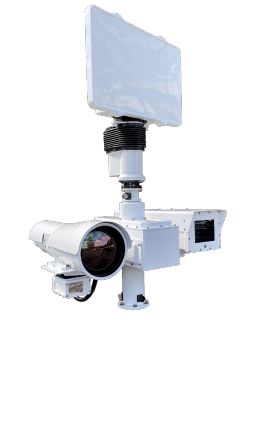
- Supplemental sensor support: Allows compatible radar, acoustic, magnetic, vibration or electronic-support data to be processed alongside the native payload.
- IP68 and IK10 enclosure ratings: Support exposed installations where water, dust and physical impact must be considered.
Downloads
for Podview series EOIR camera system
What’s in this range?
All the variants in the range and a comparison of what they offer
| Category | Specification | Value |
|---|---|---|
System | Model | PodView2600 |
System | Product type | Remote and autonomous multispectral sensor system |
EO camera | Sensor | STARVIS 2, 8.40 MP |
EO camera | Video resolution | UHD 4K at 30 fps |
EO camera | Horizontal field of view | 59.0° to 2.8°, dependent on zoom |
EO camera | Optical zoom | Configuration-dependent; both 30× and 50× references are present, so the supplied lens should be confirmed |
Thermal imager | Resolution and pixel pitch | 640p, 12 µm |
Thermal imager | Spectral band | LWIR, 8 to 14 µm |
Thermal imager | Horizontal field of view | 8° |
Laser range finder | Range | 1,850 m against a NATO 2.3 m target |
Laser range finder | Accuracy | ±1 m |
Motion platform | Pan range | 360° continuous rotation |
Motion platform | Tilt range | 360° continuous rotation |
Motion platform | Pan-and-tilt speed | 0.05°/s to 720°/s |
Motion platform | Point-to-point movement | Any two positions in 3D space within 0.5 seconds |
Motion platform | Repeatable positioning | Better than 0.01° is stated, but the conflicting notation >0.01° also appears and should be confirmed |
Stabilisation | Method | Mechanical direct-drive and electronic image stabilisation |
Processing | Edge processor | Jetson Orin AGX with JetPack 6 |
Processing | AI/ML payload | Compatible third-party or user-installed edge models |
Software | User interface | AdvISE web interface for configuration and control |
Software | Control and interoperability | ONVIF Profile S, SAPIENT, TAK, SDK and APIs |
Video | Streaming formats | H.264; optional H.265 software load |
Storage | Onboard capacity | 2 TB |
Presets | Preset positions | Unlimited quantity |
Presets | Preset tours | Unlimited |
Communications | Network interface | 1 Gbps Ethernet |
Communications | Network architecture | IP-based communications |
Digital I/O | Inputs | 2 |
Digital I/O | Outputs | 4 |
Power | Standard input | 37 to 55 V DC |
Power | Input with optional PodHub | 12 to 55 V DC |
Position and motion sensing | Integrated sensors | GPS/GNSS, IMU, compass and environmental sensing |
Hardware | Weight | 7.5 kg |
Hardware | Dimensions | 365 mm high × 212 mm wide × 183 mm deep |
Hardware | Wiper | EO camera and laser range-finder apertures |
Hardware | Operating noise | Silent |
Enclosure | Construction | Aluminium with marine-grade coating |
Enclosure | Optical apertures | Toughened glass and germanium |
Environmental | Operating temperature | -20°C to +55°C |
Environmental | Dust and water protection | IP68 to BS EN 60529 |
Environmental | Impact protection | IK10 to EN 62262 |
Environmental | Wind stability | 150 km/h or 42 m/s |
FAQs
for Podview series EOIR camera system
Selection depends on whether the application requires visual identification, thermal detection, measured target distance or a combination of all three. The EO channel uses an 8.40 MP STARVIS 2 sensor, provides UHD 4K video at 30 fps and covers a horizontal field of view from 59.0° to 2.8°. The optional LWIR channel adds 640p, 12 µm thermal imaging across the 8 to 14 µm band, while the range finder reaches 1,850 m against a NATO 2.3 m target with ±1 m stated accuracy. Thermal imaging is relevant where visible illumination is limited, whereas the EO channel provides greater visual detail. Engineers should complete application-specific detection, recognition and identification modelling before choosing the final payload.
The standard power input is 37 to 55 V DC, extending to 12 to 55 V DC when the optional PodHub is used. Communications are provided through 1 Gbps Ethernet, allowing control, metadata and encoded video to share an IP-based network. H.264 streaming is included, with H.265 available through an optional software load where reduced transmission bandwidth is required. Power consumption is not stated, so the supply, cable size and protection devices should be selected only after the maximum operating load has been confirmed. The network design should also account for simultaneous video, metadata, remote management and software-update traffic rather than sizing the connection around a single compressed stream.
The system combines direct-drive mechanical stabilisation with electronic image stabilisation and IMU data to counter platform movement. Mechanical correction is suited to larger rotational disturbances, while electronic processing can compensate for residual image movement but may introduce cropping and processing latency. Continuous rotation and movement speeds up to 720°/s support target reacquisition when the host platform changes heading or attitude. Wind stability is stated at 150 km/h or 42 m/s, although this does not replace a structural assessment of the mounting point. Vehicle and vessel integrators should evaluate vibration spectra, mounting resonance, cable routing and line-of-sight obstructions during installation design.
Yes, integration is supported through IP networking, a web interface, dedicated APIs and an SDK. Protocol support includes ONVIF Profile S and SAPIENT, while information can also be delivered into TAK environments. Encoded video is available in H.264, with an optional H.265 load, and autonomous events can be transmitted as lower-bandwidth metadata rather than continuous full-motion video. This allows the sensor to operate independently or as one component within a broader C2, VMS or battle-management architecture. Engineers should still validate the exact protocol profile, message schema, authentication method and command set against the receiving platform before deployment.
The Jetson Orin AGX processor with JetPack 6 can host compatible third-party or user-installed edge models. These models can be used for local detection, classification and tracking without relying on a central cloud-processing service. The software environment is designed to allow model loads to be exchanged as operational requirements change, while APIs connect the models with video and other sensor data. Compatible Supplemental Sensor Modules can add inputs from radar, acoustic, magnetic, vibration or electronic-support sensors to the processing workflow. Model selection remains an engineering task, as performance will depend on training data, target type, environmental conditions, sensor configuration and the required false-alarm rate.
Uncompressed imagery is transferred internally from the sensor head to the base processor, avoiding an intermediate compression stage before edge analysis. External users can receive H.264 or optional H.265 video, still imagery, alerts or lower-bandwidth metadata according to the operational requirement. The 1 Gbps Ethernet interface provides the network connection, while 2 TB of onboard storage supports local retention of events and video. No numerical end-to-end latency or storage-duration figure is stated, as both will vary with encoding settings, frame rate, model load and recording policy. System designers should therefore test the complete processing and communications chain under the intended simultaneous workload.
The enclosure is rated IP68 to BS EN 60529 and IK10 to EN 62262, with an operating temperature range of -20°C to +55°C. Its aluminium body has a marine-grade coating, while the optical openings use toughened glass and germanium for the EO and thermal paths. A wiper serves the EO camera and laser range-finder apertures, supporting maintenance of the viewing path during exposed operation. Wind stability is stated at 150 km/h or 42 m/s, which is relevant to elevated or vehicle-mounted installations. Final installation design should still address connector sealing, drainage, galvanic compatibility, mounting stiffness, cable strain relief and access for cleaning and servicing.