Exo series SWIR camera modules
- Technology
- SWIR camera modules
- Partner
- Allied Vision
The EXO SWIR camera series is designed for machine builders, vision integrators and engineering teams that need visible-to-short-wave-infrared imaging in a compact industrial housing. Its 400 to 1700 nm spectral range allows visible and SWIR response to be captured with one camera when suitable optics, filters and illumination are used. Depending on the optical arrangement and inspected material, the cameras can support semiconductor transmission inspection, liquid or moisture detection, contamination screening, material identification and temperature-related imaging.
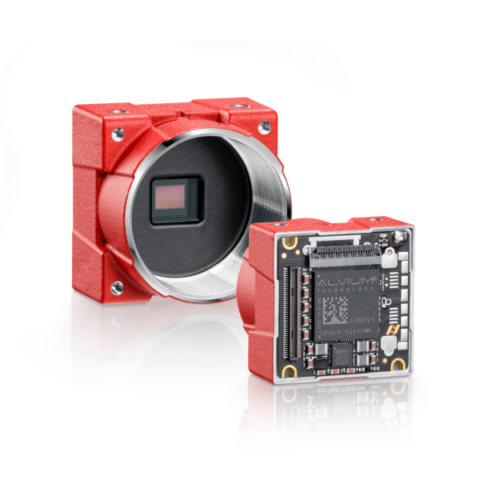
Model selection balances spatial resolution and acquisition speed, ranging from 640 × 512 pixels at 260 fps to 1280 × 1024 pixels at either 94.4 or 125.4 fps. GigE Vision and USB3 Vision options provide a choice between network-based installation, Power over Ethernet and direct host connectivity. Each model uses a 43 × 50 × 50 mm C-mount housing and includes two-point non-uniformity correction, defect-pixel correction, ROI, LUT and flat-field correction functions. Industrial inputs, open-drain outputs, programmable logic and sequencer functions support synchronized triggering and multi-light inspection arrangements. The EXO SWIR camera series is subject to export-control requirements, so written information about the intended use and final destination may be required.
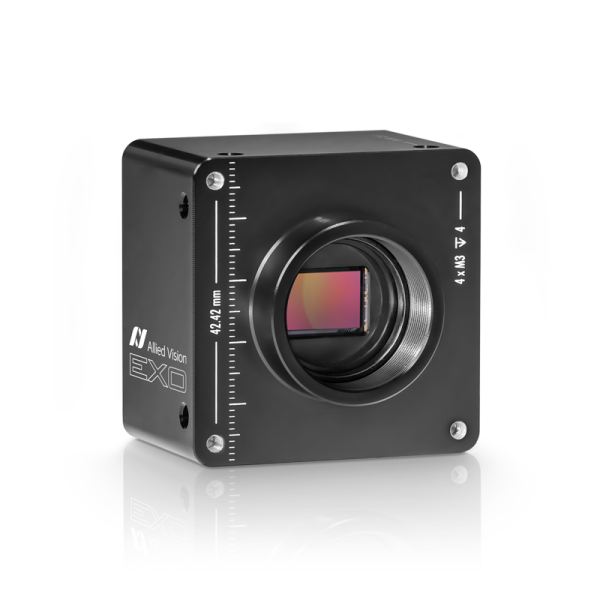
The EXO SWIR camera series combines visible-to-SWIR sensitivity with compact industrial construction for automated inspection, research and machine-vision systems. Three models provide a choice of 0.30 or 1.30 MP resolution, acquisition rates up to 260 fps and either GigE Vision or USB3 Vision connectivity. Applications can include semiconductor transmission inspection, moisture and liquid detection, contamination screening, material identification and temperature-related imaging, subject to the optical and illumination arrangement.
Range features
A high level overview of what this range offers
- 400–1700 nm spectral sensitivity – Supports visible and SWIR inspection with one camera platform.
- Sony IMX990 or IMX991 InGaAs sensor – Provides monochrome SenSWIR imaging with 5 µm pixels.
- Global shutter architecture – Reduces geometric distortion when imaging moving parts.
- Up to 260 fps – Accommodates short machine cycles and rapidly moving products.
- 0.30 and 1.30 MP models – Allows speed and spatial detail to be balanced for the application.
- Two-point NUC – Corrects pixel-to-pixel response variations for more uniform images.
- Defect-pixel, flat-field and shading correction – Supports consistent image processing across the sensor area.
- GigE Vision and USB3 Vision interfaces – Simplify integration with standard machine-vision hosts.
- Power over Ethernet on GigE models – Combines camera power and data on the Ethernet connection.
- 192 MB image buffer – Absorbs short interruptions or variations in data transfer.
- Four PWM-capable open-drain outputs – Enable synchronized control of multiple illumination channels.
- SafeTrigger and programmable logic – Filter trigger disturbances and support camera-side timing functions.
- Programmable sequencer – Coordinates successive exposure and illumination settings within an inspection cycle.
- C-mount, 43 × 50 × 50 mm housing – Supports integration with industrial lenses and compact machinery.
- −10 °C to +60 °C housing temperature range – Covers a broad range of industrial operating conditions.
Downloads
for Exo series SWIR camera modules
What’s in this range?
All the variants in the range and a comparison of what they offer
Specifications
| Specification | EXO SWIR camera series |
|---|---|
Available models | exo990MGE, exo990MU3, exo991MGE |
Product codes | F002190, F002237, F002204 |
Camera type | Monochrome area-scan camera |
Sensor technology | Sony SenSWIR InGaAs CMOS |
Sensor models | IMX990 or IMX991 |
Sensor cooling | TEC-less |
Shutter | Global shutter |
Spectral range | 400–1700 nm |
Resolution options | 640 × 512 or 1280 × 1024 pixels |
Resolution range | 0.30–1.30 MP |
Sensor dimensions | 3.2 × 2.56 mm or 6.4 × 5.12 mm |
Sensor format | Type 1/4 or Type 1/2 |
Pixel size | 5.00 × 5.00 µm |
Sensor bit depth | 8-bit or 12-bit |
Monochrome pixel formats | Mono8, Mono12 or Mono12Packed, depending on model |
Dynamic range | 57 dB |
Maximum frame-rate range | 94.4–260 fps, depending on model |
Exposure time | 15 or 21 µs minimum, depending on model; 500 ms maximum |
Gain | 0.0–42.0 dB |
Digital interfaces | GigE Vision or USB3 Vision |
Data connectors | RJ-45 for GigE; Micro-B for USB3 |
External power input | 10–25 V DC |
Interface power | Power over Ethernet on GigE models; interface power supported by USB3 |
Typical camera power consumption | 3.5–4 W, depending on model |
Non-isolated I/O | 2 × 24 V inputs; 4 × open-drain outputs |
Opto-isolated I/O | 1 × opto-isolated input |
Serial interface | 1 × RS-232 input and 1 × RS-232 output |
I/O connector | 12-pin Hirose HR10A-10P-12S specification |
Trigger modes | Internal, software and external |
Image-control functions | ROI, LUT, image mirroring, DPC, NUC and FFC |
Camera-control functions | User sets, four-channel PWM and sequencer |
Image buffer | 192 MB RAM |
Non-volatile memory | 32 MB flash |
Lens mount | C-mount |
Housing dimensions | 43 × 50 × 50 mm |
Weight | 138 g |
Ingress protection | IP40 |
Housing operating temperature | −10 °C to +60 °C |
Software standards | GenICam and GenTL support |
Model-specific declarations | CE-0101 for GigE models; CE-0169 for the USB3 model |
Export control | Intended-use and final-destination information may be required |
Variant Comparison
| Specification | exo990MGE | exo990MU3 | exo991MGE |
|---|---|---|---|
Product code | F002190 | F002237 | F002204 |
Sensor | Sony IMX990 | Sony IMX990 | Sony IMX991 |
Resolution | 1280 × 1024 | 1280 × 1024 | 640 × 512 |
Megapixels | 1.30 MP | 1.30 MP | 0.30 MP |
Sensor size | 6.4 × 5.12 mm | 6.4 × 5.12 mm | 3.2 × 2.56 mm |
Sensor format | Type 1/2 | Type 1/2 | Type 1/4 |
Maximum frame rate | 94.4 fps | 125.4 fps | 260 fps |
Exposure range | 15 µs–500 ms | 15 µs–500 ms | 21 µs–500 ms |
12-bit pixel format | Mono12 | Mono12Packed | Mono12 |
Interface | GigE Vision | USB3 Vision | GigE Vision |
Data connector | RJ-45 | Micro-B | RJ-45 |
Power options | 10–25 V DC or PoE | USB3 interface or 10–25 V DC | 10–25 V DC or PoE |
Typical power consumption | 4 W | 4 W | 3.5 W |
FAQs
for Exo series SWIR camera modules
Choose the model by balancing the required spatial resolution, inspection speed and host connection. The exo991MGE provides 640 × 512 resolution at up to 260 fps, making it appropriate when cycle time takes priority over pixel count. For 1280 × 1024 imaging, the exo990MGE reaches 94.4 fps over GigE Vision, while the exo990MU3 reaches 125.4 fps over USB3 Vision. The GigE models use an RJ-45 connection and support Power over Ethernet, whereas the USB3 model uses a Micro-B connector. In practice, GigE suits networked or remotely positioned cameras, while USB3 suits a direct, dedicated connection where its higher frame rate can be used reliably.
Yes, the sensor response extends from 400 to 1700 nm, covering visible wavelengths and the SWIR band. This allows one monochrome camera to capture different material responses by changing the illumination wavelength, optical filter or exposure settings. The actual contrast depends on the inspected material and on whether the lens, protective windows and illumination system transmit the required wavelengths. A standard C-mount lens may not maintain transmission or focus performance across the entire range, so optics should be specified for the intended spectral bands. For multi-band inspection, the programmable sequencer and four lighting outputs can coordinate successive visible and SWIR exposures.
Two-point NUC compensates for offset and gain differences between individual InGaAs pixels, improving image uniformity across the sensor. Two factory-created correction profiles are provided for nominal exposure times of 2.5 ms and 25 ms, with an additional map reserved for a user-defined calibration. Select the factory map closest to the operating exposure, or create a user map when the normal exposure, temperature or illumination differs materially from those conditions. Defect-pixel, flat-field and shading corrections can then address local pixel faults and optical fall-off. For repeatable results, allow the camera to reach a stable thermal condition before calibrating and repeat the procedure after significant changes to the imaging arrangement.
The specified −10 °C to +60 °C range refers to the camera housing temperature, so enclosure temperature alone is not sufficient for assessing thermal margin. These EXO SWIR variants are TEC-less and transfer internally generated heat through their 43 × 50 × 50 mm housings. The mounting arrangement should provide a broad contact area with a thermally conductive bracket, while cables and adjacent components should not restrict airflow around the camera. If the measured housing temperature approaches 60 °C, add a heat sink, forced airflow or another suitable cooling method. Maintaining a stable camera temperature also helps the selected NUC profile remain appropriate for the operating condition.
The integrated I/O can coordinate triggers, exposures and illumination without requiring separate timing hardware for straightforward inspection sequences. Each model provides two 24 V inputs, four open-drain outputs, one opto-isolated input and an RS-232 input/output pair through the 12-pin connection. The outputs support PWM and strobe timing, while the sequencer can program up to 16 successive intervals with separate exposure and lighting settings. Timing values use 15 ns units, and strobe duration can be configured from 1 µs to 1 second. An external supply is still required for connected lights, including when a GigE camera itself is powered through PoE, and the lighting circuit must include appropriate current limiting.
An 8-bit image provides 256 gray levels per pixel, while a 12-bit image provides 4096 levels for representing smaller intensity differences. The higher bit depth is useful when the inspection relies on subtle SWIR contrast, but it increases data volume and processing requirements. The GigE models provide Mono12, while the exo990MU3 uses Mono12Packed, which transfers two 12-bit pixels in three bytes rather than four bytes in a conventional 16-bit container. This reduces the associated transfer payload by 25 percent. Before selecting the packed format, confirm that the acquisition library or processing software can unpack it, as this is not handled automatically by every third-party GenTL application.
The exo990MGE and exo991MGE can receive camera power through PoE or through the 10–25 V DC Hirose connection. The exo990MU3 can receive power through its USB3 connection, while the external 10–25 V DC input remains available for installations that require a dedicated supply. Using the external input can reduce the electrical load placed on the host interface and may simplify power distribution in multi-camera systems. Interface power operates the camera but does not supply the four external lighting outputs, which need their own suitable source. Because the camera has no separate power switch, installation and maintenance procedures should isolate all possible interface and external power paths.
The GigE models exo990MGE and exo991MGE are covered by declaration CE-0101, while the USB3 exo990MU3 is covered by declaration CE-0169. These documents address electromagnetic compatibility and restrictions on hazardous substances, and both identify EN 55032:2015 Class B among the applied standards. The exact declaration should be matched to the ordered model rather than relying on a generic series-level document. The EXO SWIR camera series is also subject to export-control regulations. Procurement teams should therefore prepare accurate information about the intended application, system integrator, end user and final destination before placing an order or planning an international shipment.