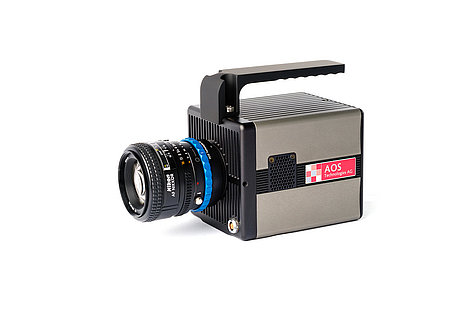
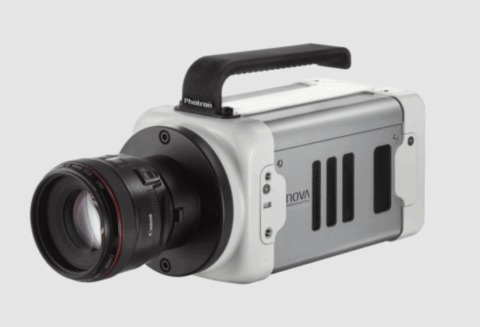
Fastcam Orion S40 series high-speed cameras
- Technology
- High-speed cameras
- Partner
- Photron
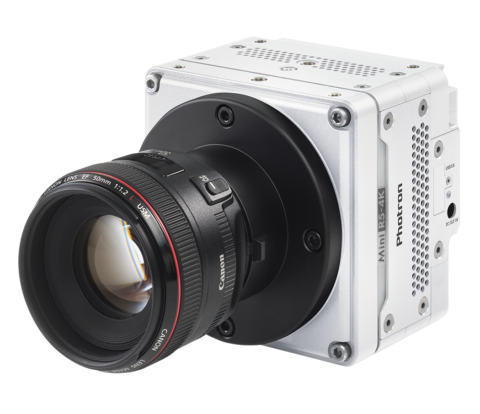
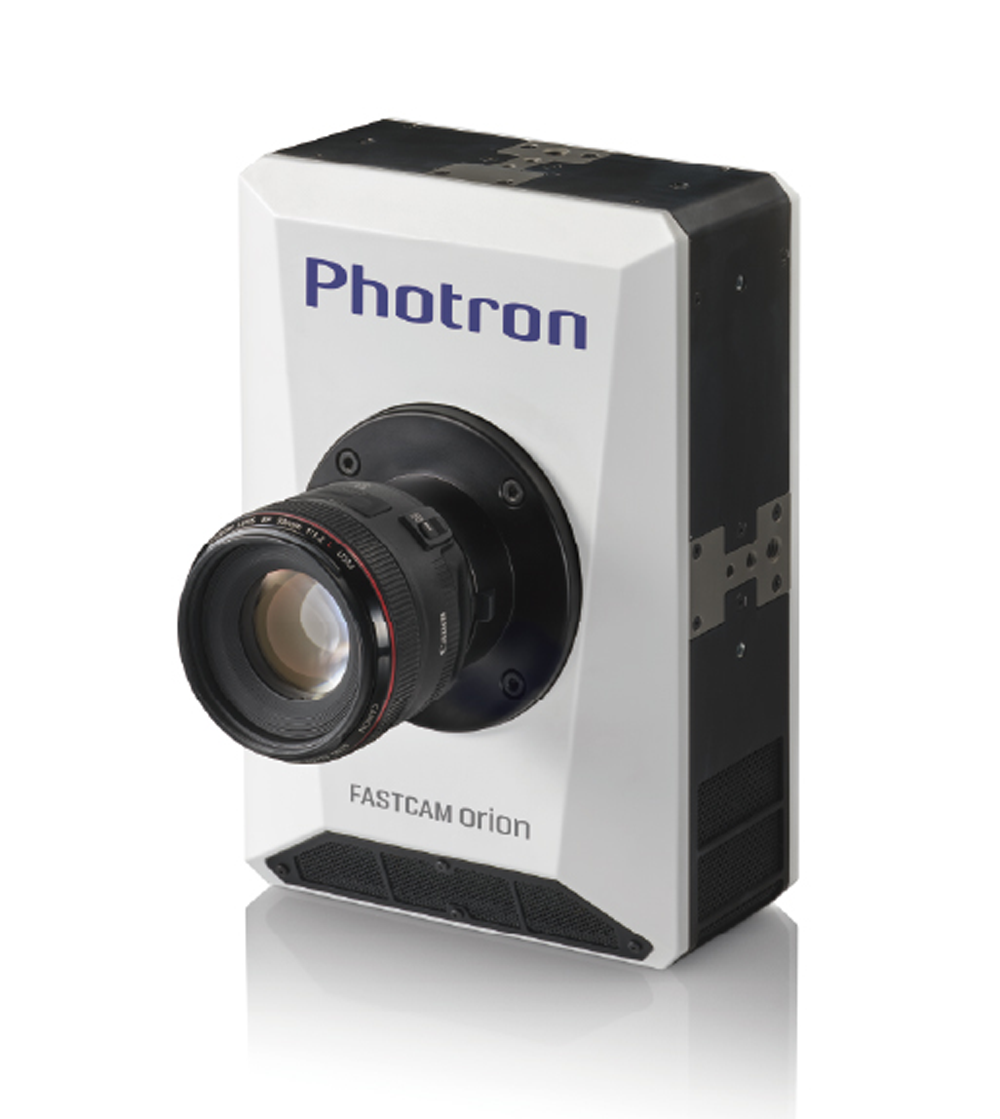
The FASTCAM Orion S40 high-speed camera series is designed for engineers studying rapid events that require short exposures and measurable image detail. Its 1.3-megapixel CMOS sensor records full-resolution images at 31,250 fps, while reduced-resolution settings provide frame rates up to 312,500 fps. Backside illumination places the photosensitive layer closer to the incoming light, supporting photon collection under restricted lighting conditions. Correlated double sampling measures and subtracts pixel reset noise from every frame, helping to preserve low-level image information.
Monochrome and colour sensor versions are available with 32 GB, 64 GB or 128 GB memory capacities. Up to 128 memory partitions support repeated tests, and recording can continue in one partition while another is downloaded. Typical applications include particle image velocimetry, digital image correlation, schlieren imaging, combustion studies, impact testing, fracture analysis and other transient scientific measurements.
Range features
A high level overview of what this range offers
- 1.3-megapixel BSI CMOS sensor: Supports photon collection during low-light, high-speed recording.
- Correlated double sampling: Reduces pixel reset noise and improves black-level resolution.
- 1,280 × 1,024 at 31,250 fps: Retains the full sensor area for spatially detailed measurements.
- Up to 312,500 fps: Captures shorter-duration events when reduced vertical resolution is acceptable.
- 1.0 µs global electronic shutter: Limits motion blur without linking exposure time to frame rate.
- ISO 40,000 monochrome sensitivity: Supports short-exposure imaging with restricted illumination.
- 12-bit monochrome recording: Provides greyscale data for image processing and quantitative analysis.
- 32 GB, 64 GB or 128 GB memory: Allows recording duration to be matched to the test window.
- Up to 128 memory partitions: Supports multiple events before a complete data download is required.
- Record while downloading: Allows one partition to record while data is transferred from another.
- 10GBASE-T interface: Provides camera control and image-sequence transfer through an Ethernet connection.
- Three programmable inputs and outputs: Supports triggering, synchronisation, event marking and DAQ integration.
- IRIG-B time-code input: Enables recorded frames to be referenced to an external time source.
- Mechanical calibration shutter: Allows remote black-balance calibration through the control software.
- Interchangeable lens mounts: Provides standard G-type F-mount compatibility with optional C-mount and EF-mount configurations.
- Control software and SDK: Supports camera operation, replay, data saving and integration into custom applications.
What’s in this range?
All the variants in the range and a comparison of what they offer
Core specifications
| Specification | FASTCAM Orion S40 |
|---|---|
Sensor technology | CMOS with backside illumination and correlated double sampling |
Sensor versions | Monochrome or Bayer colour |
Maximum resolution | 1,280 × 1,024 pixels |
Sensor size | 20.48 × 16.384 mm |
Sensor diagonal | 26.23 mm |
Pixel size | 16 × 16 µm |
Full-frame performance | 1,280 × 1,024 at 31,250 fps |
Square-resolution performance | 1,024 × 1,024 at 37,500 fps |
Maximum frame rate | 312,500 fps at 896 × 32 on the 312K configuration |
200K speed-class limit | 200,000 fps |
Frame-rate accuracy | ±50 ppm |
Standard frame-rate range | 1,000 to 312,500 fps, depending on resolution and configuration |
Low-speed frame-rate mode | 60, 125, 250, 500 and 750 fps |
Shutter type | Global electronic shutter |
Minimum exposure | 1.0 µs, independent of frame rate; restrictions apply to designated export-controlled variants |
Monochrome recording depth | 12-bit |
Colour recording depth | RGB, 12-bit per channel using a Bayer colour filter |
Monochrome light sensitivity | ISO 40,000 |
Colour light sensitivity | ISO 12,500 |
Monochrome exposure index | ISO 25,000 to 64,000 |
Colour exposure index | ISO 8,000 to 20,000 |
Temporal dark noise | 7.2 e− |
Quantum efficiency | 57.5% at 490 nm |
Monochrome spectral response | Extends beyond 900 nm without an IR-absorbing filter |
Recording method | Uncompressed recording to internal IC memory |
Memory options | 32 GB, 64 GB or 128 GB |
Memory partitions | Up to 128 segments |
Region of interest | Variable ROI with standard resolutions from 1,280 × 1,024 to 896 × 32 |
Trigger modes | Start, centre, end, manual, random reset and random manual |
Trigger input | TTL from +3.3 to +12 V with switchable polarity, or contact input |
Programmable I/O | Three inputs and three outputs |
Trigger-delay setting | 100 ns programmable resolution |
External synchronisation input | +3.3 to +12 V with switchable positive or negative polarity |
External synchronisation output | +5 V with switchable positive or negative polarity |
Time-code input | IRIG-B, selectable at the beginning or end of frame exposure |
Camera-control interface | 10-Gigabit Ethernet through RJ45, 10GBASE-T only |
Recommended network cable | Category 7 or higher STP cable |
Maximum Ethernet cable length | 100 m |
Lens mount | G-type F mount standard; C mount and EF remote-control mount optional |
Saved image formats | BMP, TIFF, JPEG, PNG, RAWW, MRAW, GRAW, AVI and MOV |
Supported operating systems | Windows 10 or 11 Pro, Enterprise and Education, 64-bit |
Software integration | C++ SDK with MATLAB and LabVIEW control libraries |
Camera dimensions | 267.0 × 182.0 × 93.6 mm, excluding protrusions |
Camera weight | 4.07 kg |
Camera DC input | 22 to 32 V DC |
Power consumption | 300 VA |
AC adapter input | 100 to 240 V AC, 50 to 60 Hz |
Operating temperature | 0 to 40 °C, non-condensing |
Operating humidity | 80% RH or less, non-condensing |
Storage temperature | −20 to 60 °C, non-condensing |
Storage humidity | 85% RH or less, non-condensing |
Maximum operating altitude | 2,000 m |
Operational shock | 30 G for 10 ms, six axes, ten times per axis |
Pollution degree | Degree 2 in accordance with IEC 60664-1 |
Overvoltage category | Category II in accordance with IEC 60664-1 |
Equipment classification | FCC Part 15 Class A; CE marked; EU EMC Directive 2014/30/EU Class A |
Model and configuration options
| Configuration segment | Option | Meaning |
|---|---|---|
Maximum frame rate at approximately 1-megapixel resolution | S40 | 37,500 fps |
Maximum frame-rate option | 312K | 312,500 fps |
Maximum frame-rate option | 312KS | 312,500 fps; shutter restrictions apply |
Maximum frame-rate option | 200KS | 200,000 fps; frame-rate and shutter restrictions apply |
Sensor | M | Monochrome |
Sensor | C | Colour |
Memory | 32GB | 32 GB recording memory |
Memory | 64GB | 64 GB recording memory |
Memory | 128GB | 128 GB recording memory |
Worked order-code example: FASTCAM Orion S40 type 312K-M-32GB
Frame rate, resolution and recording duration
| Resolution | Maximum frame rate | 32 GB recording time | 64 GB recording time | 128 GB recording time |
|---|---|---|---|---|
1,280 × 1,024 | 31,250 fps | 0.559 s | 1.118 s | 2.237 s |
1,280 × 896 | 31,250 fps | 0.639 s | 1.278 s | 2.556 s |
1,280 × 800 | 37,500 fps | 0.596 s | 1.193 s | 2.386 s |
1,280 × 640 | 48,000 fps | 0.582 s | 1.165 s | 2.330 s |
1,280 × 512 | 56,250 fps | 0.621 s | 1.243 s | 2.485 s |
1,024 × 1,024 | 37,500 fps | 0.582 s | 1.165 s | 2.330 s |
1,024 × 768 | 50,000 fps | 0.582 s | 1.165 s | 2.330 s |
1,024 × 512 | 62,500 fps | 0.699 s | 1.398 s | 2.796 s |
896 × 896 | 50,000 fps | 0.570 s | 1.141 s | 2.282 s |
896 × 512 | 80,000 fps | 0.624 s | 1.248 s | 2.496 s |
896 × 384 | 100,000 fps | 0.666 s | 1.331 s | 2.663 s |
896 × 256 | 125,000 fps | 0.799 s | 1.598 s | 3.195 s |
896 × 128 | 200,000 fps | 0.998 s | 1.997 s | 3.994 s |
896 × 64 | 250,000 fps | 1.597 s | 3.195 s | 6.391 s |
896 × 32 | 312,500 fps | 2.556 s | 5.112 s | 10.225 s |
These nominal recording times apply to the 312K configuration. Actual duration can vary with the selected settings and recording conditions.
FAQs
for Fastcam Orion S40 series high-speed cameras
Select the 312K configuration when the event requires frame rates above 200,000 fps; choose the 200K speed class when 200,000 fps is sufficient. Both use the same 1,280 × 1,024 sensor format and record full-frame images at 31,250 fps, so the difference matters mainly when the ROI is reduced for the fastest sequences. The 312K option reaches 312,500 fps at 896 × 32, whereas the 200K class is capped at 200,000 fps. Model suffixes 312KS and 200KS identify versions with export-control restrictions affecting shutter speed and, for 200KS, frame rate. Check the intended country of use and required exposure time before finalising the order code.
The selection should begin with the smallest field of view that still contains the motion and measurement features of interest. Full-frame recording provides 1,280 × 1,024 at 31,250 fps, while 1,024 × 1,024 raises the rate to 37,500 fps and 896 × 512 permits 80,000 fps. Rates of 100,000, 125,000, 200,000, 250,000 and 312,500 fps use progressively shorter vertical resolutions down to 896 × 32. Reducing resolution also lowers the data generated per frame, which can extend the recorded time despite the higher frame rate. For DIC or PIV, retain enough spatial sampling for correlation windows or particle images before increasing speed.
The sensor architecture is suited to low-light measurement because the 16 µm pixels and backside illumination improve photon collection, while correlated double sampling removes pixel reset noise from each frame. The monochrome version is rated at ISO 40,000 with an exposure-index range of ISO 25,000 to 64,000; the colour version is ISO 12,500 with an ISO 8,000 to 20,000 range. Temporal dark noise is 7.2 e−, and monochrome quantum efficiency is 57.5% at 490 nm. These values support clearer black-level detail for schlieren, combustion, PIV and DIC processing. Illumination, aperture and working distance still need to be sized for the selected exposure, particularly near the 1.0 µs minimum.
Memory capacity should be selected from the required pre-trigger and post-trigger window, rather than from capacity alone. At 1,280 × 1,024 and 31,250 fps, the nominal recording times are 0.559 seconds with 32 GB, 1.118 seconds with 64 GB and 2.237 seconds with 128 GB. At 896 × 32 and 312,500 fps, the corresponding times are 2.556, 5.112 and 10.225 seconds because each frame contains far fewer pixels. Up to 128 memory partitions allow repeated events to be retained, and one partition can be downloaded while another is used for recording. For intermittent tests, memory segmentation can be as important as choosing the largest single buffer.
The camera provides three programmable BNC inputs and three outputs for trigger, synchronisation, ready, recording, exposure, event and time-code functions. Trigger and external synchronisation inputs accept +3.3 to +12 V signals with switchable polarity, while the external synchronisation output is +5 V. Selected input and output delays can be programmed with 100 ns resolution, although this value describes the setting resolution rather than overall timing accuracy. IRIG-B input allows timing to be referenced to an external clock, with the time stamp associated with either the start or end of exposure. These interfaces support coordinated imaging, waveform acquisition and multi-camera experimental arrangements.
The standard G-type F mount is accompanied by optional C-mount and EF remote-control mount configurations. The 20.48 × 16.384 mm sensor has a 26.23 mm diagonal, allowing lenses designed for full-frame and APS-C formats to cover the sensor at full resolution. C-mount lenses must have a rear protrusion of no more than 9.5 mm from the mounting flange towards the sensor. The EF mount supports software control of focus, aperture and autofocus, but EF-S, EF-M and RF lenses cannot be attached. Electronic aperture control for E-type lenses is not supported through the standard G-type F mount, so lens control requirements should be checked before selecting the adapter.
Camera control and image transfer use a dedicated RJ45 10GBASE-T connection, requiring a compatible 10-Gigabit network interface in the control computer. Category 7 or higher STP cabling is specified, with a maximum cable length of 100 m between devices, computers or compatible switches. A single computer can address up to 64 cameras through suitable network hardware, although data throughput and system architecture must be considered separately. The included software supports camera configuration, replay, image saving, calibration and basic analysis, with output formats including TIFF, PNG, MRAW, AVI and MOV. A C++ SDK and control libraries for MATLAB and LabVIEW support integration into automated test systems.
The camera should be operated between 0 and 40 °C at no more than 80% relative humidity, without condensation, and at an altitude of 2,000 m or less. Its body measures 267.0 × 182.0 × 93.6 mm and weighs 4.07 kg, so the tripod, optical table or test-rig mount must have sufficient load capacity. The camera accepts 22 to 32 V DC and has a specified consumption of 300 VA, while the supplied adapter accepts 100 to 240 V AC. Operational shock resistance is rated at 30 G for 10 ms across six axes, ten times per axis. The system is Class A digital equipment, so electromagnetic interference control may be required if it is installed outside an industrial or laboratory environment.