Analogue RF over fibre components
Optical RF links for long reach and low interference
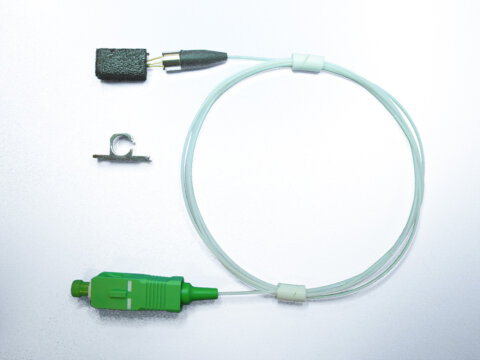
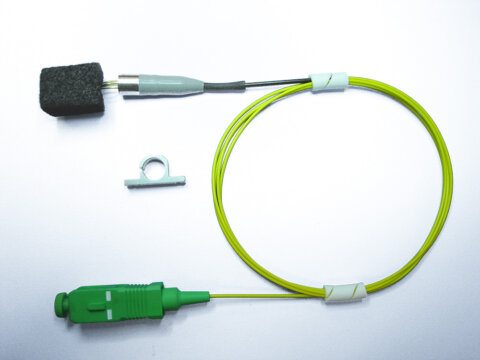
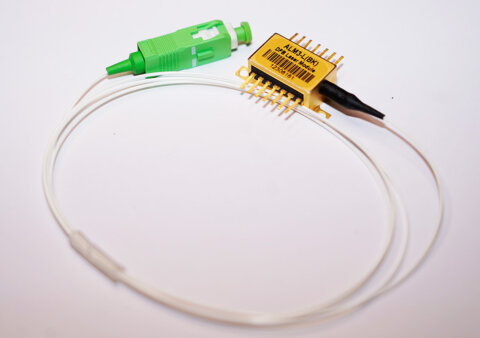
Analogue RF over fibre components are used when RF signals need to travel over longer distances without the losses, grounding issues, or electromagnetic interference that often come with conventional coaxial cabling. Within optical communication & transmission, this is a clearly distinct branch because the task is not standard digital data transfer, but the stable transport of analogue RF behaviour across an optical path. That changes the design logic from the outset. In practice, the question is not simply whether fibre can carry the signal, but whether the full link preserves the signal well enough for the application.
For customers working with antenna remoting, distributed RF systems, test environments, or EMI-sensitive installations, frequency range, linearity, dynamic range, and system noise are critical from the outset. In these applications, analogue RF over fibre offers a focused and often highly practical solution path.
Do you want to know more about this technology? Try out our new Chatbot!

Technical overview
Within the broader fibre optics category and the parent group optical communication & transmission, analogue RF over fibre is the route taken when the signal needs to remain analogue through the optical section of the system. That makes it very different from digital optical components or optical transceivers, where protocol handling, bit integrity, and interface standards are usually the main concern. Here, the optical link becomes part of an analogue chain, and that means every stage has to be considered from an RF point of view as well as an optical one.
Customers typically look at this branch when electrical cable runs are becoming too lossy, too susceptible to interference, or too difficult to manage from a grounding perspective. The benefit is not only reach. It is also cleaner separation between locations, lower sensitivity to electromagnetic environments, and more flexible system layouts. The key is to treat the link as an RF transport system, not just as fibre with an RF label on it.
Key selection factors
- RF frequency range: The first step is to match the component path to the actual RF band and modulation behaviour in the application. A link that looks acceptable at a headline level may still be the wrong fit once the full operating range is considered.
- Linearity expectations: Where multiple carriers, varying signal levels, or more demanding RF behaviour are involved, linearity becomes central. This is often the dividing line between simple transport links and more performance-sensitive RF systems.
- Noise and dynamic range: In many real systems, this matters just as much as raw reach. Customers usually need to understand how the optical section behaves as part of the wider RF budget, not as a standalone path.
- Distance versus coaxial limitations: One of the strongest reasons to move into analogue RF over fibre is when coaxial losses, weight, or installation complexity start to become a problem. That is often where the optical route becomes easier to justify.
- Electrical isolation: Fibre can simplify difficult grounding environments and help reduce the effect of electrical interference between remote locations. This becomes especially valuable in distributed or electrically noisy installations.
- System stability over time: A common pitfall is to focus only on initial signal transport. Long-term behaviour under temperature variation, power fluctuation, and real-world operating conditions is just as important for a usable reliable design.
Integration notes
Analogue RF over fibre needs to be integrated as a complete signal chain rather than as a single optical segment. The RF front end, the optical section, the power conditions, and the downstream reconstruction transmission all influence the final result. One common pitfall is to test the link under ideal bench conditions and then assume the same behaviour will hold in the installed system. Compared with other optical communication & transmission branches, this path is much more sensitive to analogue behaviour across the whole architecture. Shielding, grounding strategy, connector selection, thermal stability, and repeatable calibration points all deserve attention early. If the system will be maintained in the field, it also helps to design around test access and predictable performance checks from the start.
Why our portfolio is right for you
Analogue RF over fibre projects usually benefit most when the optical link is selected in the context of the wider RF chain, installation environment, and long-term operating stability.
FAQs on analogue RF over fibre components
Analogue RF over fibre components FAQs
Analogue RF over fibre components are used to transport radio-frequency signals over fibre while keeping the signal path functionally analogue. They are typically chosen when customers need longer reach, better electrical isolation, or lower sensitivity to electromagnetic interference than a coaxial route can provide.
Digital optical components are intended for defined digital signals and protocol-based communication paths. Analogue RF over fibre components are different because the aim is to preserve analogue RF behaviour through the optical link rather than convert the application into a conventional digital data channel.
It is often more suitable when coaxial runs become too lossy, too heavy, too vulnerable to interference, or too difficult to manage from a grounding perspective. That is especially common in remote antenna systems, distributed infrastructure, and laboratory or instrumentation setups.
- Longer practical reach
- Better electrical isolation
- Reduced susceptibility to EMI along the route
The main priorities are usually frequency behaviour, linearity, dynamic range, and noise performance across the full signal chain. Customers also need to consider how temperature, power stability, and installation conditions influence repeatable RF behaviour over time.
No. Fibre can solve important installation and interference problems, but the optical conversion stages still need to support the RF performance the system requires. The real value comes from the overall architecture, not from the medium alone.
They can be, but the suitability depends on how demanding the carrier mix and dynamic range requirements are. Multi-carrier environments usually place more pressure on linearity and predictable behaviour than simpler single-signal links.
Customers should validate the full working signal path rather than just basic link presence. A useful integration plan usually includes: • Performance across the intended RF range • Behaviour under realistic signal conditions • Stability over power and temperature variation
It is a separate section because the engineering logic is different from standard digital fibre links. The selection process is centred on analogue signal transport quality, not primarily on protocol compatibility or digital interface standards.