FP-00C-5D0 POF Duplex Plug RedLink® Transceiver
- Technology
- Fibre optic transceivers
- Partner
- Firecomms
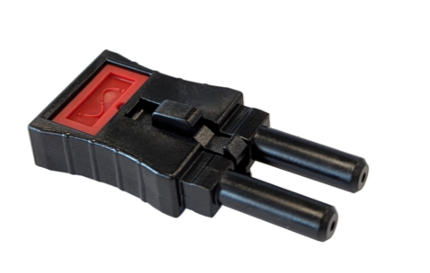
The FP-00C-5D0 POF Duplex Plug Transceiver is a compact fibre-optic module that provides a complete transmit-and-receive link over plastic optical fibre. Housed in a RedLink® duplex plug format, this transceiver combines a 650 nm RCLED emitter and a matching receiver in one unit, simplifying designs by replacing separate fiber optic transmitters and receivers. It supports digital data rates from DC up to 5 MBd, easily covering common serial protocols such as RS-232, RS-485, CAN and Modbus used in industrial automation.
Designed for harsh EMI environments, the optical link offers galvanic isolation, preventing ground loops and ensuring reliable communication even in the presence of high voltages or electrical noise. With compatibility for standard 1 mm core POF (and plastic-clad silica fibre) over distances of up to 50 m, it provides a flexible, cable-frien dly solution for short-distance data links on factory floors or inside machines. The module operates across the full industrial temperature range (-40 °C to +85 °C) and runs on 3.3 V or 5 V DC supply, allowing easy interfacing with both modern controllers and legacy systems. By using a visible red LED source, the transceiver also benefits installers with a quick visual indication of link activity and alignment during setup.
Range features
A high level overview of what this range offers
Integrated duplex optical link – Combines both transmitter and receiver in one module, simplifying PCB layout and saving space.
DC to 5 MBd data rate – Accommodates low-speed up to 5 megabaud signals, supporting protocols like serial interfaces and fieldbus communication.
650 nm RCLED emitter – Uses a resonant-cavity LED with visible red output, aiding fibre alignment and providing a safe, eye-visible indication of operation.
Plastic optical fibre (POF) support – Optimised for 1.0 mm core POF (2.2 mm jacket) cables for cost-effective short-range links (up to ~50 m typical).
Downloads
for FP-00C-5D0 POF Duplex Plug RedLink® Transceiver
What’s in this range?
All the variants in the range and a comparison of what they offer
| Specification | Value |
|---|---|
Data rate | DC to 5 MBd (megabaud) |
Wavelength | 650 nm (visible red light source) |
Transmitter | Integrated RCLED with driver (logic-level input) |
Receiver | Photodiode with internal amplifier (TTL push-pull output) |
Supply voltage | 2.97 V – 5.5 V DC (supports 3.3 V or 5 V logic systems) |
Supply current | ~20 mA (typical total, varies with data load) |
Optical fibre type | 1 mm core step-index POF (2.2 mm jacket); 200 µm PCS supported |
Typical link length | 50 m over POF (typical conditions); ~30 m in worst case |
Operating temp. | -40 °C to +85 °C (industrial range) |
Housing | RedLink® duplex plug, UL 94 V-0 flame-retardant plastic |
Mounting | Through-hole plug module (horizontal, vertical, or 30° options) |
Isolation | Optical galvanic isolation, no electrical connection between link ends |
Compliance | RoHS compliant (lead-free) |
FAQs
for FP-00C-5D0 POF Duplex Plug RedLink® Transceiver
It is designed for digital communication from DC (static signals) up to 5 MBd. This means it can comfortably handle data rates up to about 5 million bits per second, which covers low to moderate-speed protocols and serial interfaces commonly used in industrial and instrumentation systems.
The transceiver works with standard 1.0 mm core plastic optical fibre (POF) with a 2.2 mm outer jacket, which is very common for short-distance data links. It can reliably transmit over distances of around 50 m using step-index POF under typical conditions (around 30 m in worst-case conditions). It’s also compatible with 200 µm plastic-clad silica (PCS) fibre, allowing use in applications that might require a bit lower attenuation or higher temperature tolerance than pure plastic fibre.
Yes. Because it transfers data via light through an optical fibre, there is no electrical connection between the transmitting and receiving side. This optical galvanic isolation means the device naturally breaks ground loops and can withstand large differences in ground potential. It’s ideal for applications that need high voltage isolation or operation in environments with a lot of electrical noise – the fibre link won’t pick up electromagnetic interference like a copper connection would.
The module has an integrated driver for the LED transmitter and an amplifier for the photodiode receiver, making it easy to interface with logic signals. The transmitter input accepts a standard TTL/CMOS logic drive (compatible with 3.3 V or 5 V logic levels). The receiver output is provided as a TTL-level digital signal (push-pull output), so it can directly drive logic inputs high and low without the need for an external pull-up resistor. In practice, you simply supply power (5 V or 3.3 V) and connect the TX data input and RX data output lines to your microcontroller or UART – no additional conditioning circuitry is required.
The FP-00C-5D0 comes in a duplex plug form factor with a small through-hole pin footprint. It is typically provided in variants for horizontal, vertical, or 30° angled orientations to suit different board designs. Each unit has four pins (power, ground, TX input, RX output) that can be soldered into a PCB or plugged into a suitable socket/connector on your board. The dual fiber ports protrude from the housing, which either align with panel cutouts or simply allow the fiber to be inserted. In essence, mounting and connecting it is similar to installing a standard fiber-optic transmitter/receiver pair, but here it’s one integrated component carrying both signals.