CT-0155NSP-MB2L-A 1310 nm LED 2 km SFP Transceiver
- Technology
- Fibre optic transceivers
- Partner
- Coretek
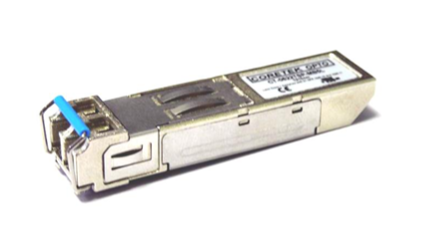
This plug-in SFP transceiver module provides cost-effective fibre connectivity for legacy network links and short-haul data communication. Operating at 1310 nm with an LED transmitter, it supports 155 Mb/s data streams such as OC-3/STM-1 SONET/SDH or 100 Mb Ethernet (100BASE-FX) over multimode fibre up to about 2 km.
The unit fits any standard SFP slot and uses a duplex LC connector for easy fibre patching. Designed without digital diagnostics (DDM), it focuses on core functionality and simplicity for applications that do not require real-time monitoring. The -A variant of this model features an extended operating temperature range (–40 °C to +85 °C), making it suitable for industrial and outdoor deployments. With its hot-pluggable design and compliance with the SFP Multi-Source Agreement (MSA), integration into existing equipment is straightforward and vendor-neutral.
Range features
A high level overview of what this range offers
- 155 Mb/s data rate support – Handles OC-3/STM-1 and Fast Ethernet fibre links for legacy telecom and networking applications
- 1310 nm LED optical transmitter – Reliable short-range performance over multimode fibre (up to ~2 km) with a cost-efficient LED source
- Duplex LC connector interface – Standard SFP connector for quick connection to multimode fibre patch cords (50/125 µm or 62.5/125 µm)
- Hot-pluggable SFP form factor – Enables easy installation or replacement without downtime, fitting any MSA-compliant SFP slot
- Industrial operating range – –40 °C to +85 °C case temperature rating for dependable operation in harsh or outdoor environments
- Single 3.3 V power supply – Simplifies power design and is energy-efficient, typically consuming well under 1 W
- MSA compliant design – Adheres to SFP multi-source specifications for broad compatibility with switches, routers, and other host devices
- RoHS and Class 1 safety compliant – Meets environmental standards and laser eye safety requirements for use in controlled environments
Downloads
for CT-0155NSP-MB2L-A 1310 nm LED 2 km SFP Transceiver
What’s in this range?
All the variants in the range and a comparison of what they offer
| Specification | Value |
|---|---|
Form factor | SFP (Small Form-factor Pluggable module) |
Optical transmitter | 1310 nm LED |
Optical receiver | PIN photodiode |
Fibre type | Multimode fibre (50/125 µm or 62.5/125 µm core) |
Distance supported | Up to 2 km over MMF |
Data rate (bit rate) | 155 Mb/s (OC-3/STM-1 or 100 Mb Fast Ethernet) |
Optical interface | Duplex LC connector |
Digital diagnostics (DDM) | No (DDM not supported in this model) |
Operating temperature | –40 °C to +85 °C (industrial grade variant) |
Storage temperature | –40 °C to +85 °C |
Supply voltage | 3.3 V DC typical (range 3.13 V to 3.47 V) |
Power consumption | < 1 W (typically 0.5–0.8 W during operation) |
Compliance standards | SFP MSA; SONET OC-3 IR; SDH STM-1 S-1.1; 100BASE-FX; Class 1 laser safety (IEC 60825) |
FAQs
for CT-0155NSP-MB2L-A 1310 nm LED 2 km SFP Transceiver
This SFP is designed for 155 Mb/s optical links. It fully supports SONET OC-3 / SDH STM-1 at 155.52 Mb/s, which is commonly used in telecom networks, and it’s also suitable for 100BASE-FX Fast Ethernet (100 Mb/s) over multimode fibre. The module’s optical characteristics meet the requirements for these legacy standards, making it a versatile choice for equipment that operates at or around the OC-3 data rate.
The CT-0155NSP-MB2L-A is optimised for multimode fibre and can reliably reach distances up to approximately 2 km using 50/125 µm or 62.5/125 µm multimode cabling. It uses a 1310 nm LED source, which is ideal for short-range multimode links. While the module can physically connect to single-mode fibre (due to the LC connector), an LED transmitter is not intended for long single-mode runs – in single-mode fibre the reach would be very limited (significantly less than 2 km). For any installation requiring greater distance or strictly single-mode performance, a laser-based SFP designed for single-mode would be recommended instead.
Yes. This particular model is the “-A” industrial grade variant, rated for an operating case temperature range from –40 °C to +85 °C. It is built to handle extreme temperatures often encountered in outdoor enclosures or industrial environments. The extended temperature specification makes it reliable for use in traffic systems, remote telemetry, base station equipment, and other scenarios where standard commercial-temperature modules would not be sufficient.
No, the CT-0155NSP-MB2L-A does not support digital diagnostic monitoring (it is listed as “W/O” DDMI in the specifications). This means the module does not report real-time parameters like optical power, temperature or voltage to the host. It is intended as a simpler plug-and-play SFP for basic link functionality. If monitoring is required, other variants (such as those with a “-D” or “-E” suffix in the series) include DDM support, but this MB2L-A version forgoes it to focus on core connectivity.
An LED-based SFP (like this one) uses an LED emitter instead of a laser diode. The main advantage is typically cost and durability – LEDs are generally less expensive and may have a longer service life for short-distance use. However, LED transmitters have a broader optical spectrum and lower coupled power, which limits the reach to around 2 km and restricts optimal use to multimode fibre. In contrast, laser-based SFPs (using FP or DFB lasers) can achieve much longer distances on single-mode fibre (tens of km) thanks to higher power and a narrow spectrum, but they come at higher cost. So, the LED SFP is a cost-effective choice for short links where 2 km or less on multimode is sufficient, whereas lasers are chosen for extended reach or single-mode requirements.
The module is designed according to the SFP MSA (Multi-Source Agreement), which means it is mechanically and electrically standardised. You simply insert it into any standard SFP slot or cage on your switch, router, media converter or SDH/SONET equipment. It is hot-pluggable, so you do not need to power down the system to install or replace it. Once plugged in, the transceiver’s LC ports can be connected to your multimode fibre optic cables. It operates from the host’s 3.3 V power supply and requires no special configuration – as long as your equipment supports OC-3 or 100 Mb optical interfaces, the link should come up automatically. Just make sure to match the SFP with the correct type of fibre and wavelength on the other end (another 1310 nm, 155 Mb/s module) for proper operation.
Mechanically and electrically, the module is vendor-neutral thanks to adherence to the SFP standards. It will fit and function in any device with standard SFP ports for 155 Mb/s optical modules. Many major network vendors use coded SFPs, but in practice a generic MSA-compliant SFP like this often works plug-and-play in their hardware for the supported speed (OC-3/FE). In cases where a switch expects a specific vendor-coded SFP, you may get a warning or need to enable third-party transceiver support. However, from a hardware standpoint, the CT-0155NSP-MB2L-A uses the common SFP interface and should be electrically compatible with all standard SFP hosts at 155 Mb/s. It has the same pin assignments, link diagnostics (LOS, TX_FAULT, etc.), and performance characteristics required for interoperability. Always consult your device’s documentation to confirm third-party module support, but technically this transceiver meets the required specifications for broad compatibility.