FB2M5PVR 650 nm 10-250 MBd 50-80 m RedLink® POF Transceiver
- Technology
- Fibre optic transceivers
- Partner
- Firecomms
The FB2M5PVR RedLink® POF Transceiver is a compact duplex optical module designed for short-range data communication over plastic optical fibre. Operating at a visible 650 nm red wavelength, it offers plug-and-play fibre connectivity using standard RedLink duplex connectors. The transceiver supports data rates from DC up to 250 Mbps, covering 10 Mb/s and 100 Mb/s Ethernet (100BASE-FX) and other high-speed serial protocols used in industry.
Built-in driver and receiver circuits provide a differential LVDS interface, allowing direct connection to FPGAs, network controllers or PHY chips for noise-immune data links. A visible red LED output makes setup and troubleshooting easier, while remaining Class 1 eye-safe. Engineered for demanding conditions, the module operates from -40 °C to +85 °C with a rugged UL 94 V-0 rated housing, ensuring dependable performance in factory automation, robotics, transportation systems, medical devices, and other harsh industrial applications.
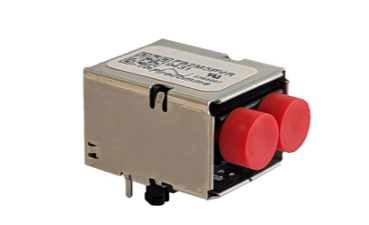
Range features
A high level overview of what this range offers
- Standard RedLink duplex interface – Uses an industry-standard POF connector system (Versatile Link style) for easy integration and retrofitting in existing fibre-optic networks.
- High data rate up to 250 Mbps – Supports 10 Mb, 100 Mb and higher serial protocols, suitable for Fast Ethernet and real-time industrial fieldbus communications.
- 650 nm visible light source – Utilises a red RCLED emitter that aids fibre alignment and fault-finding, while remaining eye-safe (Class 1) for users.
- LVDS differential I/O – Integrated low-voltage differential signalling interface for robust, EMI-resistant data transmission; compatible with LVDS, LVPECL, and CML logic levels.
- Signal Detect output – Built-in link status indicator pin signals the presence of an optical input, simplifying diagnostics and enhancing system reliability.
- Low power consumption – Intelligent design enters a sleep mode (drawing < 25 µA) when no optical signal is detected, reducing energy usage during idle periods.
- Wide temperature range – Rated for -40 °C to +85 °C operation to ensure stable performance in extreme indoor or outdoor environments.
- Durable flame-retardant housing – Sturdy through-hole module casing (UL 94 V-0) protects internal optics and electronics, meeting industrial safety and flammability standards.
- 50–80 m link range – Achieves ~50 m reach at full 250 Mb/s speed (up to ~80 m at lower data rates or with optimal fibre), providing flexibility in machine or vehicle networking layouts.
- Standards compliant – Fully RoHS compliant and satisfies IEC 60825-1 Class 1 eye safety requirements for safe, globally approved operation.
Downloads
for FB2M5PVR 650 nm 10-250 MBd 50-80 m RedLink® POF Transceiver
What’s in this range?
All the variants in the range and a comparison of what they offer
| Parameter | Value |
|---|---|
Optical interface | RedLink® duplex POF port (requires standard 1 mm POF connectors) |
Fibre type | 1 mm core plastic optical fibre (PMMA SI-POF) |
Wavelength | 650 nm (visible red LED source) |
Electrical interface | LVDS differential I/O (compatible with LVPECL & CML) |
Signal detect | Yes (digital output indicates optical link presence) |
Supply voltage | 3.0 V – 3.6 V DC (nominal 3.3 V) |
Power consumption | Active ~ tens of mA (depends on data rate); Idle < 25 µA (sleep mode) |
Operating temperature | -40 °C to +85 °C (industrial temperature range) |
Link distance (typical) | ~50 m at 250 Mbps over standard SI-POF (up to ~80 m at lower speeds) |
Housing | Through-hole module (vertical mount), UL 94 V-0 plastic housing |
Compliance | IEC 60825-1 Class 1 eye-safe; RoHS compliant |
FAQs
for FB2M5PVR 650 nm 10-250 MBd 50-80 m RedLink® POF Transceiver
The transceiver is designed for standard 1 mm step-index plastic optical fibre (POF) with a duplex RedLink connector interface. Each module has two ports that mate with industry-standard RedLink plug connectors (plastic fibre optic plugs) for transmit and receive. These connectors are the same style used in many legacy POF systems, ensuring easy adoption. (In practice, you terminate the POF cable with the appropriate RedLink plugs – typically one black and one grey plug – and then insert them into the module’s duplex port to establish a link.)
The FB2M5PVR supports data rates from DC (0 Mb/s) up to 250 Mb/s (250 MBd line rate). This covers standard network speeds like 10 Mb/s Ethernet and 100 Mb/s Fast Ethernet with ample headroom. In fact, it is specifically designed to handle the 125 MBd signalling of 100BASE-FX Ethernet. Beyond networking, it can carry other high-speed serial protocols used in industry (for example, fieldbus systems like EtherCAT or Sercos III that operate at 100 Mb/s). Any application up to a quarter-gigabit per second is within this module’s capability.
Under typical conditions, you can expect around 50 metres of reliable link length over standard 1 mm POF at the full 250 Mb/s data rate. If you don’t need the maximum speed, the reach can be extended – for example, at lower data rates (or with high-quality low-attenuation POF), distances up to around 80 m are achievable. It’s worth noting that these figures assume good fibre quality and proper termination. In harsher conditions or with very aged fibre, the maximum distance could be less (worst-case scenarios around 30 m at full speed), so always budget some safety margin for critical links.
This transceiver uses a differential LVDS interface for its data I/O, not TTL. That means the transmit and receive data lines are a pair of low-voltage differential signals, which helps with noise immunity at high speeds. You will typically interface it to an LVDS-compatible device – for example, an Ethernet PHY chip, FPGA, or microcontroller that has LVDS transceivers. Many industrial controllers and communication ICs support LVDS or similar (LVPECL/CML), so integration is straightforward in those cases. If your system only has single-ended TTL I/O, you would need level translation or a different transceiver variant designed for TTL. (Firecomms offers lower-speed POF transceivers that work with TTL logic if needed.)
The Signal Detect (SD) output is a digital status pin that indicates whether a sufficient optical signal is being received. In other words, it goes active when the incoming light level on the fibre is above the receiver’s threshold (meaning the link is up), and it drops inactive if the optical signal is lost or too weak (link down). This feature is very useful in system diagnostics – your microcontroller or FPGA can monitor the SD pin to know if the remote end is transmitting or if the fibre link has been disconnected or fails. It essentially acts as a link presence indicator, allowing your system to implement fail-safes or alert the user if the optical connection is broken. In the FB2M5PVR, the SD output is a simple logic signal (on/off). There is also a related product variant that provides an analogue RSSI output for those who want to measure the exact optical power level, but for most digital communication needs, the SD pin in the PVR variant is sufficient to detect link status.
Yes. The transceiver is designed with an automatic power-down/sleep mode to save energy when no data is being transmitted. Specifically, if the module detects no optical signal input (i.e., the link is idle or the remote transmitter is off), it can enter a low-power standby state. In this idle mode, the transmitter LED is turned off and the receiver circuitry goes into a quiescent state, drawing only a very small standby current (on the order of tens of microamps). Once data activity resumes or an optical signal is present again, the device wakes up almost instantly to full operation. This feature helps minimise power consumption in applications where the fibre link isn’t continuously active, and it doesn’t require any special control signals — it operates automatically based on the absence of incoming light.
The FB2M5PVR is the vertical mount version with digital signal detect. Within this RedLink transceiver range, there are a few variants to address different requirements. For instance, there is an FB2M5PRR variant which provides an analogue RSSI output instead of the simple digital SD – that one lets you monitor received optical power level continuously. Additionally, Firecomms offers the same 10/100/250 Mb/s transceiver in an OptoLock® format (FB2M5K series). The OptoLock version has a different housing that allows you to insert bare POF cable directly without connectors, using a built-in latching mechanism to hold the fibre. The optical and electrical performance is similar, but OptoLock makes field termination even quicker since you don’t need to attach plugs to the fibre ends. In summary, you can choose the standard RedLink connectorised module (PVR/PRR) for compatibility with existing connector systems, or the OptoLock module (KVR/KRR) if you prefer a plugless fibre connection. All share the same core specs, so it really depends on whether you want to use fibre connectors or not, and whether you need an analogue diagnostic output.