HCS® 600 µm 0.37 NA Low OH Optical Fibre
- Technology
- Speciality fibre
- Partner
- Lightera (formerly OFS)
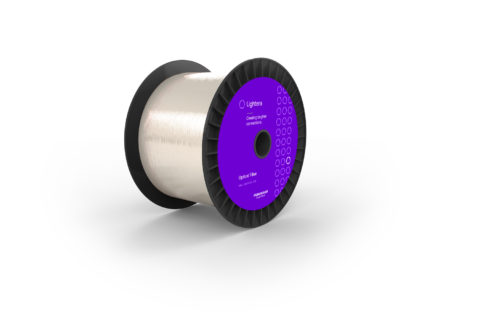
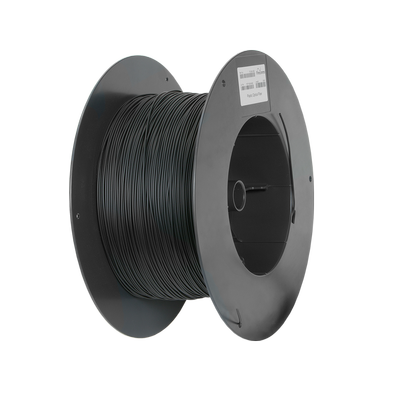
The CF01493-14 HCS® 600 µm Low OH Optical Fibre is a rugged step-index multimode fibre built for demanding use. It features a 600 µm pure silica core with hard polymer cladding and protective buffer layers for strong mechanical durability and easier handling. Optimised for visible red and near-infrared wavelengths around 650 nm and 850 nm, it maintains low attenuation across a broad spectrum. Its low hydroxyl content supports improved performance at longer wavelengths compared with standard high-OH fibre. The large core and 0.37 numerical aperture help capture more light from emitters, simplifying coupling and connectorisation. This makes it well suited for industrial data links, optical sensors, spectroscopy setups, and laser delivery systems. The fibre is also designed to resist chemicals, mechanical stress, and challenging environmental conditions. With an operating range from –65 °C to +125 °C, it can be deployed in factories or outdoor installations. Its HCS construction supports practical field handling and reliable long-term service.
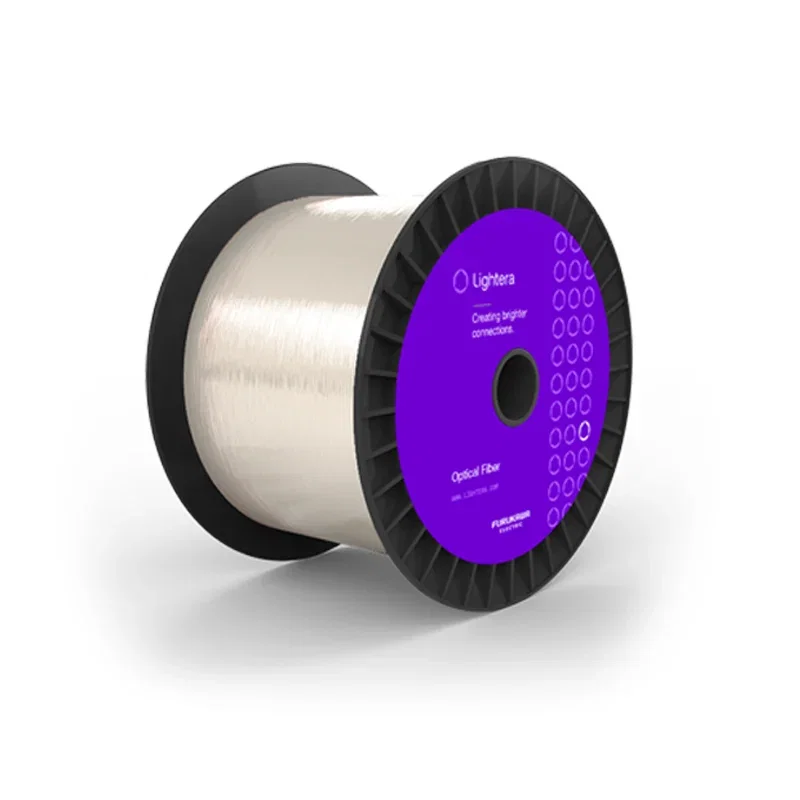
The CF01493-14 HCS® 600 µm 0.37 NA Low OH Optical Fibre is engineered for applications that need a large-core, rugged, and easy-to-handle optical transmission medium. Its Hard-Clad Silica construction combines a pure silica core with durable polymer cladding and ETFE buffering, giving a strong balance of optical efficiency and mechanical resilience.
Designed for demanding industrial and instrumentation environments, this fibre supports operation across visible red and near-infrared wavelengths while offering reliable performance under bending, twisting, temperature extremes, and chemical exposure. The large 600 µm core and high 0.37 NA make light capture easier, which helps reduce alignment sensitivity and supports the use of practical, cost-effective light sources and connector solutions.
Range features
A high level overview of what this range offers
- High mechanical strength: Built for durable performance under heavy use and repeated handling
- Bend-insensitive design: Helps minimise signal loss when routed around bends
- Large 600 µm core: Improves light capture and simplifies alignment with emitters
- 0.37 numerical aperture: Provides a wide acceptance angle for efficient coupling
- Low OH silica core: Supports reduced attenuation at longer wavelengths
- Quick crimp-and-cleave compatibility: Simplifies field termination and connectorisation workflows
- Chemical-resistant construction: Suitable for exposure to common industrial chemicals
- Wide operating temperature range: Stable performance from –65 °C to +125 °C
- High crush and twist tolerance: Maintains reliability under mechanical stress
- Thick buffered design: Easier for technicians to handle and install in the field
- Versatile application range: Suitable for industrial links, sensors, spectroscopy, and laser delivery
Downloads
for HCS® 600 µm 0.37 NA Low OH Optical Fibre
What’s in this range?
All the variants in the range and a comparison of what they offer
Specification | Value |
Product Description | 600 µm 0.37 NA Low OH multimode fibre |
Core Diameter | 600 ± 10 µm |
HCS Cladding Diameter | 630 (+5/–10) µm |
Cladding Material | Hard polymer (HCS fluoroacrylate) |
ETFE Buffer Diameter | 1040 ± 30 µm |
Buffer Material | ETFE (fluoropolymer) |
Core/Clad Concentricity Offset | ≤ 8 µm |
Crimp & Cleave Compatible | Yes |
Numerical Aperture (NA) | 0.37 |
Attenuation @ 850 nm | ≤ 8 dB/km |
Water Content | Low OH (low hydroxyl) |
Operating Temperature | –65 °C to +125 °C |
Short-Term Bend Radius | ≥ 44 mm |
Long-Term Bend Radius | ≥ 71 mm |
Proof Test Level | ≥ 100 kpsi (0.689 GPa) |
Part Number | CF01493-14 |
Description Code | HCP-M0600T |
Available Options | Buffer Colour, Buffer Diameter, Buffer Material, Proof Test |
FAQs
for HCS® 600 µm 0.37 NA Low OH Optical Fibre
The 600 µm core allows the fibre to capture a large amount of light from optical sources, making alignment and coupling easier than with smaller-core fibres. The 0.37 numerical aperture (NA) provides a wide light acceptance angle, which helps when using LEDs or other less tightly focused emitters. Together, these characteristics support efficient light transmission with simpler, more practical source coupling.
Low OH means the silica core contains low hydroxyl ion content. This matters because hydroxyl impurities can absorb light, especially in parts of the near-infrared range. A low-OH fibre therefore offers lower attenuation at longer wavelengths and can support a broader range of optical applications.
The fibre is designed to be bend-tolerant for its class, with a short-term bend radius of 44 mm and a long-term bend radius of 71 mm. This allows it to handle gentle routing and installation bends without significant optical loss or mechanical risk when used within specification.
Yes. The fibre is built for demanding environments and operates from –65 °C to +125 °C. Its hard polymer cladding and ETFE buffer provide resistance to chemicals, mechanical wear, and industrial handling stresses, making it suitable for factory, field, and outdoor use.
HCS fibre designs support practical field termination methods, including crimp-and-cleave approaches. This can reduce installation time by avoiding epoxy and polishing in compatible connector systems. For a 600 µm core fibre, suitable large-core connector hardware and proper cleaving practice should be used.
Typical applications include industrial data links, optical sensing, spectroscopy, instrumentation, and laser or high-power light delivery. It is especially useful where a rugged, large-core fibre is needed to transmit light reliably rather than maximise long-distance bandwidth.