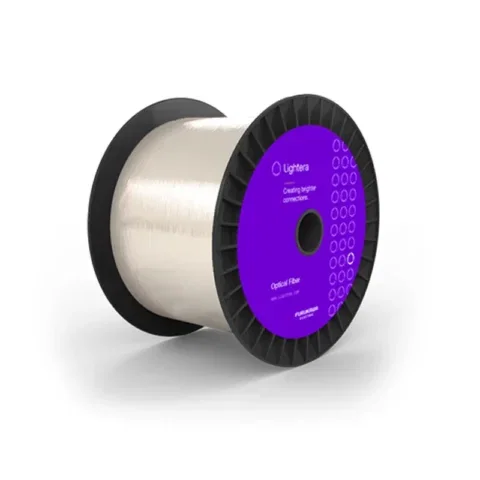
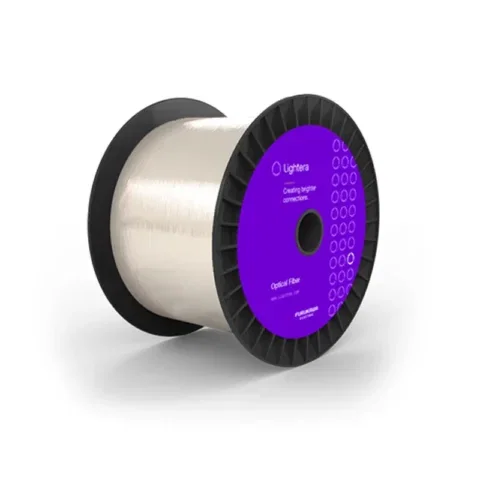
GEO Single Mode 1310/1550 nm 0.11 NA Carbon/PYROCOAT® Optical Fibre
- Technology
- Speciality fibre
- Partner
- Lightera (formerly OFS)
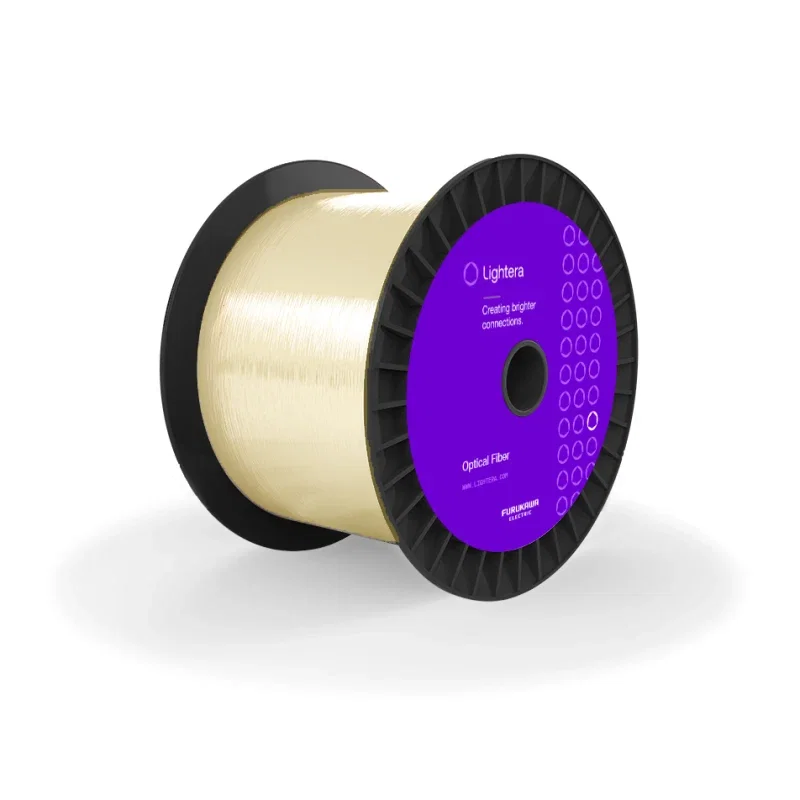
The BF05717 is a specialised single-mode optical fibre designed for use at both 1310 nm and 1550 nm wavelengths in challenging environments. It features a dual-layer Carbon/PYROCOAT® coating that helps protect the fibre from hydrogen ingress and thermal damage, enabling dependable operation in high-temperature and high-humidity conditions. With a standard 125 µm cladding and a thin 155 µm polyimide outer coating, this fibre can be tightly coiled for compact sensors or instrumentation without excessive loss. Its low attenuation at telecom wavelengths supports signal integrity over long distances, which is essential for downhole data links and distributed sensing. The robust construction also makes it suitable for geophysical monitoring and other demanding optical systems where conventional fibres may not perform reliably.
Range features
A high level overview of what this range offers
- Carbon/PYROCOAT dual coating: Helps resist hydrogen diffusion and supports operation at temperatures up to ~300 °C for improved reliability in harsh environments.
- Dual-wavelength single-mode performance: Optimised for 1310 nm and 1550 nm to support standard telecom links and fibre-optic sensing systems.
- Low attenuation: ≤0.7 dB/km at 1310 nm and ≤0.6 dB/km at 1550 nm for maintaining signal quality over long distances.
- High mechanical strength: Proof tested to ≥200 kpsi (1.38 GPa) for dependable handling and deployment in demanding applications.
- Thin 155 µm coating diameter: Supports tighter bend radii and compact coil designs for sensors and space-constrained installations.
- Standard 125 µm cladding: Simplifies splicing and connectorisation with common single-mode fibre tools and components.
Downloads
for GEO Single Mode 1310/1550 nm 0.11 NA Carbon/PYROCOAT® Optical Fibre
Product Datasheet – GEO Single Mode 1310/1550 nm 0.11 NA Carbon/PYROCOAT® Optical Fibre
DownloadWhat’s in this range?
All the variants in the range and a comparison of what they offer
| Physical Characteristics | Value |
|---|---|
Coating Material | Carbon/PYROCOAT® |
Cladding Diameter | 125 ± 1 µm |
Coating/Buffer Diameter | 155 ± 5 µm |
Core/Clad Offset | ≤ 1.0 µm |
Core Diameter (Nominal) | 8.4 µm |
Optical Characteristics | |
Operating Wavelength | 1310 / 1550 nm |
Cutoff Wavelength | ≤ 1290 nm |
Mode Field Diameter @ 1310 nm | 9.3 ± 0.5 µm |
Mode Field Diameter @ 1550 nm | 10.5 ± 1.0 µm |
Attenuation @ 1310 nm | ≤ 0.7 dB/km |
Attenuation @ 1550 nm | ≤ 0.6 dB/km |
Numerical Aperture (NA) | 0.11 |
Mechanical & Environmental | |
Proof Test Level | ≥ 200 kpsi (1.38 GPa) |
Operating Temperature | Up to ~300 °C (application-dependent) |
Order by Part Number | BF05717 |
Product Description Code | SMT-A1310J2 |
Options (Customisation) | Buffer Colour/Diameter/Material, Cabling, Metallisation, Proof Test level, Termination |
FAQs
for GEO Single Mode 1310/1550 nm 0.11 NA Carbon/PYROCOAT® Optical Fibre
The dual coating combines a microscopic carbon layer with a PYROCOAT® polyimide overcoat. The carbon layer acts as a barrier against hydrogen ingress, which helps extend fibre life in hydrogen-rich or high-humidity environments. The polyimide outer coating supports operation at very high temperatures approaching 300 °C and adds strong mechanical and chemical durability. Together, these coatings help the fibre remain stable and reliable in harsh conditions such as oil wells and industrial high-temperature installations.
Thanks to the PYROCOAT polyimide coating, this fibre can operate at temperatures up to around 300 °C. In practical use, it is suitable for environments exposed to extreme heat, such as downhole oil and gas applications or other high-temperature sensing installations. Exact performance at elevated temperatures can depend on the specific application, so validation under actual operating conditions is recommended.
Yes. The fibre uses a standard 125 µm cladding diameter and has a mode field diameter comparable to conventional single-mode telecom fibres. This supports splicing to common single-mode fibres with low splice loss and allows use with typical connector ferrules and alignment sleeves. Proper handling is still important because polyimide-coated fibres generally require different stripping methods than standard acrylate-coated fibres.
Yes. The BF05717 fibre is well suited to distributed sensing applications because it combines low attenuation, single-mode performance at 1310 nm and 1550 nm, hydrogen resistance, and high-temperature capability. These properties are especially useful in downhole Distributed Temperature Sensing (DTS) and Distributed Acoustic Sensing (DAS), where fibres may be exposed to heat, hydrogen, and long-term environmental stress.
This fibre can be customised for specific project requirements. Available options include changes to buffer colour, diameter, and material, as well as cabling, metallisation, proof test level, and termination. These choices help engineers adapt the fibre for installation, handling, protection, and reliability needs in specialised environments.
Typical applications include oil and gas downhole data links, sensing cables, distributed sensing systems, geophysical and seismic monitoring, and other harsh-environment optical systems. The fibre is also suitable for tightly coiled sensor designs and demanding optical equipment where stable single-mode transmission is required under thermal, mechanical, or chemical stress.