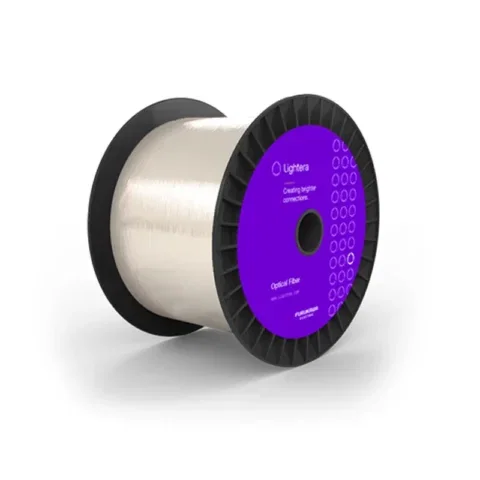
GiHCS® Multi-mode 62.5 µm Graded Index Optical Fibre
- Technology
- Speciality fibre
- Partner
- Lightera (formerly OFS)
The GiHCS® 62.5 µm Graded-Index Multimode Optical Fibre is designed for demanding industrial networking and harsh-environment data links. Its 62.5 µm graded-index core supports high-bandwidth signal transmission with reduced modal dispersion over practical distances. The hard polymer-clad construction increases durability and resistance to mechanical stress compared with conventional telecom fibre. It is suitable for applications exposed to vibration, temperature extremes, and confined routing conditions. The fibre supports simple Crimp & Cleave field termination, reducing installation complexity by eliminating epoxy and polishing steps. This makes it well suited for factory automation, industrial communications, avionics, wind energy systems, and other robust optical networking applications. Overall, it combines multimode optical performance with the toughness needed for reliable operation in demanding environments.
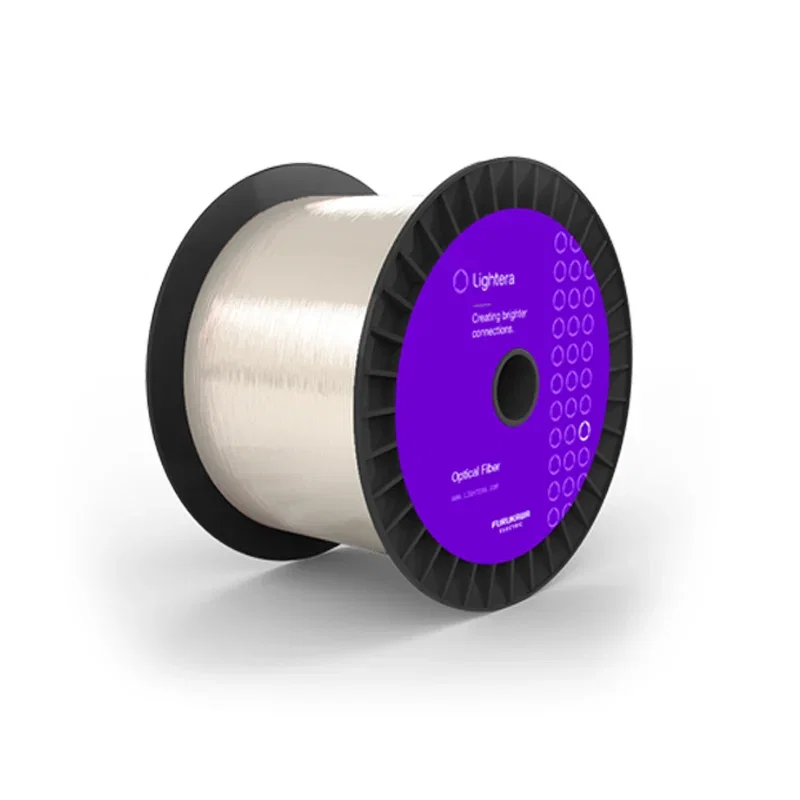
The GiHCS® 62.5 µm Graded-Index Multimode Optical Fibre is engineered for industrial and other harsh-environment networking applications where standard fibre may be too fragile. Its graded-index multimode design supports reliable high-bandwidth transmission for short-to-medium distance links, while the hard polymer cladding improves toughness against mechanical stress and difficult handling conditions.
A key advantage is its Crimp & Cleave compatibility, which enables fast field termination without epoxy, polishing, or power tools. This simplifies installation and maintenance in factories, remote sites, transport systems, avionics platforms, and renewable energy environments where robust, dependable optical links are essential.
Range features
A high level overview of what this range offers
- Hard polymer-clad design – Provides high mechanical strength and durability for harsh industrial environments.
- 62.5 µm graded-index core – Supports high optical bandwidth with reduced modal dispersion for reliable data transmission.
- Crimp & Cleave termination – Enables fast field termination without epoxy or polishing.
- Wide operating temperature range – Rated from -65 °C to +125 °C for demanding hot and cold environments.
- Tight bend tolerance – Supports routing in confined spaces with a short-term bend radius of 10 mm.
- High proof test rating – Tested to ≥150 kpsi for improved mechanical reliability.
- Configurable options – Available with different buffer colours, diameters, cabling formats, and connectorisation options.
What’s in this range?
All the variants in the range and a comparison of what they offer
Specification | Value |
Product Description | GiHCS 62.5 µm Multimode Optical Fibre (industrial grade) |
Core Diameter | 62.5 ± 3 µm |
Cladding Diameter | 200 ± 4 µm |
Coating Diameter | 230 +0/–10 µm |
ETFE Buffer Diameter | 500 ± 30 µm |
Core/Coating Offset | < 5.0 µm |
Core/Clad Offset | < 3.0 µm |
Crimp & Cleave Compatible | Yes |
Cladding Material | Silica (glass) |
Coating Material | HCS fluoroacrylate polymer |
Buffer Material | ETFE (thermoplastic) |
Fibre Type | Graded-Index Multimode |
Numerical Aperture (NA) | 0.275 |
Bandwidth @ 850 nm | ≥ 200 MHz·km |
Bandwidth @ 1300 nm | ≥ 500 MHz·km |
Attenuation @ 850 nm | ≤ 3.5 dB/km |
Attenuation @ 1300 nm | ≤ 1.2 dB/km |
Operating Temperature | -65 °C to +125 °C |
Short-Term Bend Radius | ≥ 10 mm |
Long-Term Bend Radius | ≥ 16 mm |
Proof Test Level | ≥ 150 kpsi (≈ 1.03 GPa) |
Base Part Number | F14404 |
Available Options | Buffer Colour, Buffer Diameter, Cabling configuration, Crimp & Cleave Connectorisation, Proof Test level |
FAQs
for GiHCS® Multi-mode 62.5 µm Graded Index Optical Fibre
A graded-index multimode fibre has a refractive index profile that gradually changes from the centre of the core outward. This reduces modal dispersion and allows higher bandwidth than a comparable step-index multimode fibre, helping the 62.5 µm fibre carry high-speed data more effectively over practical distances.
The hard polymer cladding adds mechanical protection around the glass structure, making the fibre more resistant to handling stress, vibration, bending, and demanding industrial installation conditions. This added toughness helps the fibre perform reliably where conventional fibre may be too fragile.
The fibre supports a Crimp & Cleave termination method. The connector is attached mechanically to the fibre, then the protruding glass is cleaved flush at the connector tip. This avoids epoxy, polishing, and complex tooling, making field installation faster and simpler.
The fibre is suited to short-to-medium distance industrial data links and supports bandwidth levels appropriate for applications up to Gigabit-class Ethernet, depending on the transceivers and system design. Lower-speed industrial communication links can typically be run over longer distances.
It is intended for harsh and demanding environments such as factory automation, industrial networking, avionics, transportation systems, wind turbines, and other installations where vibration, temperature extremes, limited space, or mechanical stress can challenge standard optical fibre.
The operating temperature range is -65 °C to +125 °C, making it suitable for very cold outdoor conditions as well as high-temperature industrial or transport applications where thermal stability is important.
Yes. Because the fibre uses a 200 µm cladding and 230 µm coating, it should be used with connectors, crimp components, and splicing tools designed for hard-clad silica fibre dimensions rather than standard 125 µm fibre hardware.
A proof test rating of ≥150 kpsi indicates that each fibre has been tested to a high tensile stress level, helping confirm strong mechanical integrity. This supports long-term reliability in demanding installations where pulling, bending, and ongoing mechanical strain are concerns.