NT250 series tunable wavelength UV-NIR range DPSS lasers
- Technology
- DPSS lasers
- Partner
- Ekspla
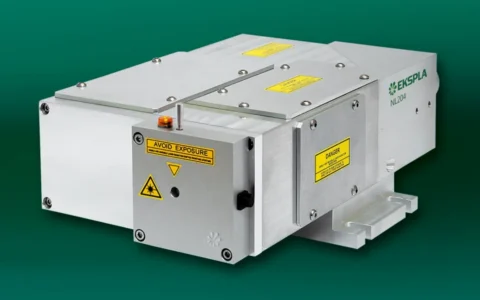
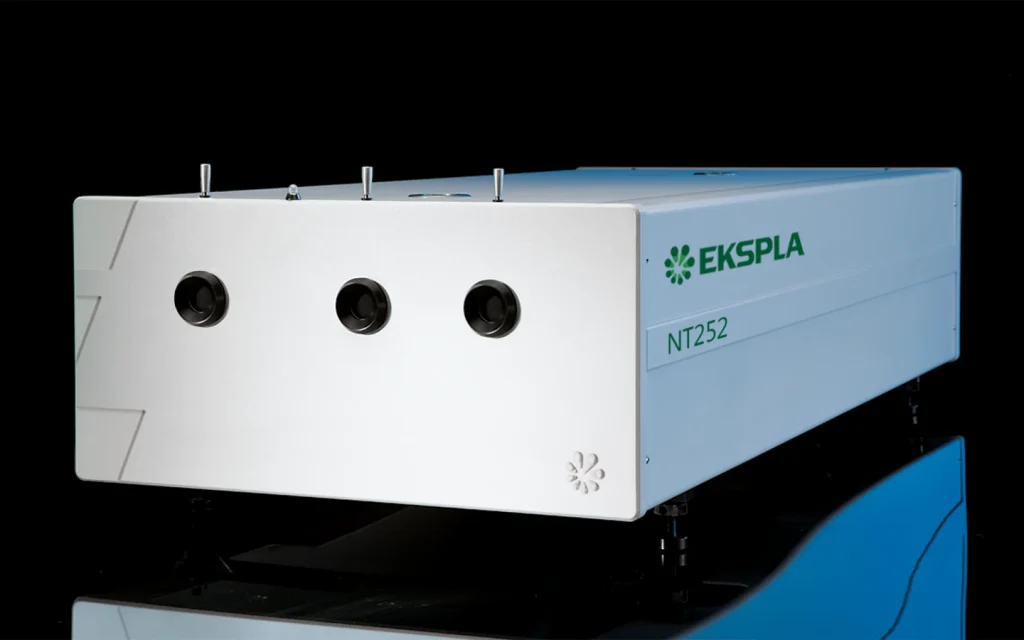
The NT250 series tunable nanosecond DPSS laser system combines a 532 nm Q-switched pump laser and an optical parametric oscillator within one laser housing. It is intended for tunable excitation and measurement tasks in photoacoustic imaging, laser-induced fluorescence spectroscopy, pump-probe spectroscopy, photobiology, remote sensing and metrology. The NT252 provides signal output from 670 to 1064 nm and idler output from 1065 to 2600 nm, while the -SH option extends operation into the UV-visible region. Motorised tuning and programmable wavelength scanning allow automated operation without manual adjustment between setpoints.
A 1000 Hz repetition rate and 1–4 ns OPO pulse duration suit experiments requiring nanosecond excitation with repeated acquisition. Operation is available from a backlit keypad or PC, with USB, RS232, LAN and WLAN interfaces for equipment integration. Air cooling removes the need for tap-water cooling, while fibre-coupled delivery, attenuation and separate harmonic outputs are available as configuration options.
Range features
A high level overview of what this range offers
- Integrated DPSS pump laser and OPO: Reduces the number of separately housed laser components.
- 335–2600 nm configured tuning range: Supports UV, visible and NIR experiments from one laser system.
- Motorised, no-gap tuning: Removes the need for manual wavelength adjustment.
- Programmable wavelength scanning: Supports automated spectral acquisition routines.
- 1000 Hz pulse repetition rate: Provides up to 1000 excitation pulses per second.
- 1–4 ns OPO pulse duration: Supports nanosecond spectroscopy, imaging and pump-probe applications.
- 1–2 cm⁻¹ minimum tuning steps: Enables closely spaced spectral measurements.
- Air-cooled construction: Eliminates the requirement for tap-water cooling.
- USB, RS232, LAN and WLAN interfaces: Support local, serial and network-based control.
- Fibre coupling and attenuation options: Provide alternative methods for delivering and controlling the output beam.
What’s in this range?
All the variants in the range and a comparison of what they offer
NT252 specifications
| Category | Specification | NT252 |
|---|---|---|
OPO | Signal wavelength range | 670–1064 nm |
OPO | Idler wavelength range | 1065–2600 nm |
OPO | SH wavelength range | 335–669 nm |
OPO | OPO pulse energy | 1100 µJ |
OPO | SH pulse energy | 200 µJ |
OPO | Pulse duration | 1–4 ns |
OPO | Pulse repetition rate | 1000 Hz |
OPO | Linewidth | <10 cm⁻¹ |
OPO | Minimum signal tuning step | 1 cm⁻¹ |
OPO | Minimum idler tuning step | 1 cm⁻¹ |
OPO | Minimum SH tuning step | 2 cm⁻¹ |
OPO | Signal polarisation | Horizontal |
OPO | Idler polarisation | Vertical |
OPO | SH polarisation | Horizontal |
OPO | Typical beam diameter | 3 × 6 mm |
Pump laser | Pump wavelength | 532 nm |
Pump laser | Typical pump pulse energy | 4 mJ |
Pump laser | Pulse duration | 2–5 ns |
Pump laser | Pulse energy stability | <2.5% StdDev |
Physical | Laser unit dimensions, W × L × H | 456 × 1040 × 297 mm |
Physical | Power supply dimensions, W × L × H | 520 × 400 × 286 mm |
Physical | Umbilical length | 2.5 m |
Operating requirements | Cooling | Air-cooled |
Operating requirements | Room temperature | 18–27 °C |
Operating requirements | Relative humidity | 20–80%, non-condensing |
Operating requirements | Electrical input | 100–240 V AC, single-phase, 50/60 Hz |
Operating requirements | Power consumption | <1.5 kW |
Operating requirements | Room cleanliness | ISO Class 9 or better |
Specification notes
- Unless stated otherwise, specifications apply at 750 nm to the basic system without options.
- OPO pulse energy is measured at its maximum within the 700–750 nm interval.
- SH pulse energy is measured at 400 nm.
- Pulse durations are measured at FWHM using a photodiode with a 1 ns rise time and a 300 MHz oscilloscope.
- The linewidth specification applies to the signal and idler ranges.
- PC-based manual control provides tuning steps of 1 cm⁻¹ for signal and idler output and 2 cm⁻¹ for SH output. Keypad resolutions are 0.1 nm for signal, 1 nm for idler and 0.05 nm for SH.
- Beam diameter is measured at the 1/e² level and can vary with pump pulse energy.
- The pump pulse energy is optimised for OPO operation and can vary between individual units.
Accessories and optional items
| Option | Function |
|---|---|
-SH | Extends tuning into the 335–670 nm range using second-harmonic generation |
-H, -2H | Provides separate 1064 nm or 532 nm output ports |
-FC | Provides fibre-coupled output across 350–2000 nm |
-ATTN | Provides output attenuation across 335–2600 nm |
Ordering configuration
The documented ordering-code example is NT252-SH-2H. NT252 identifies the laser model, -SH adds the UV-visible tuning extension and -2H adds a separate 532 nm output. The -H designation can be used for a separate 1064 nm output.
Nanosecond tunable laser range comparison
| Series | Output wavelength range | Repetition rate, up to | Pump technology | Special feature |
|---|---|---|---|---|
NT260 | 192–2600 nm | 10 kHz | Diode-pumped solid-state | Narrow-linewidth operation at kHz rates |
NT230 | 192–2600 nm | 100 Hz | Diode-pumped solid-state | OPO pulse energy up to 15 mJ |
NT240 | 210–2600 nm | 1000 Hz | Diode-pumped solid-state | Broadly tunable kHz pulsed output |
NT250 | 335–2600 nm | 1000 Hz | Diode-pumped solid-state | UV–NIR range configuration |
NT270 | 2500–4475 nm | 1000 Hz | Diode-pumped solid-state | IR tuning at kHz repetition rates |
NT340 | 192–4400 nm | 20 Hz | Flashlamp-pumped | Multiple application-specific configuration options |
The comparison presents headline capabilities across the product ranges. Not every listed maximum or output range is available simultaneously within one configuration.
FAQs
for NT250 series tunable wavelength UV-NIR range DPSS lasers
The full 335–2600 nm span is achieved by combining three adjacent output regions rather than relying on one conversion branch. With the -SH option fitted, second-harmonic output covers 335–669 nm, the OPO signal covers 670–1064 nm and the idler covers 1065–2600 nm; the option description rounds the UV upper limit to 670 nm. Motorised control and programmable scanning allow the system to move through the configured range without manual wavelength adjustment. In practice, a base NT252 covers 670–2600 nm, while work below 670 nm requires the -SH configuration. Filters, detectors and laser-safety measures must still be selected for each spectral region.
Treat the 1100 µJ OPO value and 200 µJ SH value as reference points at specified wavelengths, not as flat output across the complete tuning range. The OPO figure is measured at the maximum between 700 and 750 nm, while the SH figure is measured at 400 nm, and typical pulse energy changes elsewhere in the range. The available energy at a chosen wavelength therefore needs to be matched against detector sensitivity, sample damage threshold and the required signal-to-noise ratio. For system sizing, include margin for wavelength-dependent conversion efficiency and unit-to-unit variation. Wavelength-specific energy confirmation is advisable before fixing optical attenuation, fibre delivery or exposure settings.
At 1000 Hz, pulses are separated by 1 ms, which can support rapid averaging and scanning when the sample and detector recover within that interval. The OPO pulse duration is 1–4 ns, making the system suitable for nanosecond excitation, photoacoustic generation and pump-probe arrangements that do not require picosecond resolution. Pump pulse energy stability is specified at less than 2.5% standard deviation, but timing jitter is not specified. The experiment should therefore be checked for thermal accumulation, detector dead time and sample relaxation before using the full rate. Where absolute trigger timing is critical, obtain the required jitter and synchronisation details for the selected configuration.
PC-based manual wavelength input uses minimum tuning steps of 1 cm⁻¹ for signal and idler output and 2 cm⁻¹ for SH output. Keypad control is expressed differently, with resolutions of 0.1 nm for signal, 1 nm for idler and 0.05 nm for SH. Because wavenumber and wavelength are inversely related, a fixed cm⁻¹ step does not correspond to the same nm increment across the whole spectrum. PC control is therefore useful when a spectroscopy method is defined in wavenumber spacing, while keypad entry is convenient for direct wavelength selection. The control method should be chosen to match scan spacing, monochromator bandwidth and the linewidth of less than 10 cm⁻¹.
The installation requires a single-phase 100–240 V AC, 50/60 Hz supply and provision for power consumption below 1.5 kW. The laser is air-cooled and specified for 18–27 °C, 20–80% relative humidity without condensation, and room cleanliness of ISO Class 9 or better. Allow space for the 456 × 1040 × 297 mm laser unit, the 520 × 400 × 286 mm power supply and the 2.5 m umbilical. Ventilation clearances should be included around the air-cooled equipment rather than treating the stated dimensions as the complete installation envelope. The system should remain connected to the mains; an interruption longer than one hour can require several hours of warm-up before operation. These requirements should be included in laboratory power, thermal and start-up planning.
Option selection should begin with the required spectral region and beam-delivery method. The -SH option extends tuning into the UV-visible range, -H provides a separate 1064 nm output, and -2H provides a separate 532 nm output; the documented code example NT252-SH-2H combines UV extension with the 532 nm port. The -FC option supplies fibre-coupled output from 350 to 2000 nm, while -ATTN adds attenuation across 335–2600 nm. These ranges mean that fibre delivery does not cover the full idler range to 2600 nm. Before ordering, confirm whether the required output ports, fibre coupling and attenuation can be combined in the same build and whether all outputs are needed simultaneously.
The free-space output has a typical 3 × 6 mm beam diameter measured at the 1/e² level, and the value can vary with pump pulse energy. Signal and SH outputs are horizontally polarised, whereas the idler is vertically polarised, so downstream optics must be chosen and oriented for the active wavelength region. USB, RS232, LAN and WLAN interfaces support integration with control systems, while PC operation is available through supplied LabVIEW drivers. The system is identified as a Class IV laser product, requiring an enclosed or controlled beam path, interlocks, wavelength-appropriate eyewear and management of specular reflections. Integration should therefore treat beam geometry, polarisation, remote control and laser safety as one design task rather than separate installation details.