Alecs range smart cameras
- Technology
- Smart Cameras for Edge AI
- Partner
- Allied Vision
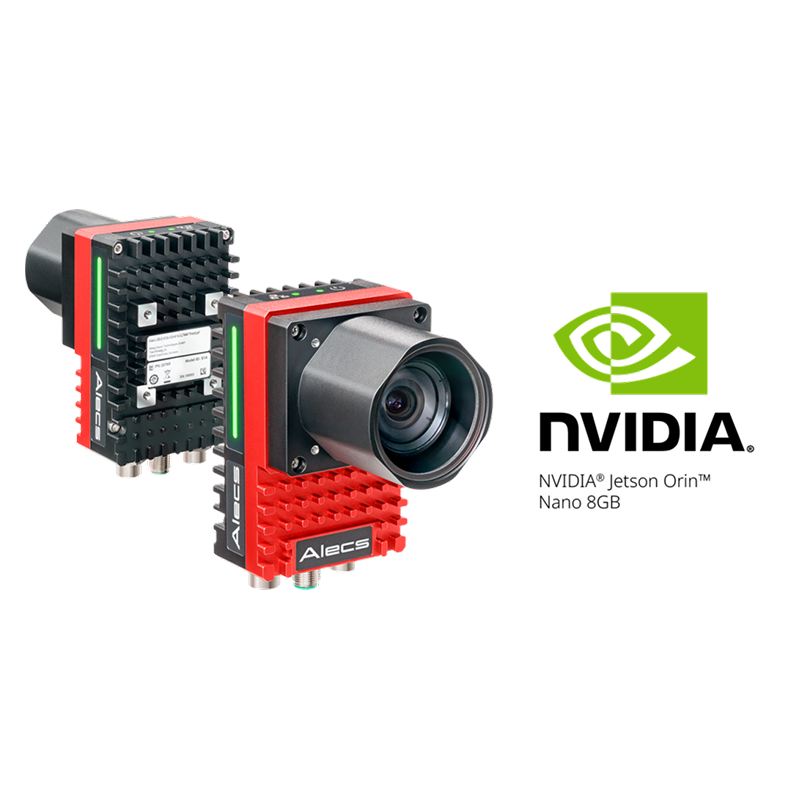
The Alecs smart camera range is an open embedded vision platform for inspection, robotics, identification and spectral imaging applications. Each system integrates an industrial camera module, NVIDIA Jetson Orin processing and 128 GByte of NVMe storage within a single housing. Engineers can select visible and near-infrared CMOS models or VSWIR InGaAs models according to the required wavelength range, resolution and frame rate. Applications can be developed in C#, C++ or Python, while GenICam for CSI-2, V4L2 and direct register access provide different routes to image acquisition.
Available software workflows include custom code, eVision libraries and compatible third-party machine vision packages such as HALCON. Opto-isolated I/O, RS485, trigger and strobe connections support integration with PLCs, lighting and automated machinery. Typical uses include in-line quality inspection, robot guidance, barcode and OCR processing, agricultural analysis, wafer inspection and material sorting.
Range features
A high level overview of what this range offers
- Integrated NVIDIA Jetson Orin processing – Runs acquisition, preprocessing, image analysis and decision logic directly on the camera.
- 0.3 to 12.4 MP model range – Supports applications ranging from high-speed spectral analysis to detailed visible-light inspection.
- Visible, near-infrared and VSWIR imaging – Enables conventional inspection and wavelength-dependent material analysis within one platform family.
- Global-shutter sensors – Captures moving parts, conveyors and robotic processes with reduced motion distortion.
- NX16 and Nano8 processor options – Allows processing resources and memory to be matched to the application workload.
- 128 GByte NVMe storage – Provides local space for applications, AI models, image data and configuration files.
- GenICam for CSI-2 and V4L2 access – Gives developers a choice between feature-oriented camera control and established Linux video workflows.
- Linux-compatible open architecture – Supports custom applications written in C#, C++ or Python and the integration of third-party libraries.
- 1000BASE-T network interface – Connects the camera to industrial networks for configuration, result transfer and image streaming.
- Opto-isolated I/O and RS485 – Supports trigger, strobe, PLC and peripheral integration while electrically separating control signals.
- Programmable side indicators – Displays operating states and application-specific conditions locally.
- Dedicated lighting connection – Supports an external ring light or separately powered industrial lighting.
- IP67 housing configuration – Protects the assembled system against dust and water when the lens tube, cables and connector caps are fitted correctly.
- Shock and vibration tested – Supports installation in machinery subject to mechanical movement and repeated operating cycles.
- Passive heat-dissipating housing – Supports processor power modes up to 25 W when installation and thermal conditions are suitable.
Downloads
for Alecs range smart cameras
What’s in this range?
All the variants in the range and a comparison of what they offer
Specifications
| Specification | Value |
|---|---|
Processing platform | NVIDIA Jetson Orin NX16 or Orin Nano8, depending on model |
Volatile memory | 16 GByte with NX16; 8 GByte with Nano8 |
Non-volatile system storage | 128 GByte NVMe SSD |
Sensor technologies | CMOS for visible and near-infrared imaging; InGaAs for VSWIR imaging |
Resolution range | 656 × 520 to 4128 × 3008; 0.3 to 12.4 MP |
Range-wide spectral coverage | 300 to 1700 nm, model-dependent |
Visible-model spectral range | 300 to 1100 nm for G1-510 and G1-1242 |
Shutter | Global shutter throughout the listed range |
Internal full-resolution frame rate | 40 to 249 fps, depending on model and access mode |
Sensor ADC | 12-bit on visible models; 8-bit, 10-bit, 12-bit and adaptive modes on VSWIR models through GenICam |
Camera access | GenICam for CSI-2 Access, Video4Linux2 and Direct Register Access |
Internal camera interface | MIPI CSI-2, up to 5.7 Gbit/s |
External network | IEEE 802.3 1000BASE-T, up to 1 Gbit/s |
Supported development languages | C#, C++ and Python |
Operating system environment | Linux with JetPack-based board support package |
Camera image buffer | 256 KByte |
Camera flash memory | 1024 KByte |
Power input | 24 VDC ±10% |
NX16 power modes | 15 W and 25 W target power |
Nano8 power modes | 7 W and 15 W target power |
Idle consumption | 8.5 W without connected lighting |
Additional electronics consumption | Carrier board approximately 2.0 W; camera module below 5.0 W, sensor-dependent |
Digital I/O | 2 opto-isolated inputs, 2 opto-isolated outputs, 1 trigger input and 1 strobe output |
Serial interface | RS485, common-mode range up to ±25 VDC |
Opto-input levels | High: 3.0 to 24.0 VDC; low: 0 to 1.0 VDC |
Opto-output rating | Open-emitter output, maximum 10 mA |
Lighting interface | Separate connector for external lighting or RMX140 ring light |
Lighting output limit | VCC-Light below 5.9 A; above 700 mA, strobe operation is limited to 50 ms and 10% duty cycle |
Lens mount | C-mount, 1 in–32 tpi UNS-2B thread |
Lens flange focal distance | 17.526 mm |
Maximum lens protrusion | 13.6 mm |
Ingress protection | IP67 to IEC 60529 when assembled and sealed as specified |
Visible-model operating temperature | −20 to +65 °C housing temperature |
VSWIR-model operating temperature | −20 to +55 °C housing temperature |
Storage temperature | −20 to +85 °C ambient temperature |
Relative humidity | 0% to 95%, non-condensing |
Vibration and shock tests | IEC 60068-2-6, IEC 60068-2-27 and IEC 60068-2-64 |
GenICam compatibility | Standard Document 2.1.1, GenAPI Schema 1.1, GenAPI 3.1, SFNC 2.7 and PFNC 2.2 |
US electromagnetic compliance | FCC Part 15, Class B digital device |
Range Comparison
| Specification | Alecs G1-030 VSWIR | Alecs G1-130 VSWIR | Alecs G1-320 VSWIR | Alecs G1-510m/c | Alecs G1-530 VSWIR | Alecs G1-1242m/c |
|---|---|---|---|---|---|---|
Imaging category | VSWIR monochrome | VSWIR monochrome | VSWIR monochrome | Visible/NIR mono or colour | VSWIR monochrome | Visible/NIR mono or colour |
Sensor | IMX991 | IMX990 | IMX993 | IMX548 | IMX992 | IMX545 |
Sensor type | InGaAs | InGaAs | InGaAs | CMOS | InGaAs | CMOS |
Resolution | 656 × 520; 0.3 MP | 1296 × 1032; 1.3 MP | 2080 × 1544; 3.2 MP | 2464 × 2064; 5.1 MP | 2592 × 2056; 5.3 MP | 4128 × 3008; 12.4 MP |
SoM options | NX16 | NX16 | NX16 | NX16 or Nano8 | NX16 | NX16 or Nano8 |
RAM | 16 GByte | 16 GByte | 16 GByte | 16 or 8 GByte | 16 GByte | 16 or 8 GByte |
Sensor size | Type 1/4 | Type 1/2 | Type 1/1.8 | Type 1/1.8 | Type 1/1.4 | Type 1/1.1 |
Pixel size | 5 × 5 µm | 5 × 5 µm | 3.45 × 3.45 µm | 2.74 × 2.74 µm | 3.45 × 3.45 µm | 2.74 × 2.74 µm |
Maximum internal full-resolution rate | 249 fps GenICam; 132 fps other access modes | 130 fps GenICam; 69 fps other access modes | 131 fps GenICam; 87 fps other access modes | 81 fps | 84 fps GenICam; 58 fps other access modes | 40 fps |
Exposure range | 15 µs to 10 s | 15 µs to 10 s | 33 µs to 10 s | 8 µs to 10 s | 36 µs to 10 s | 11 µs to 10 s |
Gain range | 0 to 42 dB | 0 to 42 dB | 0 to 42 dB | 0 to 48 dB | 0 to 42 dB | 0 to 48 dB |
Operating temperature | −20 to +55 °C | −20 to +55 °C | −20 to +55 °C | −20 to +65 °C | −20 to +55 °C | −20 to +65 °C |
Model Naming and Ordering Scheme
| Name format | Product series | Interface | Resolution | Chroma | Spectrum | SoM | SoM RAM | Lens mount | Lens tube |
|---|---|---|---|---|---|---|---|---|---|
Short name | Alecs | G1 | 510 | c | – | NX | 16 | – | – |
Long name | LXB | G1 | 510 | c | VIS | NX | 16 | C | LT4649 |
Code meaning | Alecs or LXB series | 1000BASE-T | 510: 5.1 MP; 1242: 12.4 MP | m: mono; c: colour | VIS: visible; VSWIR: visible SWIR | NX: Orin NX; NA: Orin Nano | 16 or 8 GByte | C-mount | LT4649: 46 × 49 mm; LT4670: 46 × 70 mm |
Mechanical Configurations
| Dimension | Main housing | With LT4632 | With LT4649 | With LT4670 and ring light |
|---|---|---|---|---|
Flange focal distance | 17.526 mm | 17.526 mm | 17.526 mm | 17.526 mm |
Lens thread | 1 in–32 tpi UNS-2B | 1 in–32 tpi UNS-2B | 1 in–32 tpi UNS-2B | 1 in–32 tpi UNS-2B |
Maximum protrusion | 13.6 mm | 13.6 mm | 13.6 mm | 13.6 mm |
Maximum lens length | Not applicable | 32 mm | 49 mm | 70 mm |
Maximum lens width | Not applicable | 46 mm | 46 mm | 46 mm |
Body dimensions without connectors | 49.6 × 72 × 111.75 mm | 85.2 × 72 × 111.75 mm | 102.3 × 72 × 111.75 mm | 122.7 × 140 × 149 mm |
Mass without lens | 650 g | 805 g | 810 g | 1270 g |
Worked ordering example: Alecs G1-510c NX16 is represented by the detailed ordering name LXB-G1-510c-VIS-NX16-C-LT4649.
FAQs
for Alecs range smart cameras
The choice should begin with the required spectrum, spatial resolution and full-resolution frame rate. For visible or near-infrared inspection, the G1-510 provides 5.1 MP at up to 81 fps, while the G1-1242 provides 12.4 MP at up to 40 fps. VSWIR applications can use resolutions from 0.3 MP at up to 249 fps to 5.3 MP at up to 84 fps when using GenICam access. Every listed model uses a global shutter, making the range suitable for moving targets where rolling-shutter distortion would be undesirable. The final selection should be verified against field of view, minimum detectable feature size, exposure time, lighting wavelength and the processing load of the intended algorithm.
The NX16 option provides 16 GByte of RAM and includes both a Deep Learning Accelerator and a Programmable Vision Accelerator. It supports 15 W and 25 W target power modes, making it the more appropriate option for advanced neural networks, parallel processing or compute-intensive image pipelines. Nano8 provides 8 GByte of RAM, uses CPU and GPU resources without dedicated DLA or PVA hardware, and offers 7 W and 15 W target power modes. The Nano8 configuration is available on the G1-510 and G1-1242 visible-model families, while the listed VSWIR models use NX16. Engineers should compare model size, memory use, inference framework and thermal conditions before selecting the processor configuration.
GenICam for CSI-2 is suited to applications that require structured access to camera features such as exposure, gain, binning, image correction, triggering, counters and user sets. V4L2 is useful when the software architecture already relies on Linux video tools, GStreamer or OpenCV and does not require the complete GenICam feature set. The access mode can also affect the available internal frame rate on VSWIR models; for example, the G1-030 reaches up to 249 fps through GenICam and 132 fps through other access modes. Direct Register Access provides another route for lower-level integration. The access method should therefore be selected early because it influences performance, feature availability and application architecture.
IP67 protection applies when the camera is assembled with a correctly mounted lens tube and every connector is closed by a suitable cap or properly secured cable. The locking sleeves must be tightened within the specified torque range, and any third-party cabling should be validated for the required ingress protection. The lens tube is part of the sealing arrangement, so operating the camera with an exposed C-mount does not provide the complete IP67 configuration. Lens dimensions must also remain within the selected tube limits of 32, 49 or 70 mm length and 46 mm width. Installation planning should therefore cover the lens, lens tube, cable sealing and connector access as one mechanical system.
The camera provides two opto-isolated inputs, two opto-isolated outputs, a dedicated trigger input, a strobe output and an RS485 interface. Opto-inputs recognise a high state from 3.0 to 24.0 VDC and a low state from 0 to 1.0 VDC, while the open-emitter outputs are limited to 10 mA. The camera itself requires a 24 VDC supply with a tolerance of ±10%, so signal voltages and supply voltage must not be treated as interchangeable limits. A separate lighting connector can control and power a compatible ring light or drive separately powered lighting through an appropriate cable arrangement. If lighting current exceeds 700 mA, strobe operation is restricted to 50 ms and a 10% duty cycle.
The platform supports custom Linux applications written in C#, C++ or Python, as well as software based on eVision or compatible third-party machine vision packages. The preinstalled eVision Web Demonstrator can be accessed through a browser and includes tools for barcode reading, QR code processing, OCR and deep-learning evaluation without first writing application code. A 30-day evaluation licence is activated when an eVision processing tool is first used. HALCON 26.05 or later can also be installed for the aarch64 architecture, subject to its separate package and licence requirements. For deployment planning, engineers should account for library versions, remote development, licence management, BSP updates and recovery procedures.
All listed models use a C-mount with a 17.526 mm flange focal distance and a maximum permitted lens protrusion of 13.6 mm. The LT4632, LT4649 and LT4670 configurations accommodate lenses up to 32, 49 and 70 mm long respectively, with a maximum width of 46 mm. Filters, extension tubes, locking screws and changes in lens length during focusing must be included when checking these limits. Wide-angle lenses may experience vignetting when installed behind a lens tube, so optical validation should include the complete lens and protective window assembly. The chosen tube must also match the required ingress protection, sensor format, lens resolution and any planned ring-light mounting arrangement.
It can replace an external PC where the required acquisition, processing and decision tasks fit within the selected Jetson Orin configuration. Images can be captured, preprocessed and analysed locally, with decisions or reduced result data transferred through the 1000BASE-T network or digital I/O. This is particularly relevant because the internal CSI-2 path supports up to 5.7 Gbit/s, while external Ethernet transfer is limited to 1 Gbit/s. Processing images before network transmission can therefore reduce the amount of data that must leave the device. The feasibility assessment should include algorithm execution time, model memory, storage use, thermal loading, network traffic and the response time required by the machine controller.
Related product ranges
1750-OEM Video Processors
The 1750-OEM is a state-of-the-art onboard video processing solution, enhancing small camera systems with advanced capabilities.
SightLine 4100 Series OEM Video Processor
A cutting-edge range of video processors designed to meet the demands of today’s advanced video processing applications with full HD and 4K encoding.