FP-00C-LD0 LC Duplex Plug for POF Duplex Cable
- Technology
- Plastic Optical Fibre (POF) components
- Partner
- Firecomms
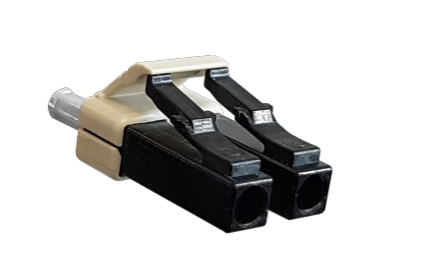
The FP-00C-LD0 POF LC duplex plug is designed for terminating plastic optical fibre duplex cable. It is intended for use with compatible LC transceivers in compact optical links where secure mechanical engagement is required. Field termination and crimp fixing support installation in electrical control equipment and other systems where pre-terminated cabling may not be practical. Typical applications include control links within high-voltage electrical equipment, connections that must maintain electrical isolation, and rugged links exposed to vibration or mechanical shock. The operating and storage temperature range is -40°C to +85°C, while termination should be carried out between 0°C and +70°C. The connector interface complies with IEC 61754-20 Edition 2 and is rated for at least 500 mating cycles.
Range features
A high level overview of what this range offers
- POF duplex LC format: Provides a compact termination for duplex optical cable assemblies.
- Field-termination design: Allows cable assemblies to be prepared at the installation or service location.
- Crimp fixing method: Provides a defined mechanical means of securing the cable.
- Minimum 100 N retention force: Supports secure engagement with compatible LC transceivers.
- 9 N typical and 12 N maximum insertion force: Provides a defined engagement load for installation planning.
- At least 500 mating cycles: Supports periodic disconnection during servicing and maintenance.
- -40°C to +85°C operating range: Accommodates equipment operating across the stated temperature window.
- IEC 61754-20 Edition 2 compliance: Aligns the interface with the stated LC connector standard.
- FG-00D-LZ0 dust cap option: Provides a matching cover for the LC plug when disconnected.
Downloads
for FP-00C-LD0 LC Duplex Plug for POF Duplex Cable
What’s in this range?
All the variants in the range and a comparison of what they offer
| Parameter | Symbol | Minimum | Typical | Maximum | Unit |
|---|---|---|---|---|---|
Storage temperature | Tstg | -40 | — | +85 | °C |
Operating temperature | Top | -40 | — | +85 | °C |
Installation temperature | TI | 0 | — | +70 | °C |
Retention force, connector to transceiver | FR | 100 | — | — | N |
Insertion force, connector to transceiver | FI | — | 9 | 12 | N |
Durability, mating cycles | — | 500 | — | — | cycles |
Standards compliance | — | — | IEC 61754-20 Edition 2 | — | — |
Fixing method | — | — | Crimp | — | — |
FAQs
for FP-00C-LD0 LC Duplex Plug for POF Duplex Cable
Yes. The FP-00C-LD0 is designed for field termination of POF duplex cable and uses a crimp fixing method, allowing cable assemblies to be prepared at the installation or service location. Termination work should be performed within the stated 0°C to +70°C installation range. A professional installation kit for LC connectors is recommended for termination and polishing, indicating that controlled fibre-end preparation is an important part of the assembly process. No detailed crimp dimensions or step-by-step assembly sequence are stated, so production users should establish controlled work instructions and inspect completed ends. In practice, the plug suits field-built or locally assembled links when appropriate crimping and polishing tools are available.
During normal operation and storage, the plug is specified from -40°C to +85°C, but installation is limited to 0°C to +70°C. This distinction means that a completed connector may be used at temperatures where crimping, termination or polishing should not be carried out. Assembly below freezing or above +70°C falls outside the stated installation range and may affect process consistency, even though the finished plug has a wider service range. Humidity, ingress-protection and chemical-resistance ratings are not stated. Enclosure design and environmental validation therefore remain necessary when the connector is used in exposed or contaminated locations.
The connector-to-transceiver interface has a minimum retention force of 100 N, while its insertion force is 9 N typical and 12 N maximum. The retention figure supports use where accidental disconnection, vibration or mechanical shock is a concern, provided that the mating transceiver and cable assembly are correctly fitted. The insertion figure should be considered when defining operator access, panel support and any insertion fixture used during assembly. These loads apply to the connector-to-transceiver interface and do not state the allowable pull load on the terminated cable itself. Cable routing and strain relief should therefore prevent external loads from being transferred directly to the plug.
Yes, within its stated minimum durability of 500 mating cycles. This rating makes the plug applicable to serviceable equipment, test access and maintenance connections that require periodic disconnection rather than a one-time installation. The cycle count should be compared with the expected service schedule, as frequent laboratory reconnection can consume the rated cycle life more quickly than occasional field maintenance. A matching FG-00D-LZ0 dust cap can be specified for the plug when it is not connected. No optical degradation limit after repeated mating is stated, so applications sensitive to link margin should include inspection and performance checks in their maintenance plan.
IEC 61754-20 Edition 2 compliance identifies the LC connector interface standard used by the plug. This helps engineers assess the mechanical interface when selecting mating hardware, but it should not be treated as a complete guarantee of system-level optical compatibility. The cable construction, POF characteristics, transceiver interface and termination process still need to match the intended link. No insertion-loss, return-loss, wavelength or fibre-dimension values are stated for this plug. These optical parameters should therefore be confirmed at cable-assembly or complete-link level before the design is released.
Yes, the plug is intended for control links within high-voltage electrical control equipment and for connections where electrical isolation must be maintained. Its role is to terminate the POF duplex cable and provide the LC connection to a compatible transceiver. The connector specification does not define a system isolation voltage, creepage distance, clearance distance or safety approval for the complete link. Those requirements depend on the transceivers, equipment layout, cable routing and applicable end-product standards. Engineers should therefore treat the plug as one component of the isolation architecture rather than as the sole basis for an isolation rating.
The core order item is the FP-00C-LD0 LC plug for POF, with the FG-00D-LZ0 white LC dust cap available as a matching accessory. The plug uses crimp fixing, so an appropriate crimping process must be included in the assembly plan. Termination also requires polishing of the connector and cable assembly, and a professional LC connector installation kit is recommended for this work. Cable preparation lengths, crimp settings and inspection criteria are not defined. For repeatable production, engineers should document these process parameters and validate the finished assembly with the intended cable and transceiver.