HCS® All Silica 200 µm 0.22 NA Step-Index High OH Optical Fibre
- Technology
- Speciality fibre
- Partner
- Lightera (formerly OFS)
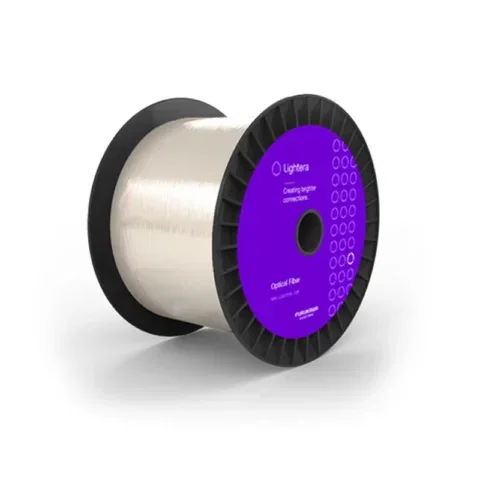
The HCS® 200 µm All-Silica High OH Step-Index Optical Fibre is a specialised large-core fibre designed for reliable light delivery in industrial, scientific, and medical applications. It uses a Hard-Clad Silica construction with a durable polymer cladding over a pure silica core for improved handling and mechanical strength. Its high OH silica core is optimised for efficient UV and visible wavelength transmission, making it well suited to illumination systems, UV spectroscopy, fluorescence measurements, radiation sensor feeds, and medical laser delivery. The typical numerical aperture of 0.22 provides a practical balance of light acceptance and focus for coupling from lamps or lasers. The fibre operates from -65 °C to +125 °C and supports tight bend radii for dependable use in demanding environments. Optional customisation includes alternative buffer materials, diameters, colours, cabling, connectorisation, and polyimide coating for higher temperature applications.
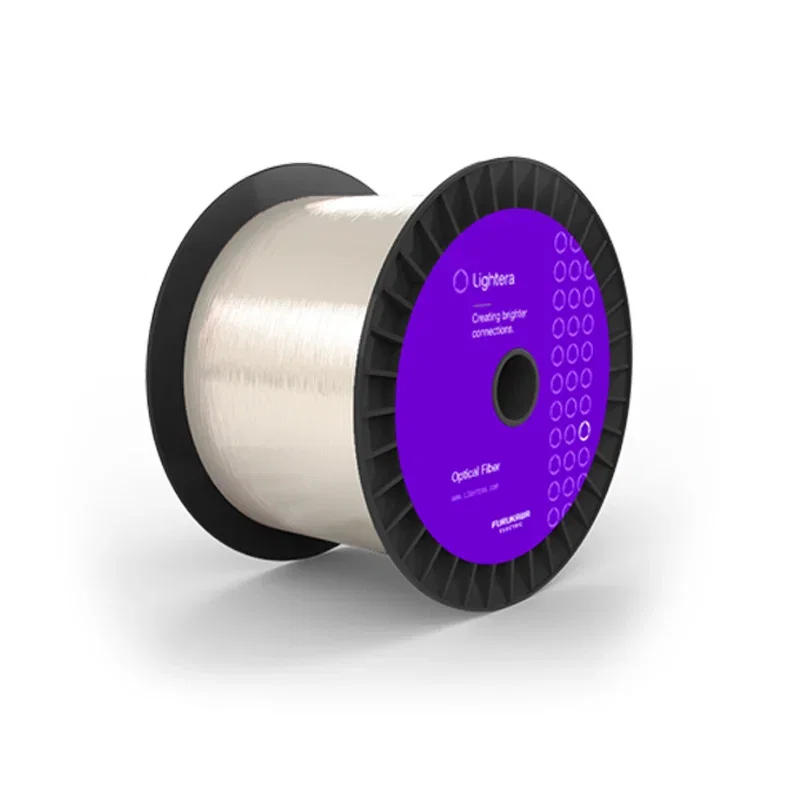
The CF01493-41 HCS® 200 µm optical fibre is a Hard-Clad Silica (HCS), all-silica, high OH, step-index multimode fibre engineered for dependable UV and visible light delivery. Its large 200 µm core supports efficient coupling from lamps, LEDs, and lasers, while the hard polymer cladding improves handling robustness compared with conventional all-glass fibres.
Typical applications include illumination systems, UV spectroscopy, fluorescence measurement, radiation sensing, industrial laser delivery, and medical laser systems where durability, bend tolerance, and stable optical performance are important.
Range features
A high level overview of what this range offers
- High OH all-silica core: Optimised for efficient transmission of UV and visible wavelengths with low attenuation and strong resistance to optical damage.
- Large 200 µm core: Simplifies alignment and light coupling while supporting high optical power throughput.
- Hard-Clad Silica construction: Combines a silica core with durable polymer cladding for improved toughness and easier handling.
- Step-index multimode design: Well suited to illumination, sensing, and laser delivery applications where large-core performance is required.
- Numerical aperture of 0.22: Provides a practical balance between light acceptance and beam control.
- Bend-tolerant performance: Supports short-term bend radius down to 9 mm and long-term bend radius of 14 mm or greater.
- Wide operating temperature range: Rated from -65 °C to +125 °C for harsh and demanding environments.
- Proof-tested mechanical reliability: Tested to ≥ 200 kpsi (1.38 GPa) for dependable handling and long-term durability.
- Flexible configuration options: Available with custom buffer materials, colours, diameters, cabling, and connectorisation on request.
Downloads
for HCS® All Silica 200 µm 0.22 NA Step-Index High OH Optical Fibre
HCS® 200 µm High OH Optical Fibre – Datasheet
DownloadWhat’s in this range?
All the variants in the range and a comparison of what they offer
Specification | Value |
Core Diameter | 200 ± 5 µm |
Cladding Diameter | 240 ± 5 µm |
Coating (Cladding) Diameter | 260 ± 5 µm |
Buffer Diameter | 375 ± 30 µm |
Core/Clad Offset | ≤ 7 µm |
Cladding Material | Hard-Clad Silica polymer (HCS) |
Buffer Material | ETFE (Mid-temp thermoplastic) |
Standard Buffer Colour | Natural (clear) |
Fibre Type | Multimode step-index |
Numerical Aperture (NA) | 0.22 (typical) |
Attenuation @ 820 nm | ≤ 10 dB/km |
Water Content (OH) | High OH (hydroxyl-rich silica) |
Operating Temperature | -65 °C to +125 °C |
Short-Term Bend Radius | ≥ 9 mm |
Long-Term Bend Radius | ≥ 14 mm |
Proof Test Level | ≥ 200 kpsi (1.38 GPa) |
Part Number | CF01493-41 |
Product Description Code | HCG-M0200T |
Available Options | Buffer colour, buffer diameter, buffer material, cabling, connectorisation, numerical aperture |
FAQs
for HCS® All Silica 200 µm 0.22 NA Step-Index High OH Optical Fibre
A high OH silica core is optimised for UV and visible wavelength transmission, helping reduce loss in short-wavelength applications such as UV curing, fluorescence, spectroscopy, and visible-light laser delivery. A low OH fibre is generally better suited to longer visible and near-infrared wavelengths. Choose the high OH version when your system primarily operates in the UV or visible range.
Hard-Clad Silica (HCS) means the fibre has a pure silica core with a hard polymer cladding rather than a glass cladding. This construction improves toughness, handling, and resistance to breakage compared with conventional all-glass fibres. It is especially useful for rugged industrial, scientific, and medical light-delivery applications.
The fibre supports a short-term bend radius of 9 mm and a long-term bend radius of 14 mm or greater. This makes it suitable for installation in constrained spaces while maintaining reliable optical and mechanical performance, provided recommended bend limits are observed.
With the standard ETFE buffer, the fibre is rated for operation from -65 °C to +125 °C. For applications requiring greater temperature resistance, an optional polyimide coating (PYROCOAT®) can be specified. This makes the product suitable for a wide range of harsh industrial and technical environments.
This HCS fibre can be terminated using mechanical crimp connectors or standard epoxy/polish connector methods, depending on the application. Common connector styles may include SMA, ST, SC, or LC with appropriate ferrules for 200 µm fibre. The product can also be supplied with connectorisation as a custom option.
Yes. The fibre is available with configurable buffer materials, buffer diameters, buffer colours, cabling options, and connectorisation. This allows adaptation for OEM integration, custom assemblies, or more rugged installation requirements.
Yes. The all-silica core, large 200 µm diameter, and high damage threshold make this fibre suitable for many medium- to high-power laser delivery applications, especially in the UV and visible range. Proper optical coupling and adherence to application-specific power limits remain important for safe use.
The specified attenuation is ≤ 10 dB/km at 820 nm. In typical application lengths of a few metres to a few tens of metres, this results in very low practical loss, making the fibre well suited to short- and medium-range illumination, sensing, and laser delivery systems.