Trunk Cable Pre-terminated (LC, MPO/MTP) 8 or 12 Fibres
- Technology
- Fibre optic cables, connectors and assemblies
- Partner
- Lightera (formerly OFS)
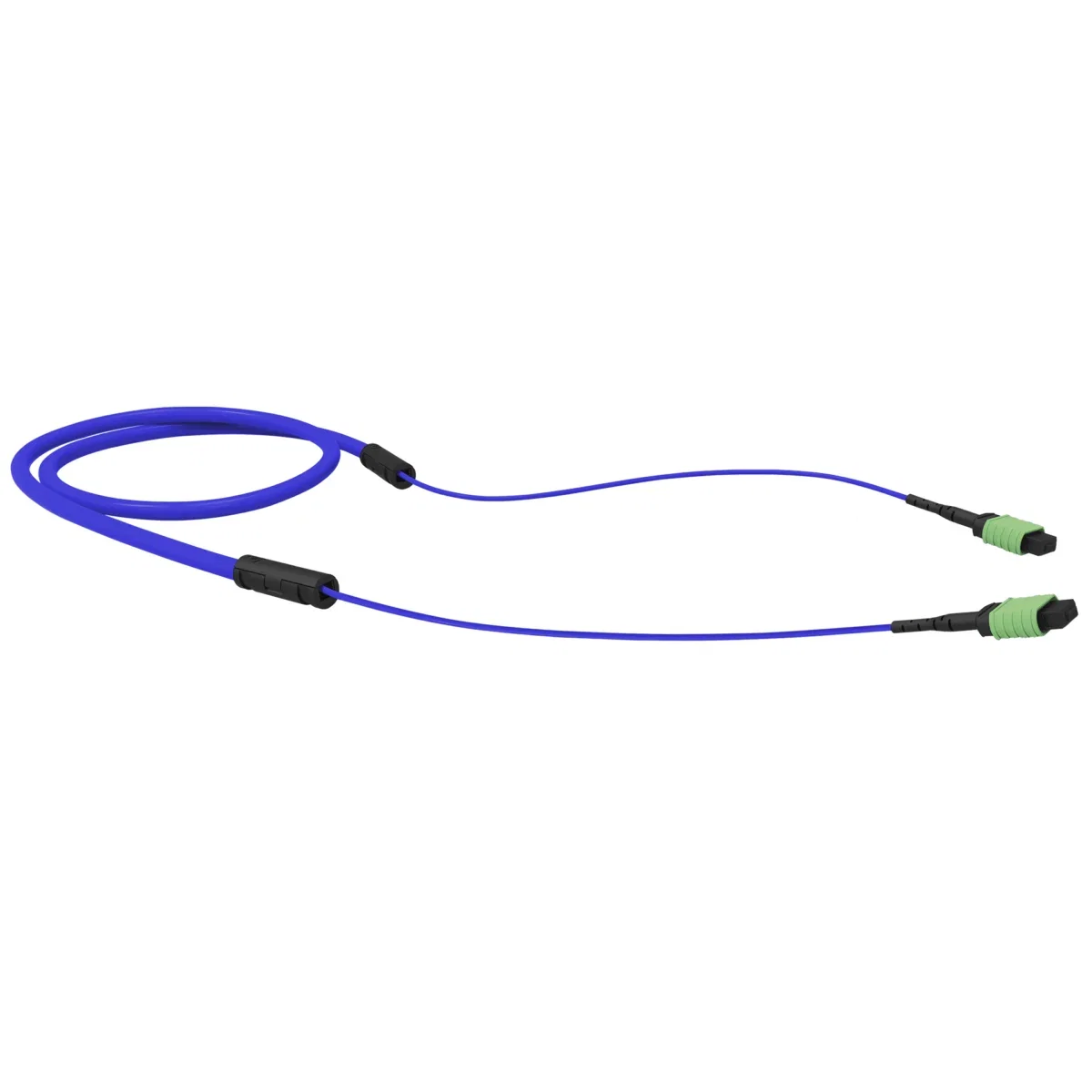
Pre-terminated optical trunk cables are multi-fibre cable assemblies designed for quick, reliable installation in data centres and telecom infrastructure. Each trunk cable is factory-terminated with either an MPO/MTP multi-fibre connector or a fan-out to LC duplex connectors, delivering an immediate backbone link without field termination work. Available in 8-fibre and 12-fibre configurations, these assemblies support typical high-bandwidth applications such as 10 Gigabit Ethernet, 40G/100G Ethernet, Fibre Channel, and other optical communication standards. By using pre-terminated trunks, network engineers can significantly reduce installation time and labour costs while ensuring consistent factory-polished connector performance.
The cables are typically used to connect patch panels, network equipment, or distribution frames, providing a tidy and efficient way to route multiple fibres between racks or facilities. With robust construction and low-loss connectors that are 100% tested, these trunk cable solutions help maintain reliable signal quality in high-density and mission-critical network environments.
Range features
A high level overview of what this range offers
- Factory pre-terminated assembly – Ready-to-use out of the box, enabling fast deployment with no on-site fibre splicing or connector termination required.
- High-performance low-loss connectors – Utilises premium MPO/MTP and LC connectors that ensure minimal signal attenuation and high return loss, supporting stable performance at high data rates.
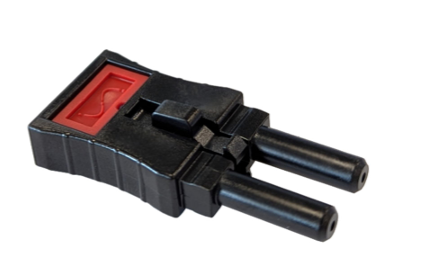
- MPO connector with field-changeable gender/polarity – The MPO end is a universal type that can be reconfigured from male to female and adjusted between Type A and Type B polarity as needed, offering flexibility if network requirements change (Note: polarity changes on single-mode MPO are generally not recommended to avoid performance degradation).
- LC uniboot duplex connectors – Uses space-saving LC uniboot connectors for single-fibre links, which combine a pair of fibres in one compact plug. This simplifies cable management and can allow easy polarity flipping by swapping the duplex pair orientation, if required.
- Fully dry loose-tube construction – The trunk cable is a dry-core design (no gel fillers), making it cleaner and easier to handle during installation. There is no gel to clean off, and the cable’s fibres are safely protected in buffer tubes, ensuring a tidy installation process and reduced cleanup.
- Integrated pulling eye for installation – Each pre-terminated trunk can be supplied with a removable pulling eye or protective cap on the connector end. This feature protects the connectors and helps guide the cable through conduits or ducts during installation, reducing the risk of snags or damage to the fibre ends.
- 100% factory tested with results – Every trunk cable assembly is optically tested for insertion loss (IL) and return loss (RL) before shipment. The test results for each fibre link are provided with the product, giving you confidence that the link meets its specified performance and standards compliance from day one.
- LSZH jacket for indoor use – The cable sheath is made from Low Smoke Zero Halogen (LSZH) material (or equivalent), suitable for indoor installations and in-building network routes. This fire-retardant jacket material ensures low smoke and non-toxic emissions in the event of a fire, meeting common building safety regulations. (For special projects, indoor/outdoor rated versions of the cable are available to handle more rugged environments or outdoor runs if needed.)
- Bend-optimised fibre and robust breakout – The trunk uses bend-insensitive fibre types (e.g. G.657.A2 single-mode and OM4/OM5 multimode) which tolerate tight bends with minimal loss, helping maintain performance in high-density cabling trays. The fan-out breakout assembly at the end (where individual connectors split from the main cable) is protected by a flexible rugged tubing, safeguarding fibres and maintaining proper bend radius as they transition into individual connectors.
- Colour-coded for fibre type – Jackets are colour-coded by fibre type for easy identification (for example, OM4 multimode cables are typically Aqua, OM5 multimode are Lime Green, and single-mode cables are Yellow). This allows installers to quickly recognise the cable type and reduces the chance of mixing up fibres in mixed-network environments.
- Supports current and future network standards – The 8-fibre trunk option is ideal for parallel optical links like 40GBASE-SR4 or 100GBASE-SR4, and the 12-fibre option suits structured cabling systems or breakout to 6 duplex channels. Both versions support legacy and emerging standards, ensuring the trunk cable can be used in today’s 10G/25G networks and easily scale to tomorrow’s 40G, 100G or higher.
Downloads
for Trunk Cable Pre-terminated (LC, MPO/MTP) 8 or 12 Fibres
Pre-Terminated Trunk Cable – Technical Datasheet
DownloadWhat’s in this range?
All the variants in the range and a comparison of what they offer
| Specification | 8-Fibre Trunk Cable | 12-Fibre Trunk Cable |
|---|---|---|
Total fibre count | 8 fibres | 12 fibres |
Available configurations | MPO–MPO both ends, or MPO to 4× LC duplex fan-out | MPO–MPO both ends, or MPO to 6× LC duplex fan-out |
Connector types | MPO (male or female, pinned) and LC uniboot duplex connectors (UPC polish) | MPO (male or female, pinned) and LC uniboot duplex connectors (UPC polish) |
Fibre type options | Single-mode (OS2 G.657.A2 bend-insensitive) or Multimode (OM4 / OM5) | Single-mode (OS2 G.657.A2 bend-insensitive) or Multimode (OM4 / OM5) |
Polarity methods | Type A or Type B (connector keying can be flipped in field) | Type A or Type B (connector keying can be flipped in field) |
Factory test certification | IL/RL test report included per assembly | IL/RL test report included per assembly |
Typical cable jacket | Indoor-rated LSZH, orange or yellow (MM/SM) | Indoor-rated LSZH, aqua or yellow (MM/SM) |
Cable outer diameter | ~5–6 mm (loose tube construction) | ~5.5 mm (loose tube, indoor variant); ~8.9 mm (indoor/outdoor rugged variant) |
Min. bend radius | 20× cable diameter during install; 10× diameter long-term | 20× cable diameter during install; 10× diameter long-term |
Pulling eye | Included on one end (approx. 49 mm diam.) | Included on one end (approx. 49 mm diam.) |
Standard lengths | 5 m to 150 m (custom lengths on request) | 5 m to 150 m (custom lengths on request) |
Operating environment | Indoor (data centre / premises cabling); | Indoor (standard) or Indoor/Outdoor (with rugged jacket); |
Note: Both 8F and 12F trunk cables are part of the same product family and share most specifications (connectors, fibre types, etc.). The primary difference is the fibre count and the corresponding number of LC connectors in fan-out configurations.
FAQs
for Trunk Cable Pre-terminated (LC, MPO/MTP) 8 or 12 Fibres
Yes. The pre-terminated trunk cable can be ordered with either single-mode fibres or multimode fibres. For single-mode, it uses low-loss OS2 G.657.A2 fibre (bend-insensitive), which is suitable for long-distance and high-density installations. For multimode, options include OM4 or OM5 fibre types (typically used in data centres for 40/100G short-reach applications). The cable jacket colour usually indicates the fibre type (e.g. yellow for single-mode, aqua or lime for multimode) for easy identification.
You can choose two main configurations: MPO–MPO or MPO–LC fan-out. In an MPO–MPO configuration, each end of the trunk cable has an MPO/MTP multi-fibre connector (often used to link MPO patch panels or plug into MPO adapters). In an MPO–LC configuration, one end has the MPO connector and the other end breaks out into multiple LC duplex connectors (uniboot style). For the 8-fibre cable, the LC fan-out typically consists of 4 duplex LC connectors (carrying 8 fibres total). For the 12-fibre cable, the fan-out has 6 duplex LC connectors (12 fibres). This allows you to, for example, connect an MPO backbone on one end to individual LC ports on equipment or patch panels on the other end.
The choice depends on your network design and equipment. 8-fibre trunk cables are often used for parallel optic links like 40GBASE-SR4 or 100GBASE-SR10 where 8 fibres (4 transmit + 4 receive) are needed – in these cases an MPO with 8-fibre layout suits the transceivers. They can also support four duplex channels (if broken out to LC, that’s 4 LC pairs). 12-fibre trunk cables carry 12 fibres and are commonly used to connect between fibre enclosures or patch panels, providing six duplex channels (6 pairs) or to interface with 12-port MPO modules. If you are using MPO-LC cassette modules or structured cabling that is based on 12-fibre groupings, a 12-fibre trunk might be more efficient. In summary, use the fibre count that matches your hardware or the grouping of ports you need to connect – 8-fibre trunks for certain parallel optics or divisible by 4 channels, and 12-fibre trunks for standardised 12-port groupings or higher density needs. Both types support high-speed traffic; it’s mainly about the port count and architecture you are targeting.
Yes, the MPO connectors used are a universal type that allows field changes. By default, the trunk cable’s MPO typically comes as male (pinned) to ensure alignment when mating with standard female MPO adapters or cassettes. If you need a female (unpinned) MPO instead, the connector design allows you to remove the pins (using an appropriate tool) to convert it to female. Likewise, the polarity (the mapping of fibre cores from one end to the other) can be adapted: the MPO connector cover can be reinserted in a flipped orientation to swap between Method A and Method B polarity. This modularity is useful if your cabling scheme changes or if you need to correct a Tx/Rx flip. It should be noted, however, that for single-mode MPO connectors, frequent gender or polarity changes in the field are not recommended — single-mode alignment is very precise, and it’s best to order the correct configuration to avoid any possible performance loss. But the capability is there for occasional adjustments or error corrections.
These trunk cables use high-quality factory-polished connectors, so the insertion loss (IL) per connector is very low. Typical insertion loss for an MPO connection or an LC connection in this system is on the order of a few tenths of a decibel. For example, a multimode MPO or LC might have a typical IL around 0.1–0.25 dB, and single-mode (UPC polish) around 0.2–0.35 dB per connector – well within industry standards for ‘low-loss’ performance. The return loss (RL) is also high (for single-mode UPC connectors usually >50 dB, and for multimode >20–30 dB), indicating very little signal reflection. Each assembly is 100% tested at the factory, and a test report is provided listing the exact IL for each fibre path in your cable. Because of this controlled manufacturing and testing, you can be confident that the installed trunk cable will meet or exceed the specified optical performance in your network.
Yes, typically a pulling eye (also called a pulling sock) is pre-installed on one end of the trunk cable to aid with installation. The pulling eye is a durable shroud that encapsulates the connectors (for example, the fan-out LC connectors) and provides a loop or hook point to attach your pull rope or fish tape. This way, you can safely pull the cable through conduits, ducting, or cable trays without risking damage to the delicate connector ends. The pulling eye is designed to handle the mechanical stress of pulling and has a smooth profile (around 49 mm in diameter) that helps guide the cable through tight spaces. Once the cable is in place, the pulling eye assembly can be easily removed to reveal the connectors, which can then be plugged in. This feature greatly simplifies the deployment of pre-terminated cables in environments where routing through infrastructure is required.
The trunk cables should not be bent tighter than 20× their outer diameter while actively installing or pulling them. After installation (once the cable is in place and no longer under tensile load), it can be safely coiled or routed with a minimum bend radius of 10× its diameter. For a typical indoor 12-fibre cable with ~5.5 mm outer diameter, this guideline means about a 110 mm bend radius during installation and about 55 mm in service. Adhering to these bend radius recommendations is important to avoid inducing excessive loss or potential damage to the fibre. The cables use bend-insensitive fibres which tolerate bends better than conventional fibres, but it’s still good practice to follow the recommended limits to ensure long-term reliability. Additionally, the breakout legs (the tails to individual connectors) are protected by tubing with its own bend limit (approximately 19 mm diameter for the breakout bundle), so they are quite robust against accidental sharp bends near the connector end.
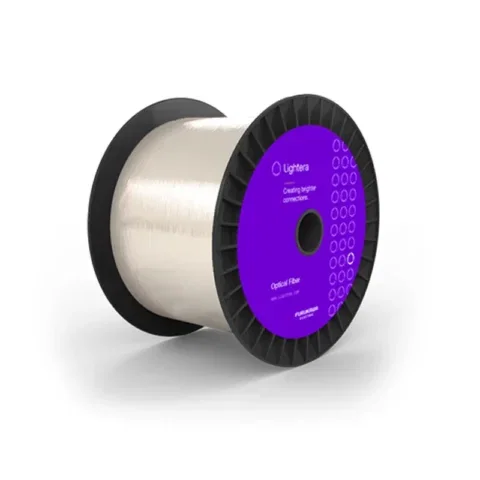
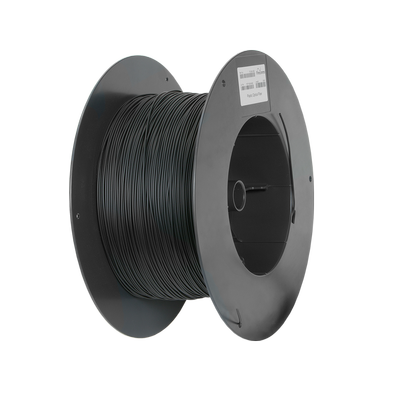
Standard lengths range from 5 metres up to 150 metres for both 8-fibre and 12-fibre versions. You can select common lengths (10 m, 20 m, 30 m, etc.) as required for your installation – these are assembled and tested to order. If you need a custom length outside the standard range or a very specific length (for example, 37.5 m to run exactly between two particular panels), the manufacturer can usually accommodate that as well on request. It’s recommended to measure the route and include a little slack for service loops when choosing the length. Because these cables are factory-finished, you’ll want to get the length correct (or slightly longer, not shorter) to avoid tension. Each trunk is delivered as a coil or on a drum, and even long cables (50 m, 100 m, etc.) come pre-tested so you can install them with confidence that the whole length is performing correctly end-to-end.
LC uniboot connectors are a special duplex version of the standard LC fibre optic connector. In a uniboot design, a single connector housing holds two fibre cores (a transmit/receive pair) in one slim unit, effectively combining what would normally be two separate LC connectors into one. The key advantages in trunk cable use are space savings and simplified polarity management. By halving the number of connector plugs (two fibres in one plug), the connector area is less cluttered – beneficial in high-density patch panels or equipment with many connections. Uniboot LC connectors often allow the two fibre positions to be swapped (the connector has a reversible polarity feature), meaning if for some reason the TX/RX leads need to be flipped, it can be done without re-terminating or using a crossover cable; one just reconfigures the uniboot. In these pre-terminated trunk cables, the LC uniboots make the fan-out ends neat and compact, and they maintain proper spacing to plug into LC adapters. The uniboot design still complies with the same standards as regular LC connectors (and uses the same ferrules and ceramic sleeves), so performance (insertion loss, etc.) is on par with standard LC connectors, just delivered in a more convenient form factor for multi-fibre assemblies.
The standard versions of the 8-fibre and 12-fibre trunk cables are primarily designed for indoor use, featuring an LSZH (low-smoke, zero-halogen) jacket suitable for data centre and enterprise environments. For typical inside plant applications (runs within buildings or between racks), they are more than robust enough and meet fire-safety codes. If you require outdoor deployment – for instance, running a trunk cable between buildings or to an outdoor cabinet – there are indoor/outdoor rated variants or custom constructions available. The product family can be built using an outdoor-capable jacket (for example, a UV-resistant, water-blocked cable with a polyethylene outer jacket or a double-jacket with armouring) for those scenarios. In fact, for fibre counts of 12 and above, the manufacturer offers an indoor/outdoor loose-tube version with a slightly larger diameter for extra ruggedness (as indicated by the spec options). These can withstand typical outdoor conditions like temperature swings and moisture, although they may not have heavy rodent protection or armouring unless specifically requested. In summary, by default use these trunks inside, but if you need to go outdoors, you should request the appropriate indoor/outdoor grade cable. Always ensure any outdoor fibre run is in conduit or properly protected, and check the spec sheet for temperature and environmental ratings if installing in non-climate-controlled areas.