FE50MKxR 650 nm DC-50 MBd 50 m OptoLock® POF Transceiver
- Technology
- Fibre optic transceivers
- Partner
- Firecomms
The FE50MKxR series (including model variants FE50MKIR and FE50MKNR) is an industrial duplex optical transceiver for plastic optical fibre (POF) links. It combines a 650 nm visible RCLED emitter and a photodiode receiver in one small housing to provide a bidirectional data link over two POF cables. A key feature is the patented OptoLock® interface, which allows a standard 2.2 mm POF cable to be cut to length and inserted directly into the module without any connector, greatly simplifying installation and maintenance.
This transceiver supports data rates from DC (continuous signals) up to 50 MBd, covering a range of serial protocols commonly used in automation (e.g. RS-485, CAN, MODBUS, Profibus). It runs on 3.3 V or 5 V DC supply and interfaces directly with TTL/CMOS logic levels, with two output logic versions available (non-inverting or inverting) to suit different system requirements. Designed for robust performance, it operates over a wide -40 °C to +85 °C temperature range and uses a visible red light source that is Class 1 eye-safe, making alignment and troubleshooting easier. Typical applications include factory automation networks, industrial controllers, robotics, and any systems that benefit from EMI-immune, galvanically isolated data links over short runs of POF.
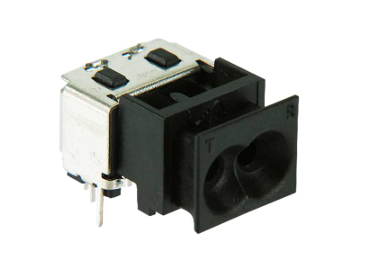
Range features
A high level overview of what this range offers
The FE50MKxR series offers the following key features and benefits:
- Direct OptoLock fibre termination – Patented plugless design allows bare 2.2 mm POF to lock in directly, eliminating separate connectors and reducing installation time and cost.
- DC to 50 MBd data rate – Supports a wide range of signal speeds from low-frequency serial communications up to 50 Mbaud, suitable for protocols like CAN, RS-232/485, MODBUS and more.
- Up to 50 m reach over POF – Enables short-range data links of around 50 metres (typical conditions) using standard step-index POF; even under worst-case conditions ~30 m is achievable, covering most on-site networking needs.
- Dual supply voltage (3.3 V or 5 V) – Allows flexible power integration with both modern 3.3 V logic systems and legacy 5 V systems without additional regulators or level translators.
- TTL/CMOS logic interface – Transmitter input and receiver output are TTL/CMOS compatible (push-pull), so the transceiver can connect directly to microcontroller I/O or digital interfaces without extra interface circuitry.
- Industrial temperature range – Rated for -40 °C to +85 °C operation, assuring reliable performance in harsh industrial environments, outdoor installations, or high-temperature machinery.
- Visible 650 nm LED emitter – Uses a red RCLED light source that is eye-safe (Class 1) and visible, simplifying alignment and fault checking since you can see the light during setup and troubleshooting.
- Integrated transceiver module – Combines both optical transmitter and receiver in one compact module, saving PCB space and simplifying design compared to using separate transmit and receive components.
- Inverting vs non-inverting options – Available in two variants: one with non-inverted receiver output and one with inverted output, allowing designers to choose the appropriate logic polarity for their application.
- RSSI diagnostic output – Includes a Received Signal Strength Indicator pin that provides an analog signal level, useful for monitoring link quality or detecting fibre connection issues in real time.
- All-optical link (EMI immunity) – The fibre optic connection provides inherent galvanic isolation and is immune to electromagnetic interference, ensuring reliable data transfer even in electrically noisy environments and eliminating ground loop problems.
Downloads
for FE50MKxR 650 nm DC-50 MBd 50 m OptoLock® POF Transceiver
What’s in this range?
All the variants in the range and a comparison of what they offer
| Specification | FE50MKNR (Non-inverting) | FE50MKIR (Inverting) |
|---|---|---|
Data rate | DC to 50 MBd | DC to 50 MBd |
Wavelength | 650 nm (visible red) | 650 nm (visible red) |
Optical fibre interface | OptoLock® port for 2.2 mm POF (duplex) | OptoLock® port for 2.2 mm POF (duplex) |
Distance over POF | Up to ~50 m (typical); ~30 m in worst case | Up to ~50 m (typical); ~30 m in worst case |
Supply voltage | 3.3 V or 5 V DC | 3.3 V or 5 V DC |
Receiver output polarity | Non-inverting logic | Inverting logic |
Output driver | Push-pull, TTL/CMOS levels | Push-pull, TTL/CMOS levels |
RSSI (signal strength) | Yes (analog output pin) | Yes (analog output pin) |
Operating temperature | -40 °C to +85 °C | -40 °C to +85 °C |
Compliance | RoHS (lead-free); IEC 60825-1 Class 1 eye-safe LED | RoHS (lead-free); IEC 60825-1 Class 1 eye-safe LED |
FAQs
for FE50MKxR 650 nm DC-50 MBd 50 m OptoLock® POF Transceiver
The two variants are electrically identical except for the logic polarity of the receiver’s output. FE50MKNR provides a non-inverted TTL/CMOS output (output is HIGH when light is received), whereas FE50MKIR has an inverted output (output is LOW when light is received). This allows you to choose the device that matches your system’s logic convention without additional inverters.
Terminating a fibre is very simple with the OptoLock® interface. You cut the plastic optical fibre cable (typically 1 mm core with 2.2 mm jacket) cleanly to the desired length and then insert the bare end directly into the OptoLock port on the module. The transceiver’s built-in latching mechanism will lock the fibre in place. No special connectors, polishing, or crimping are required – the fibre is held securely by the OptoLock housing, ensuring correct alignment with the internal optics. If needed, the fibre can be released by depressing the latch to remove or reposition it.
The FE50MKxR transceivers can operate from either a 5 V DC or 3.3 V DC supply, giving flexibility to work with different systems. The module’s input and output are TTL/CMOS logic compatible, so they can connect directly to standard digital circuits (like microcontroller GPIO pins, UART/USART, etc.) without level shifters. This means if your system already uses 3.3 V or 5 V logic, the transceiver will interface seamlessly at those levels.
Yes. The transceiver’s data rate range of DC to 50 MBd covers many popular industrial communication protocols. It can handle low-speed serial links (e.g. RS-232) up through mid-speed fieldbus networks such as RS-485/MODBUS, CAN bus (typically up to 1 Mbps), and even Profibus (which runs up to 12 Mbps). As long as the protocol’s baud rate is 50 Mbaud or below, the FE50MKxR can transmit the data over POF. This makes it suitable for isolating and extending these communication links in electrically noisy environments while maintaining protocol performance. Keep in mind that very high-speed protocols like 100 Mb Ethernet require a faster OptoLock model (the 250 Mbps version), but for all those listed, this 50 MBd transceiver is sufficient.
Under typical conditions, you can achieve around 50 metres of link length using standard 1 mm core step-index POF at the full 50 MBd data rate. This assumes good quality fibre, proper termination (clean cut), and nominal operating conditions. In a worst-case scenario (for example, at temperature extremes or with fiber attenuation at the high end of its spec), the reliable distance may reduce to roughly 20–30 metres. If you require longer reach, using a lower data rate can sometimes improve the distance, or you may need to switch to a higher-performance fibre optic solution. For most in-building industrial and automotive uses, a 50 m span is sufficient and within the capability of the FE50MKxR series.
Yes. The transmitter uses a 650 nm resonant-cavity LED which emits red light that is visible to the human eye (a dull red glow). Importantly, it is classified as Class 1 eye-safe under IEC 60825-1, meaning under normal operation conditions it does not pose a hazard to eyesight. This allows you to work with the fibre and transceiver without special laser safety precautions. The visible red light is actually an advantage during setup: you can see light at the end of the fibre or through the OptoLock port, which helps in verifying that the link is active and aligned properly.
Yes. The transceiver includes an RSSI (Received Signal Strength Indicator) output pin on the receiver. This analog output gives a measure of the optical signal level being received. By monitoring the RSSI voltage, a system can determine if a fibre link is present and gauge its signal margin or quality. For example, a microcontroller’s ADC could read the RSSI value to raise an alert if the signal drops (indicating a possible fibre disconnection, severe bending, or degradation). This feature can be very useful for diagnostics and maintenance, helping predict failures or misalignments in the optical link.
Plastic optical fibre transceivers find use in industrial and commercial systems where electrical isolation and noise immunity are important. Common examples include factory automation networks (connecting sensors, actuators, PLCs, and motor drives across noisy plant floors), industrial robotics (where moving joints benefit from flexible, light fibre cables), and power electronics or renewable energy systems (isolating communication between high-voltage sections and control units). They are also used in transportation systems (like in-vehicle or train communications) where vibrations and EMI are concerns. In general, these modules are chosen whenever you need a reliable short-distance data link that won’t be affected by electromagnetic interference and where copper wiring might introduce ground loops or safety issues. By using a POF transceiver, you get the robustness of fibre optics with the convenience of an easy, field-terminable connection.