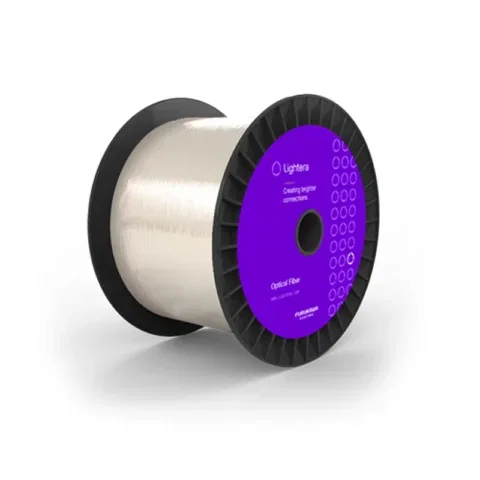
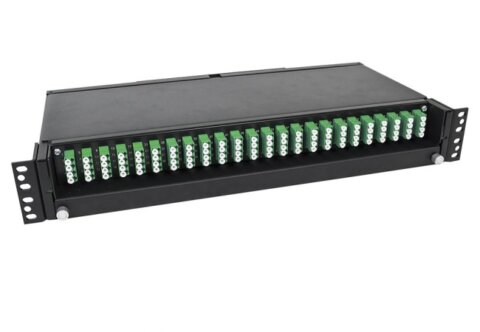
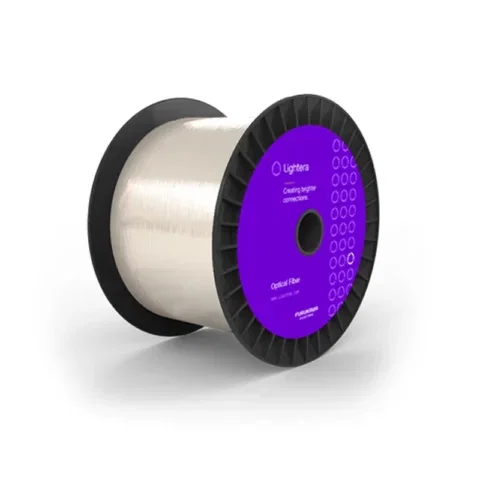
125/250 µm Coreless Acrylate Coated Termination Optical Fibre
- Technology
- Speciality fibre
- Partner
- Lightera (formerly OFS)
The F15330 coreless termination optical fibre is designed for optical systems where unused fibre ports must be terminated with minimal back reflection. Because the fibre has no light-guiding core, incoming light is not confined and instead dissipates gradually along the fibre length. When a short section is fusion-spliced onto an open port, it creates a permanent low-reflection endpoint with return loss greater than 65 dB. This approach avoids polished end faces and angled cleaves, reducing the risk of contamination, surface damage and inconsistent termination quality. Its standard 125 µm glass diameter and 250 µm coating diameter make it compatible with common fusion splicing equipment and standard fibre infrastructure. The dual UV acrylate coating provides protection and flexibility across a wide operating temperature range. With high tensile strength and compatibility with standard as well as specialty fibres, it is a practical solution for reliable optical termination in assemblies, modules and test setups.
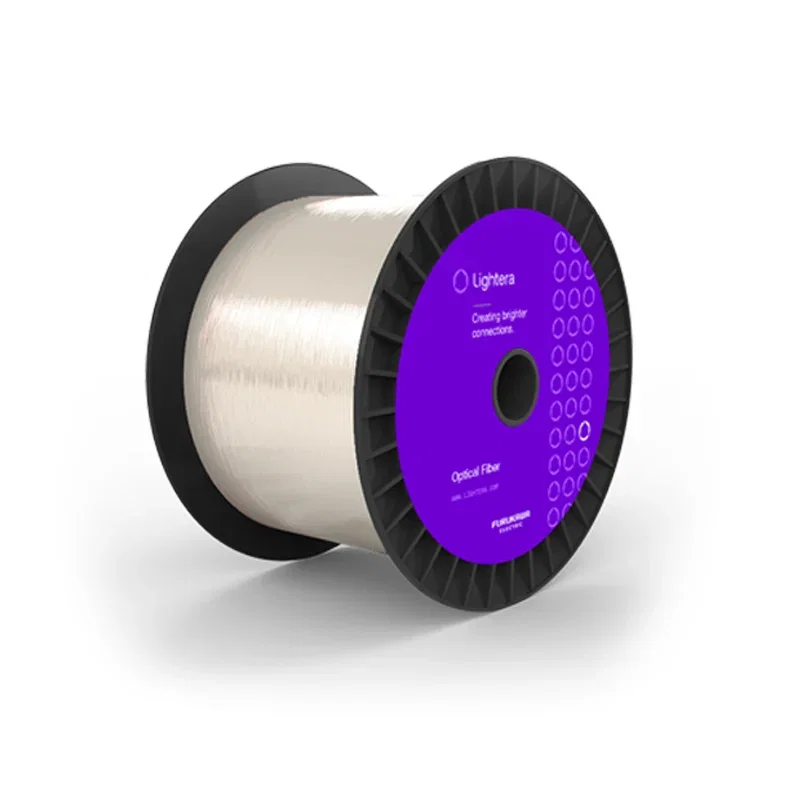
For optical systems with multiple fibre ports, preventing unwanted reflections is essential for maintaining signal quality. The F15330 coreless termination optical fibre provides a simple way to terminate any unused branch with virtually no reflection.
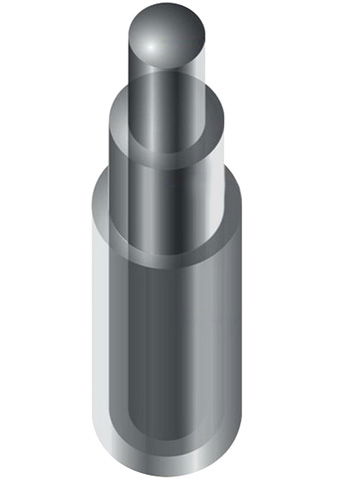
Unlike standard optical fibre, this 125/250 µm silica strand has no core, so light is not guided and instead leaks out gradually. Splicing an approximately 0.25 m length onto an open port creates an extremely high return loss of over 65 dB, helping eliminate back reflections at that interface.
Because the termination is formed by fusion splice, it creates a permanent sealed end with long-term reliability and repeatable performance. This avoids issues associated with polished or angle-cleaved fibre ends, such as contamination, fibre breakage and inconsistent results. The result is a convenient passive termination solution for fibre-optic assemblies and test setups.
Range features
A high level overview of what this range offers
- Coreless fibre design: Allows light to dissipate out of the fibre rather than reflect back, achieving return loss greater than 65 dB for terminated ports.
- Fusion-spliced termination: Creates a permanent and stable end-of-line solution that supports long-term reliability and consistent performance.
- No polished facets needed: Avoids risks such as end-face damage, micro-cracks and contamination while improving repeatability.
- Standard 125 µm diameter: Works with common splicing equipment and standard fibre infrastructure without special adapters.
- Dual UV acrylate coating: Protects the fibre while maintaining flexibility across temperatures from –40 °C to +85 °C.
- High tensile strength: Proof-tested to 200 kpsi (1.38 GPa) for durability during handling and installation.
- Broad fibre compatibility: Suitable for terminating standard, high-NA and doped fibre types across a wide range of optical applications.
Downloads
for 125/250 µm Coreless Acrylate Coated Termination Optical Fibre
125/250 µm Coreless Termination Fibre Datasheet
DownloadWhat’s in this range?
All the variants in the range and a comparison of what they offer
Specification | Value |
Coating Material | Dual UV acrylate |
Glass Diameter | 125 ± 1 µm |
Coating Diameter | 250 ± 10 µm |
Core Non-Circularity | < 2% |
Coating Concentricity Error | ≤ 6 µm |
Operating Temperature | –40 to +85 °C |
Proof Test Level | 200 kpsi (1.38 GPa) |
Part Number | F15330 |
FAQs
for 125/250 µm Coreless Acrylate Coated Termination Optical Fibre
A coreless termination optical fibre is a specialised fibre with no core, so light is not guided in the usual way and instead gradually escapes into the cladding and surrounding area. When spliced onto an unused port, incoming light is dispersed rather than reflected back, resulting in very high return loss and minimal back reflection.
It achieves very low reflection by using a sufficient length of coreless fibre, typically around 0.25 m, spliced to the end of the line. Over that length, the light leaks out and dissipates, so only a very small fraction returns toward the source.
A fusion-spliced coreless terminator creates a sealed and stable optical endpoint without exposed polished facets. This helps avoid contamination, misalignment, micro-cracks and other issues associated with polished or angle-cleaved terminations, giving more consistent long-term performance.
Yes. The F15330 uses standard geometric dimensions of 125 µm glass diameter and 250 µm coating diameter, so it can be fusion-spliced to regular single-mode or multimode fibres using standard splicing equipment.
The fibre is designed for typical environmental and mechanical stress. Its dual-layer acrylate coating supports operation from –40 °C to +85 °C, and the fibre is proof-tested to 200 kpsi (1.38 GPa) for strong resistance to breakage during installation and use.
Yes. The termination method is suitable for virtually any fibre type, including high numerical aperture fibres and rare-earth-doped fibres. This makes it a versatile low-reflection solution for both standard and specialty optical designs.
Typical applications include terminating unused output ports on fibre splitters, couplers and multi-port modules to prevent back reflections from affecting active channels. It is also useful in laboratory and field test setups where a stable low-reflection fibre endpoint is needed.