C series (cryogenic) RTD sensors
- Technology
- Platinum RTD sensors
- Partner
- YAGEO Nexensos GmbH
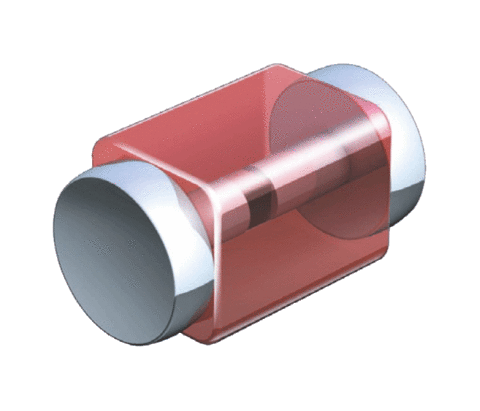
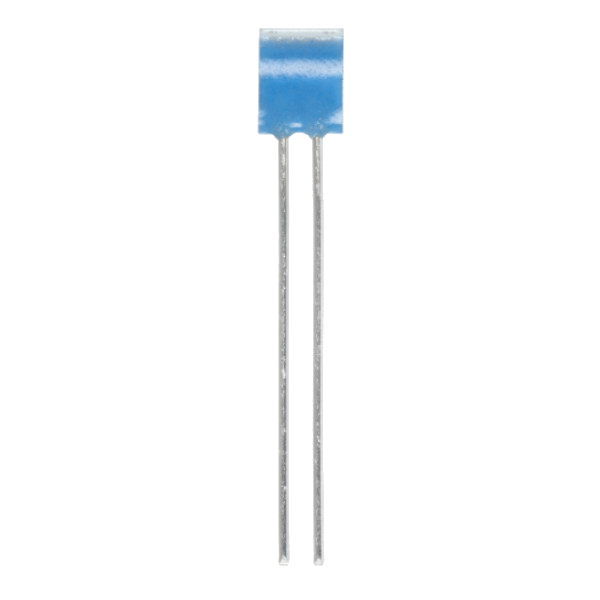
The C series comprises three leaded thin-film platinum RTD elements designed for cryogenic measurement at temperatures down to -196 °C. These sensors are intended for engineers developing probes, analytical instruments, process-monitoring equipment and temperature-control assemblies. C220 and C416 provide a Pt100 nominal resistance, while C420 offers Pt1000 for measurement circuits requiring a higher-resistance signal.
All three follow the DIN EN IEC 60751 characteristic with a temperature coefficient of 3850 ppm/K and Class F 0.3 (B) tolerance. C220 and C420 are configured for low-temperature applications up to +150 °C and must not be exposed above this limit during storage, assembly or operation. C416 extends the operating range to +500 °C for systems that must measure both cryogenic and elevated process temperatures. Application areas include chemical and pharmaceutical processing, analytical equipment, cold-chain monitoring, superconductivity systems and general cryogenic instrumentation.
Range features
A high level overview of what this range offers
- -196 °C minimum operating temperature: Supports temperature measurement at cryogenic levels.
- Pt100 and Pt1000 variants: Provides a choice of nominal resistance for different interface circuits and cable arrangements.
- Class F 0.3 (B) tolerance: Establishes a defined accuracy and interchangeability class under DIN EN IEC 60751.
- 3850 ppm/K temperature coefficient: Supports standard platinum RTD conversion and linearisation methods.
- Specified air and water response times: Provides reference data for evaluating dynamic temperature measurements.
- Typical R(0 °C) drift of 0.03% after 1,000 hours: Supports stable measurement over extended operation at the declared upper temperature limit.
- Declared vibration and shock resistance: Supports integration into mechanically exposed assemblies, subject to installation conditions.
- Brazing and soft-soldering options: Allows the joining process to be matched to the selected variant and operating temperature.
- RoHS compliance: Supports integration into assemblies with controlled-substance requirements.
What’s in this range?
All the variants in the range and a comparison of what they offer
Common specifications
| Specification | Range data |
|---|---|
Product range | C series cryogenic RTD sensors |
Sensor technology | Thin-film platinum resistance temperature detector |
Product type | Wired sensor element |
Characteristic standard | DIN EN IEC 60751 |
Temperature coefficient | 3850 ppm/K |
Tolerance class | F 0.3 (B) |
Common minimum operating temperature | -196 °C |
Typical long-term drift | R(0 °C): 0.03% after 1,000 hours at the variant’s declared upper temperature limit |
Vibration resistance | At least 40 g acceleration from 10 to 2,000 Hz; installation-dependent |
Shock resistance | At least 100 g acceleration with an 8 ms half-sine pulse; installation-dependent |
Storage life | Minimum 12 months in original packaging |
Environmental compliance | RoHS compliant |
Variant comparison
| Specification | C220 | C420 | C416 |
|---|---|---|---|
Order number | 32207399 | 32207502 | 32208519 |
Nominal resistance R0 | Pt100 | Pt1000 | Pt100 |
Operating temperature range | -196 to +150 °C | -196 to +150 °C | -196 to +500 °C |
Class F 0.3 (B) validity | -196 to +150 °C | -196 to +150 °C | -196 to +500 °C |
Recommended measuring current | 0.3 to 1 mA | 0.1 to 0.3 mA | 0.3 to 1 mA |
Water response at 0.4 m/s | t0.5: 0.06 s; t0.9: 0.20 s | t0.5: 0.08 s; t0.9: 0.25 s | t0.5: 0.07 s; t0.9: 0.25 s |
Air response at 2 m/s | t0.5: 3 s; t0.9: 13 s | t0.5: 3.5 s; t0.9: 15 s | t0.5: 3.2 s; t0.9: 14 s |
Self-heating at 0 °C | 0.4 K/mW | 0.3 K/mW | 0.4 K/mW |
Insulation resistance |
|
|
|
Body size, L × W × H | 2.3 ±0.15 × 1.9 ±0.15 × 1.0 +0.3/-0.2 mm | 3.9 ±0.15 × 1.9 ±0.15 × 1.0 +0.3/-0.2 mm | 3.9 ±0.2 × 1.5 ±0.15 × 0.8 +0.2/-0.1 mm |
Lead length | 10 ±1 mm | 15 ±1 mm | 10 ±1 mm |
Nominal-resistance measuring point | 8 mm from the end of the sensor body | 13 mm from the end of the sensor body | 8 mm from the end of the sensor body |
Connection technology | Brazing | Soft soldering | Brazing or soft soldering |
Lead material | AgPd | AgPd | AuPd |
Lead tensile strength | ≥8 N | ≥8 N | ≥5 N |
Packaging | VCI plastic bag | VCI plastic bag | Blister reel |
Temperature-handling note | Do not exceed +150 °C during storage, assembly or use | Do not exceed +150 °C during storage, assembly or use | Keep the element within its declared -196 to +500 °C range |
FAQs
for C series (cryogenic) RTD sensors
Choose C220 for compact Pt100 cryogenic measurement up to +150 °C, C420 for Pt1000 measurement over the same temperature span, and C416 when operation must extend to +500 °C. The Pt100 versions suit interfaces designed around 100 Ω at 0 °C, while the C420’s Pt1000 element produces ten times the nominal resistance and reduces the relative influence of external lead resistance. C220 has the shortest body, whereas C416 provides a narrower and thinner package. Connection method also separates the variants: C220 is intended for brazing, C420 for soft soldering and C416 for either process. Selection should begin with maximum temperature and nominal resistance, followed by the available installation space, lead length and joining method.
Use the lowest measuring current that provides adequate signal quality and noise immunity in the intended circuit. C220 and C416 accept 0.3 to 1 mA and have a self-heating value of 0.4 K/mW at 0 °C, while C420 accepts 0.1 to 0.3 mA and is rated at 0.3 K/mW. At 0 °C, a Pt100 element driven at 1 mA dissipates approximately 0.1 mW, corresponding to an estimated rise of 0.04 K under the stated reference condition. A Pt1000 element at 0.3 mA dissipates about 0.09 mW, giving an estimated rise of 0.027 K. Actual error depends on the medium, mounting arrangement, enclosure and thermal coupling, so the assembled probe should be tested at its intended excitation current.
The response figures describe the sensor elements under defined fluid-velocity conditions and should be treated as a baseline rather than a complete probe rating. In water moving at 0.4 m/s, t0.5 ranges from 0.06 to 0.08 seconds and t0.9 from 0.20 to 0.25 seconds across the three variants. In air moving at 2 m/s, t0.5 ranges from 3 to 3.5 seconds, while t0.9 ranges from 13 to 15 seconds. A protective sheath, adhesive, potting compound or poor surface contact will add thermal mass and resistance, usually increasing the final response time. Engineers should therefore compare the element figures during selection and then verify the complete assembly under representative flow and installation conditions.
The joining process must match the selected sensor: C220 uses brazing, C420 uses soft soldering and C416 supports either method. Although C220 is intended for brazing, the sensor body must not be exposed above +150 °C, so heat sinking, joint distance and process duration require close control. The same +150 °C storage, assembly and operating limit applies to C420. C416 permits element operation up to +500 °C, but solder alloy, connecting cable, insulation and encapsulation may impose a lower practical assembly limit. Lead tensile strength is rated at ≥8 N for C220 and C420 and ≥5 N for C416, but the joint and finished probe still require separate mechanical qualification.
At element level, each variant is rated for at least 40 g acceleration between 10 and 2,000 Hz and at least 100 g with an 8 ms half-sine shock pulse. Both ratings depend on the installation, so they do not automatically apply to a finished probe, cable assembly or instrument. Unsupported leads can amplify movement and transfer stress into the ceramic body or electrical joints, particularly during repeated vibration. Strain relief, controlled potting, suitable lead routing and avoidance of rigid thermal-expansion mismatches can help retain the element’s mechanical capability. The final assembly should be qualified using the actual mounting orientation, enclosure materials, cable mass and expected vibration spectrum.
All three C series cryogenic RTD sensors use the DIN EN IEC 60751 characteristic, a 3850 ppm/K temperature coefficient and Class F 0.3 (B) tolerance throughout their declared ranges. F 0.3 (B) is not a fixed ±0.3 °C tolerance across the full range, so the applicable standard tolerance band must be evaluated at each measurement temperature. Typical R(0 °C) drift is 0.03% after 1,000 hours at the upper temperature limit, equivalent to 0.03 Ω for Pt100 or 0.3 Ω for Pt1000. Near 0 °C, either resistance change corresponds to approximately 0.078 °C, but this is a typical stability figure rather than a guaranteed total error. The complete uncertainty calculation should also include readout accuracy, lead compensation, self-heating, calibration and installation-induced thermal offsets.
Nominal resistance is referenced at a defined point on the leads: 8 mm from the sensor body for C220 and C416, and 13 mm for C420. Any extension wiring beyond that point introduces additional resistance unless it is removed by the measurement topology or calibration method. The same external lead resistance produces a larger relative error with a Pt100 element than with the Pt1000 C420. For longer cable runs, a three-wire or four-wire circuit can be considered when supported by the measurement electronics, with low-resistance and thermally stable connections throughout the signal path. Calibration records should identify the complete wiring configuration rather than treating the bare element resistance as independent of its leads.
The sensors are RoHS compliant and use the DIN EN IEC 60751 platinum RTD characteristic, but these points do not qualify the finished assembly for a regulated or safety-critical application. C420 and C416 are supplied with a California Proposition 65 warning relating to potential exposure to lead oxide and cobalt oxide, so handling and product-labelling obligations should be reviewed for the intended US market. Standard catalogue parts are explicitly not recommended for aerospace applications or crewed space flight, even though the C416 temperature range can suit aerospace-related thermal conditions. Medical, pharmaceutical, transport and safety-related designs therefore require independent material review, risk assessment and final-system qualification.