PPDA 1100-1650 nm 3 GHz Coaxial Analogue Photodiode
- Technology
- Fibre optic sensors
- Partner
- AGx Technologies
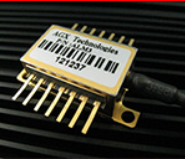
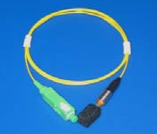
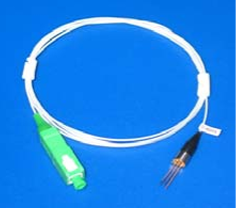
The PPDA coaxial analogue photodiode is a broadband InGaAs detector engineered for demanding fibre-optic applications. Covering wavelengths from 1100 nm to 1650 nm with a 3 GHz RF bandwidth, it can faithfully convert wideband optical signals into electrical form. This photodiode is designed for high linearity, ensuring minimal distortion of analogue RF-over-fibre signals in systems like cable television (CATV), QAM modulation links, satellite communications, and FTTx/PON networks. Its hermetically sealed coaxial package includes a single-mode fibre pigtail (SMF-28e) terminated with an SC/APC or FC/APC connector for easy integration. The device operates reliably from –40°C to +85°C, making it suitable for indoor and outdoor deployments where stability over temperature is crucial. With its combination of high responsivity and ultra-low dark current, the PPDA provides a strong and low-noise photodetection solution for analogue fibre-optic receivers.
Range features
A high level overview of what this range offers
3 GHz bandwidth – Supports wide RF frequency ranges and high data-rate optical signals for versatile analogue and digital applications.
Wide wavelength range (1100–1650 nm) – Compatible with O-, C- and L-band wavelengths, covering standard telecom and CATV bands for maximum application flexibility.
High responsivity (≈0.85 A/W @ 1310 nm, 0.95 A/W @ 1550 nm) – Converts light to electrical current efficiently, yielding strong signal levels in the receiver.
Low dark current (<1 nA) – Minimises noise floor and enhances signal clarity, enabling excellent sensitivity even at low optical input levels.
Low distortion design – Offers superior linearity (typical CSO ~–70 dBc, CTB ~–80 dBc) to preserve signal integrity in multi-channel analogue fibre links.
Hermetic coaxial package – Sealed metal package ensures high reliability and long operational lifetime with no degradation in performance over time.
Downloads
for PPDA 1100-1650 nm 3 GHz Coaxial Analogue Photodiode
What’s in this range?
All the variants in the range and a comparison of what they offer
| Parameter | Value |
|---|---|
Wavelength range | 1100 nm to 1650 nm |
Photodiode type | InGaAs PIN (analogue receiver grade) |
Bandwidth (–3 dB) | 3 GHz (RF optical receiver bandwidth) |
Responsivity @ 1310 nm | 0.85 A/W (typical) |
Responsivity @ 1550 nm | 0.95 A/W (typical) |
Dark current (@ 5 V) | 0.2 nA (typ.), 1 nA max. |
Junction capacitance | 0.5 pF (typ.), 0.65 pF max. (@ 5 V bias) |
Rise time | ~0.1 ns (corresponding to 3 GHz bandwidth) |
Optical input | SMF-28e fibre pigtail, 0.9 mm loose tube |
Connector | SC/APC or FC/APC standard (others on request) |
Maximum optical input | +6 dBm (approx. 4 mW) |
Recommended bias voltage | 5 V DC (reverse bias) |
Maximum reverse voltage | 15 V DC |
Output impedance | 50 Ω (designed for RF coaxial 50 Ω load) |
Composite second order (CSO) | –70 dBc typical (analogue distortion) |
Composite triple beat (CTB) | –80 dBc typical (analogue distortion) |
Operating temperature | –40 °C to +85 °C |
Storage temperature | –40 °C to +100 °C |
Compliance | RoHS compliant; designed to meet Telcordia GR-468 |
FAQs
for PPDA 1100-1650 nm 3 GHz Coaxial Analogue Photodiode
A 3 GHz optical bandwidth means the photodiode can faithfully detect and convert modulation frequencies up to 3 GHz. In practice, this supports very wide RF signals over fibre, such as broadband CATV or radio-over-fibre feeds. It also means the device can handle digital data rates up to around 2.5 Gbps with good performance.
The PPDA photodiode is designed for high linearity in analogue applications. It typically achieves a Composite Second Order (CSO) distortion of about –70 dBc and Composite Triple Beat (CTB) around –80 dBc, indicating very low nonlinear distortion.
The PPDA requires a reverse bias (typically 5 V DC) for optimal speed and linearity. It’s usually connected to a 50 Ω RF load or transimpedance amplifier to convert the photocurrent into a voltage. An appropriate receiver circuit or TIA is needed to amplify the photodiode’s current signal.
The PPDA comes standard with a single-mode fibre pigtail, typically 1 m in length, terminated with either an SC/APC or FC/APC connector. Different connector types and pigtail lengths are available on request.
Yes. The device is hermetically sealed in a robust coaxial metal canister, which protects the photodiode from humidity and contaminants and is specified for a wide operating temperature range from –40 °C to +85 °C.
An optional mounting clamp is available for the PPDA photodiode. It allows secure mounting to a chassis or PCB and is recommended for mechanically stabilising the pigtailed photodiode in high-vibration environments.
Yes. The RPDA series is the receptacle variant corresponding to the PPDA, providing similar performance but in an SC receptacle package, allowing flexible fibre connection.