ALM3HP 1310 nm 31 mW CW Butterfly Analogue DFB Laser
- Technology
- Fibre optic sensors
- Partner
- AGx Technologies
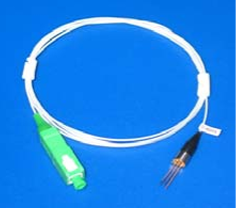
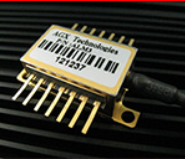
The ALM3HP 1310 nm 31 mW CW Analogue DFB Laser Module is a high-power optical source designed for demanding fibre-optic link applications. Operating at 1310 nm with up to 31 mW output, it provides a stable continuous-wave beam suited to broadband analogue transmission such as CATV and RF over fibre systems. Its industry-standard 14-pin butterfly package integrates a thermoelectric cooler, thermistor, Faraday optical isolator, and monitor photodiode to support stable and reliable performance.
The distributed feedback design delivers narrow spectral output, low noise, and strong linearity for transporting multiple RF channels or other analogue signals with minimal distortion. Built-in thermal stabilisation and hermetic sealing help maintain wavelength and output consistency across changing environments. This makes the module suitable for telecom infrastructure, fibre-optic sensor systems, broadband video distribution, and precision optical test setups requiring a dependable 1310 nm CW laser source.
Range features
A high level overview of what this range offers
- 31 mW optical output at 1310 nm: Provides a strong optical signal for long-distance fibre links and distribution architectures with multiple splitting points.
- High-linearity DFB design: Supports low-distortion analogue modulation for CATV, broadband RF feeds, and other signal-sensitive optical links.
- Continuous-wave single-frequency operation: Delivers a stable optical carrier for consistent analogue waveform transmission over time.
- 14-pin butterfly package with TEC: Integrates thermoelectric cooling and temperature sensing to keep wavelength and output power stable across varying ambient conditions.
- Integrated optical isolator: Reduces the impact of back-reflections, improving signal stability and protecting the laser from feedback-related noise.
- Built-in monitor photodiode: Enables active output monitoring and automatic power-control loop implementation.
- Hermetically sealed construction: Protects internal optical and electronic components for improved field reliability and service life.
- Single-mode fibre pigtail with FC/PC connector: Simplifies installation into fibre systems with low coupling loss and convenient connectivity.
Downloads
for ALM3HP 1310 nm 31 mW CW Butterfly Analogue DFB Laser
What’s in this range?
All the variants in the range and a comparison of what they offer
Parameter | Value |
Laser type | DFB (Distributed Feedback), multi-quantum well structure |
Centre wavelength | 1310 nm (± 5 nm standard) |
Optical output power | 31 mW typical (up to ~35 mW max, CW) |
Spectral purity (SMSR) |
|
Slope efficiency | ~0.45 mW/mA (typical) |
Threshold current | ~15 mA (typical) |
Operating current | ~80 mA (typical for 31 mW output) |
Forward voltage | ~1.5 V (typical), 2.0 V (max) |
Fibre pigtail | 1 m single-mode fibre (SMF-28 or equivalent), FC/PC connector |
Integrated isolator | Yes (Faraday isolator, ~30 dB isolation) |
Monitor photodiode | Yes (built-in, for power monitoring) |
Thermistor / TEC | Yes – NTC thermistor and TE cooler internal |
Operating case temperature | 0 °C to +70 °C (with TEC active) |
Storage temperature | –40 °C to +85 °C |
Laser safety class | Class 3B (IEC 60825-1 standard) |
Package format | 14-pin butterfly (standard pin configuration) |
FAQs
for ALM3HP 1310 nm 31 mW CW Butterfly Analogue DFB Laser
The 14-pin butterfly package is an industry-standard format that integrates the laser diode and key support components into one sealed module. It provides electrical connections for the laser drive, TEC, thermistor, and monitor photodiode, making integration with control electronics easier. The package is mechanically robust, can be mounted to a heat sink, and helps protect internal optics and components through hermetic sealing.
The built-in thermoelectric cooler actively regulates the laser diode temperature to keep wavelength and output power stable as ambient conditions change. This is especially important in analogue applications where drift can reduce signal quality. In most cases, no separate cooler is required, but the module should still be mounted on a suitable heat sink to dissipate heat. A TEC controller in the driver circuit is required to use the thermistor and TEC properly.
Yes. The ALM3HP is a directly modulated DFB laser designed for broadband analogue use. The RF signal is superimposed on the laser bias current so that the optical output follows the modulation. This makes it suitable for CATV, RF over fibre, and similar applications. For extremely high-frequency use beyond the range typical of these systems, a laser specifically optimised for higher bandwidth may be preferable.
Typical applications include CATV distribution networks, analogue and hybrid fibre-optic communication systems, RF over fibre links, broadband video transport, optical test and measurement setups, and certain sensor or interferometric systems that require a stable 1310 nm continuous-wave light source.
The built-in monitor photodiode detects a portion of the laser output inside the package and provides a feedback signal proportional to optical power. In practice, this signal is connected to an APC (Automatic Power Control) circuit in the driver so the system can adjust laser current and maintain stable output over time despite temperature changes or ageing.
- Use ESD protection: Laser diodes are sensitive to static discharge, so grounding and anti-static handling are essential.
- Follow laser safety procedures: The output power places the module in Class 3B, so avoid direct eye exposure and use appropriate protective measures for 1310 nm infrared light.
- Provide thermal management: Mount the butterfly package to a suitable heat sink for reliable operation.
- Use a proper driver: A low-noise laser driver with current and temperature control is recommended, and current spikes or hot-plugging should be avoided.
Although the ALM3HP is optimised for analogue linearity and CW stability, it can also be used for digital transmission. Its 1310 nm DFB architecture supports direct modulation for many practical telecom and fibre-link applications. However, if the application is purely digital at very high data rates, a laser specifically designed for higher-speed signalling may be a better fit.