PLMR1xxC CWDM 3 GHz 4 mW Coaxial Analogue DFB Laser
- Technology
- Fibre optic sensors
- Partner
- AGx Technologies
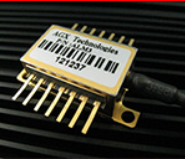
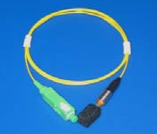
The PLMR1xxC CWDM laser series is a family of coaxial analogue DFB lasers designed for broadband fibre-optic communications. Housed in a compact hermetic coaxial package, each laser provides a stable single-frequency output at coarse WDM wavelengths between 1270 nm and 1610 nm. This allows network engineers to multiplex multiple return-path or RF signals on a single fibre, expanding capacity without laying new cable. With an analogue modulation bandwidth up to 3 GHz, these lasers can carry high-frequency RF signals – from CATV upstream channels to wireless IF streams – while maintaining low noise and high linearity.
The up to 4 mW optical output power is suitable for typical link spans in CATV and RF-over-fibre systems, offering a cost-effective solution for short to medium distance links. Designed for uncooled operation, the PLMR1xxC lasers operate reliably over a wide temperature range, making them well-suited to field installations (such as outdoor nodes or remote modules). By combining DFB technology with an optimised coupling design, the series achieves consistent optical performance without requiring thermoelectric cooling, ensuring a low-cost yet high-performance transmitter solution for broadband analog fibre networks.
Range features
A high level overview of what this range offers
- CWDM wavelength options (1270–1610 nm) – Supports up to eight coarse WDM channels, enabling multiple signals to share one fibre for flexible network design.
- Distributed Feedback (DFB) laser technology – Provides stable single-mode output with narrow linewidth, minimising interference between channels and improving signal fidelity.
- 3 GHz analogue bandwidth – Accommodates high-frequency RF modulation (up to 3 GHz), allowing transmission of broadband CATV, cellular, or other RF signals without distortion.
- Up to 4 mW optical output – Delivers sufficient optical power for reliable link budgets over typical fibre distances, ensuring clear signal transmission in return-path and RFoF applications.
- Hermetic coaxial package – Compact, industry-standard coaxial can (TO-can) design simplifies integration into existing transmitter designs and provides robust, sealed protection for the laser diode.
- Low RIN noise & high linearity – Maintains excellent signal quality with minimal noise and distortion, which is critical for analogue modulation and preserving carrier-to-noise ratios.
- Built-in monitor photodiode – Integrated photodiode monitors output power in real time, facilitating feedback control to stabilise the laser output over temperature and lifetime.
- Optional optical isolator – Single- or dual-stage Faraday isolators can be added to block back-reflections, improving stability and preventing feedback-induced signal degradation in sensitive links.
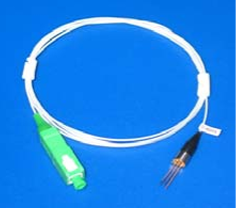
- Customisable pigtails & connectors – Supplied with a single-mode fibre pigtail (typically SMF-28) with standard connector options (e.g. SC/APC, FC/APC); other connector types or receptacle versions available to fit specific system requirements.
- Wide operating temperature range – Designed for reliable operation under industrial conditions (e.g. –40 °C to +85 °C), making it suitable for both indoor headends and outdoor enclosures without active cooling.
Downloads
for PLMR1xxC CWDM 3 GHz 4 mW Coaxial Analogue DFB Laser
What’s in this range?
All the variants in the range and a comparison of what they offer
| Parameter | Value |
|---|---|
Laser type | Uncooled MQW-DFB (Distributed Feedback) diode |
Wavelength range | 1270 nm – 1610 nm (CWDM channels, 20 nm spacing) |
Optical output power | Up to 4 mW (CW, per laser channel) |
Analogue bandwidth | 3 GHz (–3 dB modulation bandwidth) |
Spectral linewidth | Narrow (single longitudinal mode DFB) |
Linearity / RIN noise | High linearity, low RIN (for low distortion) |
Package type | Hermetic coaxial laser module (industry standard TO-can) |
Fiber pigtail | Single-mode fibre (SMF-28 or equivalent), 0.9 mm buffered, ~1 m length |
Connector options | SC/APC (standard); FC/APC or others on request |
Monitor photodiode | Yes – built-in rear-facet monitor for power feedback |
Optical isolator | Optional (single-stage or dual-stage available) |
Operating temperature | Wide range (e.g. –40 °C to +85 °C, ambient) |
Applications | CATV return path, RF over fibre uplinks, broadband wireless DAS, etc. |
(Note: “PLMR1xxC” denotes multiple variants across CWDM wavelengths; all specifications are general for the series. Specific parameters may vary slightly by wavelength.)
FAQs
for PLMR1xxC CWDM 3 GHz 4 mW Coaxial Analogue DFB Laser
CWDM stands for Coarse Wavelength Division Multiplexing. It refers to a set of standardised wavelengths (spaced 20 nm apart) that these lasers can operate at, ranging roughly from 1270 nm up to 1610 nm. By using CWDM wavelengths, multiple PLMR1xxC lasers each on different wavelengths can send signals over a single optical fibre without interfering with each other. This allows network designers to multiplex several upstream or RF signals together, greatly increasing fibre capacity while using simpler, less tightly controlled optics compared to dense WDM systems.
DFB (Distributed Feedback) lasers emit on a single longitudinal mode (single wavelength) with a narrow spectral width and low chirp. This is crucial for analogue fibre links – it means the laser’s output is spectrally pure and stable, which prevents overlapping channels in a WDM system and minimises distortion. Fabry-Perot lasers, by contrast, produce multiple wavelengths and have higher phase noise, which can cause interference and signal degradation in analogue systems. In short, the DFB design gives much better linearity, lower noise (RIN), and compatibility with WDM multiplexing, all of which are essential for high-quality analogue transmission (like CATV signals).
No – one of the advantages of the PLMR1xxC coaxial laser design is that it operates uncooled. The lasers are designed to remain stable over a broad ambient temperature range without an active TEC. The hermetic coaxial package and the device design (including proper chip structure and monitor photodiode feedback) help maintain consistent optical power and wavelength even as temperatures vary. This reduces cost and complexity. If an application demands extremely tight wavelength control or operation at very high power/temperature extremes, a cooled butterfly-type laser might be chosen instead, but for typical CATV and RF-over-fibre applications the PLMR1xxC’s uncooled performance is sufficient.
The 3 GHz bandwidth indicates the approximate upper frequency limit that the laser’s intensity can be modulated at (the –3 dB point of its frequency response). In practical terms, it means the PLMR1xxC series can faithfully transmit RF signals up to 3 GHz in frequency. This covers the needs of CATV networks (whose upstream/downstream signals are typically in the tens to hundreds of MHz) with plenty of headroom, and also enables transmission of higher-frequency services such as certain wireless and cellular bands or other microwave-frequency analog signals. Having a 3 GHz bandwidth ensures the laser can handle modern high-density channel plans, wide-band carriers, or future expansion without becoming the limiting factor in the system’s frequency range.
An optical isolator is recommended if there’s a risk of back-reflections or optical feedback into the laser – for example, if your fibre link has multiple connectors, splitters, or if it’s connecting to reflective components. Even small reflections can destabilise a DFB laser’s output and add noise or distortion, especially in analogue links. The isolator (single- or dual-stage) inserted at the laser output allows light to exit but blocks reflections coming back, thereby protecting the laser from interference. In relatively simple setups (like a short fibre directly into a well-terminated receiver) an isolator might not be necessary. However, for most CATV headend or field installations – where connectors and patch panels are involved – using at least a single-stage isolator is a good practice to preserve signal quality. The dual-stage isolator provides even greater isolation for very sensitive or multi-channel systems.
Each PLMR1xxC laser typically comes with a factory-attached single-mode fibre pigtail (usually standard 9/125 µm SM fibre) of about 1 metre in length. The default connector at the end of the pigtail is often SC/APC (angled polish) – which is commonly used in CATV networks for its low back-reflection. However, the manufacturer can supply other connector types to match your system – for instance FC/APC, SC/UPC, etc., or even leave the pigtail unterminated (bare fibre) if you plan to fusion-splice. In some configurations, a receptacle version of the laser can be provided instead of a fixed pigtail, allowing you to plug a fibre connector directly into the laser module. The choice of connector will depend on the standard in your network; SC/APC is popular for its superior return loss in analogue systems.
Yes, the PLMR1xxC coaxial lasers use an industry-standard pin configuration for coaxial laser diodes. Typically, such lasers have three or four pins: two pins for the laser diode (anode and cathode) and one or two pins for the monitor photodiode (with the case usually serving as common ground). The exact pin count can depend on the variant (for example, some designs use a common ground for both laser and photodiode). Standard pinning means you can drop these lasers into existing transmitter or analog optical transmitter boards without a custom socket – the leads will match typical laser diode driver circuits. Moreover, AGx (the manufacturer) offers custom pin configurations if needed for large orders, so they could rewire pin assignments to suit a particular legacy board. But in most cases, out-of-the-box these lasers will plug into a standard coaxial-laser socket or PCB footprint in fibre transmitter modules.
Yes. The high modulation bandwidth and linear performance of the PLMR1xxC make it feasible to use them for RF-over-fibre in wireless applications – for example, transporting cellular signals (LTE, CDMA, etc.) from remote antennas to a base station hotel. The lasers can modulate RF carriers up to 3 GHz, which covers common cellular bands (and even some WiFi/microwave frequencies). However, one consideration is output power: the PLMR1xxC provides up to 4 mW. While that is plenty for shorter links, some wireless RF-over-fibre systems (especially if distributing to many nodes or over long distances) might prefer a higher-power laser or use an optical amplifier to ensure sufficient link gain. If the application is a distributed antenna system (DAS) within a building or campus, in many cases 4 mW on each fibre link is adequate. In summary, these lasers can certainly handle the signal bandwidth and linearity requirements for wireless RF signals – just ensure the optical power budget fits the distance and splitting needs of your specific system.
A 4 mW output corresponds to about +6 dBm of optical power. In a typical fibre, with roughly 0.2–0.3 dB/km attenuation (at 1550 nm) or ~0.4 dB/km (at 1310 nm), this power can travel quite far – for example, around 20–30 km of fibre might incur only 5–6 dB of loss. In pure optical terms, that means a few tens of kilometers range. However, analogue CATV links are usually limited by noise and distortion rather than just total loss. In practice, the return-path receivers have sensitivity requirements to achieve a good C/N (carrier-to-noise ratio). A typical return receiver might need around –6 to 0 dBm of receive power for optimal performance. Given +6 dBm launch, you have approximately a 6–12 dB margin for fibre loss and splitting. So, a scenario could be: 10 km of fibre (~2 dB loss) plus a 1×4 splitter (~6–7 dB) is feasible. Or without splitting, 20+ km of fibre is within reach. Each network is different, but generally the PLMR1xxC lasers provide plenty of headroom for most node-to-headend return paths in HFC networks. If you have an exceptionally long or lossy path, you may consider an optical amplifier or a higher-power laser variant, but for standard cable plant distances these lasers meet the needs.
Coaxial lasers like the PLMR1xxC are small, cylindrical devices without built-in temperature control – they are simpler and more cost-effective, intended to operate in setups where extreme precision or stability isn’t required beyond what the intrinsic design provides. Butterfly-packaged lasers, on the other hand, are larger modules with integrated thermoelectric coolers (TEC), often a 14-pin package. They keep the laser chip at a fixed temperature and sometimes include isolators and other components inside. This gives butterfly lasers extremely stable wavelength and output power even under varying ambient conditions, which is important for certain high-performance or dense WDM applications. The trade-off is cost, size, and power consumption. In many analogue applications like CATV return paths or short-range RF links, coaxial lasers are preferred because they are far less expensive and still meet the performance requirements. They’re easy to mount on a PCB by their pins or a coaxial socket and don’t require the complex TEC driver circuitry. In summary, coaxial lasers offer a lower-cost, compact solution and are used where good performance suffices; butterfly lasers are used when ultimate stability or higher power is needed. For most broadband analogue systems (except the most demanding), coaxial lasers like PLMR1xxC strike the right balance between performance and cost.