NIR series high sensitivity, low noise spectrometers
- Technology
- Spectrometers
- Partner
- Ocean Optics
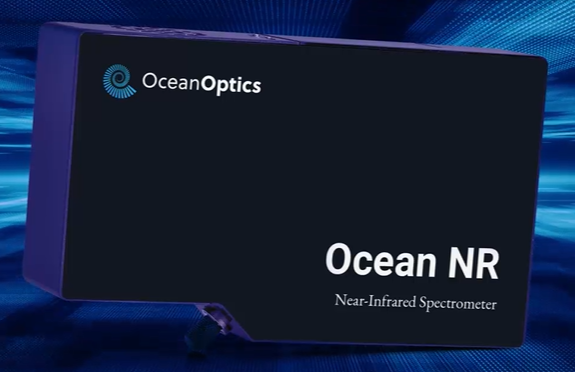
The NR-512 NIR spectrometers comprise five standard-gain and high-gain configurations for nominal wavelength ranges of 900–1700 nm, 900–2200 nm and 900–2500 nm. Standard-gain models prioritise single-scan signal-to-noise ratio and dynamic range, while the high-gain 1.7 and 2.2 variants increase responsivity for weak optical signals. Thermoelectric detector cooling and interchangeable slit widths allow thermal stability, optical throughput and spectral resolution to be balanced for the measurement. Integration times from 1 ms to 120 s accommodate strong signals and low-light applications.
Maximum stated scan rates reach 275 Hz for the 1.7 variants and 242 Hz for the 2.2 and 2.5 variants. USB, RS-232, GPIO, external triggering and strobe functions support integration into automated test equipment and process-monitoring systems. Typical applications include moisture analysis, material identification, pharmaceutical measurements, food and agricultural testing, environmental analysis, semiconductor materials and energy research.
Range features
A high level overview of what this range offers
- Three NIR wavelength configurations: Match the measurement range to the absorption bands required by the application.
- Standard-gain and high-gain variants: Choose between wider dynamic range and greater responsivity to weak optical signals.
- Thermoelectric detector cooling: Controls detector temperature to reduce the effects of thermal drift and dark current.
- Interchangeable 10–200 µm slits: Balance optical resolution and light throughput for each measurement.
- 1 ms to 120 s integration range: Supports rapid acquisition and lower-intensity measurements.
- Scan rates up to 275 Hz: Accommodates dynamic samples, moving materials and time-dependent processes.
- USB 2.0 and RS-232 host interfaces: Supports direct computer operation and embedded system integration.
- Four GPIO lines, external triggering and strobe outputs: Simplifies synchronisation with light sources, conveyors and external equipment.
- SMA 905 fibre input: Enables modular connection to optical fibres, probes and sampling accessories.
- Power and data status LEDs: Provides visible indication of device operation and data transmission.
- Wavelength and linearity calibration sheets supplied: Supports commissioning, traceability and subsequent recalibration planning.
Downloads
for NIR series high sensitivity, low noise spectrometers
What’s in this range?
All the variants in the range and a comparison of what they offer
Common specifications
| Specification | Value |
|---|---|
Product type | Modular near-infrared spectrometer series |
Detector | 512 pixels |
Nominal series wavelength coverage | 900–2500 nm, depending on model |
Standard entrance aperture | 25 µm |
Alternative entrance apertures | 10 µm, 50 µm, 100 µm, 200 µm or no slit |
Shutter activation time | 11 ms |
Integration range | 1 ms–120 s |
Power input | +5 VDC, 3.5 A maximum |
Power-up time | 3 s |
USB Type-C VCC rating | 4.75 V minimum, 5 V nominal, 5.25 V maximum |
Host interfaces | USB 2.0 High Speed; two-wire RS-232 at 115.2 kbaud |
I/O connectors | USB Type-C, SMA 905 input and 16-pin Samtec TFM |
I/O standard | 3.3 V CMOS; inputs are +5 V compatible |
GPIO | Four general-purpose I/O lines |
Strobe modes | Single and continuous |
Trigger modes | Software, external rising edge and external level |
External triggering jitter | 10 ns maximum |
Dimensions | 182.25 × 109.19 × 46.45 mm |
Weight | 1.17 kg |
Operating temperature | 10–35 °C |
Storage temperature | -30–70 °C |
Thermoelectric cooling range | 40 °C below ambient within the specified operating range |
TEC stability | ±0.5 °C of set temperature in under 1 minute; typical long-term stability ±0.1 °C |
Relative humidity | 0–85%, non-condensing |
Operating altitude | Up to 2,000 m |
Pollution degree | 2 |
Supplied items | Spectrometer, +5 VDC power supply, standard 15-pin accessory cable, USB Type-A to Type-C cable, wavelength calibration sheet and linearity calibration sheet |
EMC conformity | 2014/30/EU; EN 61326-1:2013 Basic Level; EN 55011:2009/A1:2010 Group 1, Class A |
Electrical safety | 2014/35/EU; IEC 61010-1:2010 and IEC 61010-1:2010/AMD1:2016 |
Materials conformity | RoHS Directive 2011/65/EU with extension 2015/863 |
Additional compliance information | FCC Part 15 Class A and WEEE-marked disposal requirements |
Variant comparison
| Specification | NR-512-1.7-XX | NR-512-1.7HG-XX | NR-512-2.2-XX | NR-512-2.2HG-XX | NR-512-2.5-XX |
|---|---|---|---|---|---|
Gain configuration | Standard | High gain | Standard | High gain | Standard |
Nominal wavelength range | 900–1700 nm | 900–1700 nm | 900–2200 nm | 900–2200 nm | 900–2500 nm |
Optical resolution range, FWHM | 2.70–13.03 nm | 2.70–13.03 nm | 3.12–18.96 nm | 3.12–18.96 nm | 4.21–29.59 nm |
Grating groove density | 150 lines/mm | 150 lines/mm | 95 lines/mm | 95 lines/mm | 78 lines/mm |
Grating blaze wavelength | 1100 nm | 1100 nm | 1300 nm | 1300 nm | 1300 nm |
SNR, single scan at 10 ms | 10,000:1 | 2,800:1 | 9,700:1 | 2,788:1 | 7,200:1 |
Dynamic range, single scan | 21,000:1 | 12,000:1 | 17,510:1 | 10,323:1 | 14,452:1 |
Dark noise at minimum integration time | 3.1 counts | 5.5 counts | 3.3 counts | 5.7 counts | 4.3 counts |
Corrected linearity, 10–90% | 99.80% | 99.60% | 99.90% | 99.50% | 99.80% |
Maximum stated scan rate | 275 Hz | 275 Hz | 242 Hz | 242 Hz | 242 Hz |
Order sorting | Longpass filter transmitting above 830 nm | Longpass filter transmitting above 830 nm | Order-sorting filter with OD greater than 4 | Order-sorting filter with OD greater than 4 | No dedicated filter stated |
Wavelength range and optical resolution are typical values and depend on the selected components, slit and operating conditions. Use the order-specific calibration sheet when transferring or validating a measurement method.
Optical resolution by interchangeable slit
| Variant | 10 µm slit | 25 µm slit | 50 µm slit | 100 µm slit | 200 µm slit |
|---|---|---|---|---|---|
NR-512-1.7 and NR-512-1.7HG | 2.72 nm | 2.85 nm | 4.02 nm | 6.71 nm | 13.03 nm |
NR-512-2.2 and NR-512-2.2HG | 3.12 nm | 4.80 nm | 5.52 nm | 10.08 nm | 18.96 nm |
NR-512-2.5 | 4.21 nm | 6.50 nm | 7.45 nm | 13.60 nm | 29.59 nm |
FAQs
for NIR series high sensitivity, low noise spectrometers
Select the shortest wavelength range that fully contains the absorption bands and reference regions needed by the method. The 900–1700 nm variants suit measurements dominated by moisture and organic overtone bands, while the 900–2200 nm models add combination-band coverage that can improve chemical differentiation in pharmaceutical and polymer applications. The 900–2500 nm version provides the widest nominal span for broader material identification and multicomponent calibration models. Extending the range affects grating selection, scan rate and resolution, so the widest model is not automatically the correct choice. Check the final calibrated range supplied with the individual instrument before transferring an existing chemometric model.
Choose high gain when the expected optical signal is weak and shorter integration times are required. High gain electronically amplifies the detector signal, but it also increases baseline noise and causes saturation at lower incident-light levels. For example, the NR-512-1.7 changes from a 10,000:1 SNR and 21,000:1 dynamic range in standard gain to 2,800:1 and 12,000:1 in high gain. The corresponding NR-512-2.2 figures change from 9,700:1 and 17,510:1 to 2,788:1 and 10,323:1. Standard gain is therefore preferable for strong signals, long integrations or applications requiring the widest single-scan dynamic range.
A narrower slit improves optical resolution but admits less light, while a wider slit increases throughput at the cost of broader spectral features. On the NR-512-1.7, the stated resolution changes from 2.72 nm with a 10 µm slit to 13.03 nm with a 200 µm slit. The NR-512-2.2 changes from 3.12 nm to 18.96 nm across the same slit range, and the 25 µm slit is the standard configuration. Engineers should compare the expected width and separation of the analytical peaks with the available photon level before selecting a slit. High gain can support a narrower slit in some low-light systems, but the resulting noise and saturation trade-offs still need to be tested.
Yes, the available electrical interfaces support computer-controlled measurements and embedded integration. USB 2.0 High Speed is provided for direct operation, while two-wire RS-232 communicates at 115.2 kbaud and can be used with a host controller. Four GPIO lines, external edge and level triggers, and single or continuous strobe outputs allow acquisition to be synchronised with light sources, conveyors or moving samples. Maximum stated scan rates are 275 Hz for the 1.7 models and 242 Hz for the 2.2 and 2.5 models, although the achieved rate also depends on the host and software. RS-232 operation requires external +5 VDC power, and only one host communication interface should be active at a time.
The spectrometer is specified for operation from 10 to 35 °C and storage from -30 to 70 °C. Its thermoelectric cooler can operate to 40 °C below ambient within the stated operating range, reaching ±0.5 °C of the selected temperature in under one minute with typical long-term stability of ±0.1 °C. A brief warm-up period is still required after power-up or a sudden ambient-temperature change. Relative humidity must remain between 0 and 85% without condensation, and the installation altitude is limited to 2,000 m. Particular care is needed when choosing a low detector setpoint because reaching the local dew point can cause condensation inside the measurement environment.
The high-gain NR-512-1.7 is the relevant configuration within this series for low-intensity Raman signals generated with 1064 nm excitation. Its nominal 900–1700 nm coverage accommodates the excitation wavelength and the longer-wavelength Raman response, while electronic gain increases the responsivity available for weak peaks. This benefit is accompanied by a lower single-scan SNR of 2,800:1 and a reduced dynamic range of 12,000:1 compared with the standard-gain model. Strong background or excessive integration time can therefore cause earlier saturation. The optical filter, probe, fibre and laser-rejection arrangement must also be selected as a complete Raman system rather than treating detector gain as the only design parameter.
Install the control software and drivers before connecting the spectrometer to a Windows host through USB. The NR Series requires OceanView version 2.0.15 or later, and the unit must receive +5 VDC through its power input before it can complete the boot sequence. A solid red status LED indicates power, while a flashing green LED indicates data transmission. Each unit is supplied with wavelength and linearity calibration data sheets, which should be retained with the instrument records. Annual wavelength recalibration is recommended, with additional calibration intervals determined by the quality system, operating environment and measurement risk. Absolute irradiance calibration is separately required when the application needs traceable radiometric values rather than relative spectral intensity.