Beam Expanders
- Technology
- F-theta lenses and beam expanders
- Partner
- Wavelength Opto-Electronic
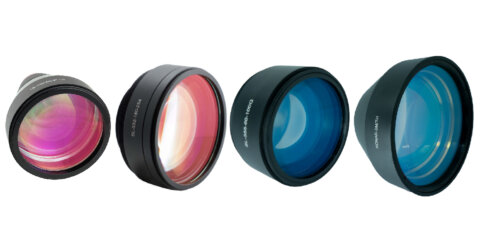
Ronar-Smith laser beam expanders are telescopic optical assemblies designed to magnify a collimated laser beam without sacrificing beam quality. By increasing beam diameter and reducing divergence, they help downstream optics such as F-Theta scan lenses and focusing systems achieve smaller, more uniform spot sizes. The range includes fixed-magnification models for dedicated processes as well as adjustable manual and motorised zoom beam expanders for flexible beam sizing. Supported wavelengths extend from 266 nm UV through visible and infrared bands up to 10.6 µm CO₂ lasers. These expanders are suited to laser marking, engraving, drilling, cutting, additive manufacturing, scanning, and precision optical research. Their Galilean design keeps the units compact and avoids an internal focus, improving robustness in high-power environments. Custom options are available for coatings, apertures, and magnification factors to meet system-specific requirements. Each unit is rigorously tested for optical and mechanical reliability before shipment.
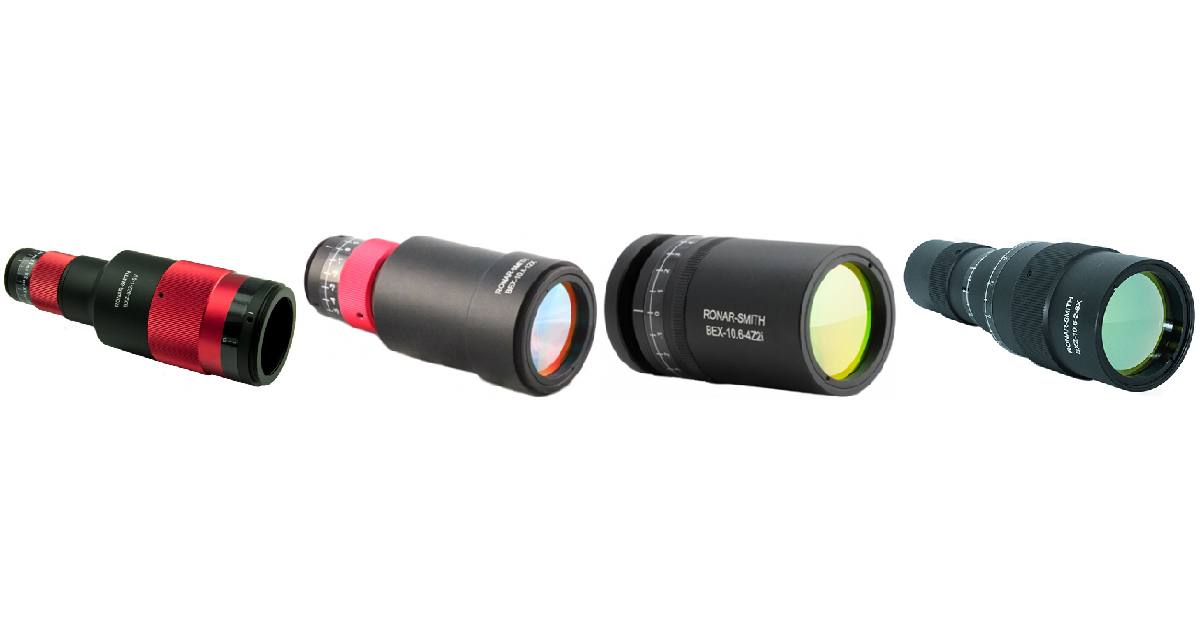
Ronar-Smith beam expanders are engineered for laser systems that require precise beam conditioning before scanning or focusing optics. By enlarging the input beam while preserving collimation, they help reduce divergence and improve achievable spot quality at the target.
The range includes fixed beam expanders for stable, repeatable setups and zoom variants for applications where beam size must be adjusted between materials, processes, or recipes. With versions for UV, visible, NIR, and CO₂ wavelengths, these beam expansion optics support demanding industrial and scientific environments.
Range features
A high level overview of what this range offers
- Galilean telescopic design: Uses a negative-positive lens arrangement with no internal focal point for compact size and improved resistance to internal optical damage under high laser power.
- Broad wavelength compatibility: Supports laser sources from 266 nm UV through visible and NIR wavelengths up to 9.4 µm and 10.6 µm CO₂ lasers.
- Wide magnification options: Fixed beam expanders cover approximately 1× to 50×, while zoom beam expander models provide continuous adjustment across application-specific ranges.
- Fixed, manual zoom, and motorised zoom versions: Enables selection of a simple dedicated setup or an adjustable platform for changing process requirements.
- High-power CO₂ capability: UniBET and MiniBET models support high-power CO₂ lasers, while BET-WC water-cooled versions are designed for even higher continuous power loads.
- High-transmission AR-coated optics: Appropriate substrate materials and anti-reflection coatings help maximise throughput and reduce thermal loading.
- Customisable beam expansion optics: Available with tailored coatings, apertures, magnification factors, and wavelength-specific configurations to fit specialised laser systems.
- Stable beam alignment: Designed for low beam walk-off and strong pointing stability to maintain beam consistency in production environments.
What’s in this range?
All the variants in the range and a comparison of what they offer
Beam expander series | Magnification | Wavelength range (nm) |
Fixed beam expander (BEX) | 1× – 50× | 266 / 355 / 405 / 532 / 633 / 1064 / 1550 / 2000 / 9400 / 10600 |
Manual zoom beam expander (BXZ) | Continuous zoom | 266 / 355 / 405 / 532 / 633 / 1064 / 1550 / 2000 / 9400 / 10600 |
Motorised zoom beam expander (BXZ-MOT) | Continuous zoom | 266 / 355 / 405 / 532 / 633 / 1064 / 1550 / 2000 / 9400 / 10600 |
CO₂ beam expander (UniBET series) | 1.5× – 10× | 10600 (far-IR CO₂ laser) |
CO₂ beam expander (MiniBET series) | 1.5× – 6× | 10600 (far-IR CO₂ laser) |
CO₂ water-cooled beam expander (BET-WC) | 1.5× – 10× | 10600 (far-IR CO₂ laser) |
FAQs
for Beam Expanders
A beam expander is an optical device that increases the diameter of a collimated laser beam while keeping the output beam collimated. This reduces divergence and allows downstream optics to produce a smaller focal spot. A Galilean beam expander uses a negative lens and a positive lens without creating an internal focal point, making the unit shorter, more compact, and better suited to high-power laser use.
The Ronar-Smith range covers a broad span of magnifications and wavelengths. Fixed beam expanders are available from around 1× up to 50×, while manual and motorised zoom beam expanders provide continuous magnification adjustment within model-specific ranges. Supported wavelengths include 266, 355, 405, 532, 633, 1064, 1550, 2000, 9400, and 10600 nm, covering UV, visible, NIR, and CO₂ laser applications.
A fixed beam expander is ideal when beam size and process conditions remain constant, such as in dedicated laser marking, engraving, or cutting setups. It offers a stable expansion factor, straightforward alignment, and fewer moving parts. A zoom beam expander is better when the application requires frequent changes in beam diameter for different materials, focal conditions, or process recipes.
A beam expander enlarges the beam entering the F-Theta scan lens, reducing divergence and enabling the scan optics to form a smaller and more uniform focal spot across the field. This can improve marking resolution, cutting precision, and spot consistency. The selected magnification should match the scan lens aperture closely enough to improve performance without overfilling the optics.
These beam expansion optics can be tailored for specific applications with customised AR coatings, wavelength-specific filtering, non-standard magnification factors, different clear apertures, and mechanical interface adaptations. Material and coating choices can also be selected to suit higher beam intensities or specialised laser wavelengths, helping the expander integrate cleanly into a production system.
For high-power CO₂ systems, UniBET and MiniBET models are suitable for lasers in the 100 W class and above, with compact Galilean designs for robust operation. For higher continuous powers of around 200 W or more, the BET-WC water-cooled beam expander series is the preferred option because it is designed to dissipate heat more effectively and maintain optical stability.
Motorised zoom beam expanders allow beam magnification to be adjusted automatically under software or controller command. Internal motorised motion changes lens spacing to vary the beam expansion ratio without manual intervention. This is useful in automated production lines where different products or materials require different beam sizes, enabling rapid and repeatable process changes.
The clear aperture must be large enough to pass the full beam diameter without clipping, including margin for alignment tolerance. The AR coatings should be optimised for the laser wavelength being used to reduce reflection losses, improve transmission, and minimise heating. These two factors are important for maintaining beam quality, efficiency, and long-term optical durability.
Mount the beam expander securely and align its optical axis so it is collinear with the laser beam. Adjust position and tilt until the beam passes centrally through the optics without clipping. After installation, verify output collimation and ensure the expanded beam properly matches the downstream optics, such as scanner heads or focusing lenses, for the intended spot size and performance.
Before shipment, the expanders undergo checks for transmission efficiency, magnification accuracy, output collimation, and mechanical integrity. Zoom and motorised versions are additionally tested for movement quality, repeatability, and interface functionality. These inspections help ensure each unit delivers stable beam performance and reliable integration into demanding laser systems.