ALM3K 1310 nm 10 mW 10 GHz Butterfly Analogue DFB Laser
- Technology
- Fibre lasers
- Partner
- AGx Technologies
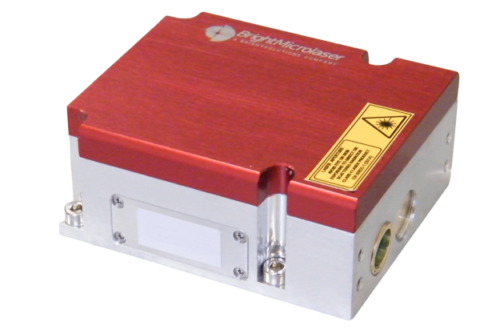
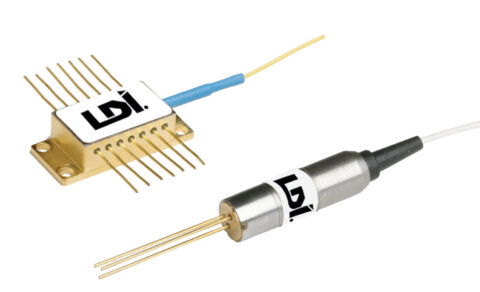
The ALM3K 1310 nm 10 mW Analogue DFB Laser module is a high-performance laser diode solution for broadband fibre-optic communications and signal distribution. Housed in a standard 14-pin butterfly package with an integrated thermoelectric cooler and isolator, it provides stable single-frequency output at 1310 nm. It is optimised for analogue modulation up to 10 GHz, making it suitable for CATV networks, RF-over-fibre links, and other wideband analogue optical systems. With high linearity and low noise, the module can transmit multi-channel analogue signals with minimal distortion. The built-in monitor photodiode and thermistor support precise control of output power and wavelength stability. This fibre-coupled DFB laser module offers a reliable solution for telecom, broadcasting, instrumentation, and other demanding analogue optical transmitter applications.
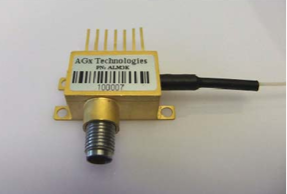
The ALM3K analogue DFB laser module is engineered for stable, wideband optical transmission in demanding analogue fibre systems. Its combination of 1310 nm single-frequency output, up to 10 mW optical power, and 10 GHz analogue modulation capability makes it a strong fit for CATV distribution, RF-over-fibre, telecom test setups, and broadband instrumentation.
The module integrates the key control and protection functions needed for reliable operation, including a TEC, thermistor, monitor photodiode, and Faraday isolator, all inside a hermetic 14-pin butterfly package with fibre pigtail output.
Range features
A high level overview of what this range offers
- 1310 nm DFB laser: Stable single-frequency output with narrow linewidth for low-noise analogue transmission
- Up to 10 mW optical output: Supports robust fibre distribution, longer links, and optical splitting
- Analogue modulation up to 10 GHz: Suitable for broadband RF, CATV, and microwave-over-fibre applications
- Integrated TEC and thermistor: Maintains wavelength and output stability across varying operating conditions
- Built-in Faraday isolator: Reduces optical feedback and back reflections to preserve linearity
- Monitor photodiode included: Enables closed-loop power control and long-term output stability
- Hermetic 14-pin butterfly package: Industry-standard format for reliable integration with compatible drivers and mounts
- High-linearity design: Optimised to minimise distortion in demanding analogue optical links
Downloads
for ALM3K 1310 nm 10 mW 10 GHz Butterfly Analogue DFB Laser
What’s in this range?
All the variants in the range and a comparison of what they offer
Parameter | Value |
Centre Wavelength | 1310 nm (±5 nm standard) |
Optical Output Power (CW) | Up to 10 mW |
Analogue Modulation Bandwidth | Up to 10 GHz (–3 dB small-signal) |
Spectral Linewidth (typical) | ~500 kHz |
Side Mode Suppression Ratio | 50 dB (typical) |
Threshold Current (typical) | 8 mA |
Operating Current (for 10 mW) | ~70 mA (typical) |
Forward Voltage (typical) | 1.6 V |
Forward Voltage (max) | 2.1 V |
Thermoelectric Cooler (TEC) | Integrated, max 1 A / 1.5 V driving capacity |
Thermistor | 10 kΩ NTC, integrated |
Optical Isolator | Integrated Faraday isolator (≈30 dB isolation) |
Monitor Photodiode | Integrated rear-facet monitor photodiode |
Fibre Pigtail | Single-mode fibre (SMF-28 or equivalent), ~1 m length |
Fibre Connector | FC/APC |
Polarisation Maintaining Fibre | Optional on request |
Package Type | 14-pin butterfly, Type 1 pin configuration, hermetic sealed |
Operating Case Temperature | ~0 °C to +60 °C |
Storage Temperature Range | –40 °C to +70 °C |
Specification Note | Typical values at 25 °C case temperature unless otherwise noted |
FAQs
for ALM3K 1310 nm 10 mW 10 GHz Butterfly Analogue DFB Laser
The ALM3K supports analogue modulation up to approximately 10 GHz (–3 dB bandwidth). This allows it to carry very wideband RF or microwave signals over fibre with low degradation within its operating range.
The integrated TEC and thermistor actively regulate the laser diode temperature. This helps minimise wavelength drift and output power variation caused by ambient temperature changes, resulting in more stable optical performance for demanding analogue applications.
The built-in Faraday isolator reduces back reflections from downstream fibre components and connectors. By suppressing optical feedback into the laser cavity, it helps preserve linearity, reduce noise, and maintain signal fidelity in analogue transmission systems.
Yes. The ALM3K is designed for broadband analogue fibre-optic transmission, making it suitable for CATV forward-path links, radio-over-fibre systems, broadband wireless signal distribution, and optical test environments where wide bandwidth and low distortion are important.
Although the ALM3K is optimised for analogue use, its 10 GHz bandwidth can support digital modulation around 10 Gb/s in suitable applications. However, directly modulated DFB lasers may introduce chirp at high bit rates, so dedicated digital transmitters or externally modulated solutions may be preferred for longer links.
The module includes an internal monitor photodiode that enables feedback-based control of laser output. When used with a compatible driver operating in APC mode, the photodiode signal can be used to maintain constant optical power over time and across environmental changes.
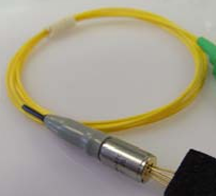
The standard configuration uses a single-mode fibre pigtail of approximately 1 metre with an FC/APC connector. Alternative connector types and polarisation-maintaining fibre may be available as custom options depending on application requirements.
The ALM3K requires a suitable low-noise laser diode current driver plus a TEC controller. For best results, the driver should support stable biasing, high-frequency modulation input, monitor photodiode feedback for power control, and temperature regulation through the integrated thermistor and TEC.